
Instead of defining American fashion, The Metropolitan Museum of Art’s Costume Institute hopes to spark a far-reaching debate with its new exhibition.
Heavy on contemporary designers and light on old-timers, never mind deceased ones, “Part One: In America: A Lexicon of Fashion” spotlights 100 ensembles, the majority of which were created in the last five years. True to the youth-driven culture that steers fashion, technology and so many other aspects of society, the show magnifies the present. In doing so, it hints at issues of social justice, genderless dressing and body acceptance, among others.
With this year being the Costume Institute’s 75th anniversary, the exhibition is in line with its heritage. During a preview Sunday afternoon, Andrew Bolton, the Wendy Yu curator in charge of The Costume Institute, said one of its core missions since its founding in 1946 has been to support the American fashion community and “they’ve supported us through the gala, from the period that it was inaugurated in 1948. Talking to the designers, the language that they were using to define their work was much more emotional based on values and sentiments. It hit me thinking about how American fashion has usually been described, which is usually through sportswear principles like functionality, practicality, ease, comfort and egalitarianism. That’s where the idea came from to create this new lexicon, this vocabulary of American fashion that is more expressive and emotional.”
Related Articles
Of-the-moment designers like Prabal Gurung, Pyer Moss’ Kerby Jean-Raymond, Off-White’s Virgil Abloh, Telfar Clemens, Heron Preston, Vaquera and Rihanna’s Savage x Fenty are among the ones featured, as are lesser-known ones like Puppets and Puppets, Stan, Dauphinette, KidSuper, Mimi Prober and No Sesso. Styles by Mainbocher, Claire McCardell, Bonnie, Cashin, Rudi Gernreich and Norman Norell are among the designers who worked in fashion decades ago, while established ones including Tom Ford, Tory Burch, Thom Browne, Vera Wang, Stephen Burrows, Andre Walker, the late Patrick Kelly and Marc Jacobs are also in the mix. Some, like Zac Posen and Miguel Adrover, have styles featured but are no longer designing collections.
You May Also Like
Bolton spoke of his far-reaching approach. “This one has been really inspirational for me, just getting to know the work of younger designers and hearing what their ambitions and aspirations are. It’s so different from previous generations who may have aspired to work for a French couture house or to think more businesslike. It seems their aspirations are much more community-based,” Bolton said. “…they’re taking a lot of control for themselves in terms of their business. The models they are creating works for them. They are developing this close community of followers, fans and admirers.”
To organize the vocabulary of the exhibition, Bolton and his team zeroed in on a statement by Rev. Jesse Jackson at the 1984 Democratic National Convention: “America is not like a blanket, one piece of unbroken cloth, the same color, the same texture, the same size.…America is more like a quilt: many patches, many pieces, many colors, many sizes, all woven and held together by a common thread.” Visitors will find the quote on view, as it is a metaphor for American fashion with all these distinctive identities, Bolton said.
Reluctant to define American fashion with one description, Bolton said to do so would imply it is homogeneous, which it’s not, nor has it ever been. Even in the 1940s when Dorothy Shaver was creating the American look with McCardell and Cashin, which was all about notions of versatility and practicality, people like Jessie Franklin Turner and Elizabeth Hawes were operating outside of that canon and producing historicist pieces that looked to Ancient Greece or the Renaissance. There’s always been a sort of heterogeneity and diversity that I wanted to highlight in this exhibition and just not reduce it down to this American designer sportswear,” the curator said.
The two-part exhibition will be a yearlong one with the first installment opening to the public Saturday. “Part Two: In America: An Anthology of Fashion,” will bow in the American Wing’s period rooms on May 5. That will feature men’s and women’s dress from the 18th century to the present. This will be the first “living exhibition” for the institute, which plans to cycle out some of the older pieces for preservation purposes every few months and replace them with other American designs.
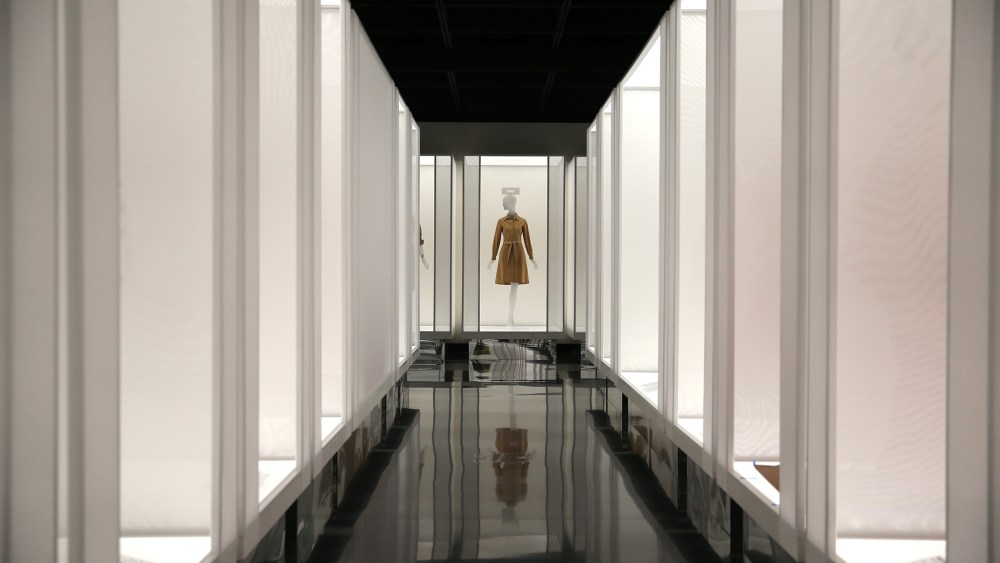
Cognizant of how globally American fashion is often synonymous with Ralph Lauren, Donna Karan, Tommy Hilfiger and Calvin Klein, Bolton noted they are represented in the first part of the exhibition. That said, he wanted to feature as many designers, aesthetics and creative outlets as possible. Each ensemble is showcased in a glass cube, which is meant to evoke the square patches of a quilt. There are rows of the glass cubes, just as there are in the lines of a quilt.
Sterling Ruby’s 2020 cotton denim “Veil Flag” that was inspired by the political division of the U.S. before the 2016 presidential election hangs with the introductory wall text on the entrance opposite a black granite sarcophagus from 380 to 342 B.C. Nearby, a white dress from Prabal Gurung with a sash imprinted with “Who Gets to Be an American?” sets the tone for what’s ahead.
Descending the stairs to the lower galleries, visitors will see a mannequin atop a pole in a star-spangled ensemble from Gypsy Sport’s fall 2019 collection. Two framed flag sweaters hang on opposite walls, including one from Ralph Lauren, one of the few designers to have more than one design in the exhibition. Nearby, a striking red and white striped one-shouldered dress imprinted with “No Justice, No Peace” and other social justice messages from LRS’ spring 2021 line is displayed on a pedestal.
A sweeping magenta Christopher John Rogers ballgown is not to be missed at the foot of the stairs. Bolton was a little concerned (unnecessarily) that its nine-foot wide skirt would not fit in the enlarged case that was created for it. The bold-colored eveningwear from Rodarte, Carolina Herrera and Oscar de la Renta that flank Rogers’ creation looks almost diminutive in comparison.
Nearby, a quilt from the museum’s American Wing begun in 1856 by Adeline Harris Sears is worth a closer inspection. She sent the small diamond-shaped squares to well-known Americans including eight U.S. presidents to sign. Abraham Lincoln obliged and added “Your Friend & Servant.” The framed colorful quilt is meant to be an emblem for the country and its cultural identities.
Deliberately skewed to contemporary designers, between 70 and 80 percent of the ensembles were created in the past five years, according to Bolton, who added that about 40 percent of the featured designers are people of color. Traditionalists may criticize the everyone-gets-a-trophy approach, pining for Donald Brookes, Adolfo, James Galanos, Oleg Cassini, Liz Claiborne and the like. But Part Two will be more historical, and will address how the initial vernacular of American fashion was established, how a particular American style that was independent and autonomous from Europe emerged, and in turn the rise of the independent designer that allowed them to have their own name on a label.
”I always feel that what we try to do, and we did it with ‘Camp: [Notes on Fashion,’] as well is have exhibitions that prompt debate and start the debate. And that debate will continue outside of the four walls of the museum. As a curator, I don’t believe in a curator defining what American fashion is. One’s role is to suggest and prompt discussion and for that discussion to continue. I like exhibitions to be open. It’s the only way that visitors can learn, and we can learn as curators just to expand our canon, our field,” said Bolton.
About 100 men’s and women’s ensembles are spotlighted.
Along with the widely recognized designers like Lauren and Karan, there are more forgotten ones like Fabrice Simon and Carmelo Pomodoro. “I didn’t want to do a traditional ‘A’ to ‘Zed’ in American fashion where you have Adrian, Beene, Cashin. They are there but I wanted to create a more alternative and inclusive A to Zed with contemporary designers but also designers that weren’t commercially successful, but had an impact. Pomodoro had a big impact in the ’80s,” Bolton said, adding that the exhibition is also “trying to problematize and create a more nuanced approach to American fashion.”
Teasing out stories — untold, hidden and little-known ones, including those about lesser-known designers — is something that Bolton has been doing for a few years. Part Two, for example, will feature the work of Fanny Criss, a Richmond-based Black designer in the early 20th century. “Not a household name,” she created a thriving business in Richmond, Va., so “it’s a story about race, gender and the American dream,” Bolton said.
This more holistic approach is meant to help the museum to become more inclusive, having been criticized in the past. Bolton said, “Certainly, part of the exhibition was a response to Black Lives Matter, in being more inclusive and diverse in the designers that we are showing. That certainly was a response to The Met’s DEIA (diversity, equity, inclusion and access) initiatives, the social justice movements of last summer and ongoing movements.”
Working on the show, Bolton saw up close the renaissance in men’s wear with designers who are focusing on gender and sexuality, but with machismo. Praising Willy Chavarria and his new role at Calvin Klein, Bolton recalled how his runway a few seasons ago had very machismo guys with little silver tears. “In speaking with a lot of the designers, I’m finding that vulnerability really moving. The bravado that one has been used to in our field is disappearing. It’s much more about vulnerability and closeness,” Bolton said.
Bolton hatched Part One with assistant curator Amanda Garfunkel and the Costume Institute’s curatorial team. LAMB Design Studio’s Nathan Crowley and Shane Valentino pitched in with the exhibition’s design. Cinematographer Bradford Young offered insights about the sets and lighting with the duo. Another film executive, Franklin Leonard, acted as an adviser. Stephen Jones created all the headdresses for the exhibition.
The designs are contained in scrimped cases that are meant to be reminiscent of patches in a quilt. Playing into the theme of fashion’s modern vocabulary, the garments fall under 12 sections that are meant to explore the emotional qualities of American fashion. The areas are “Nostalgia,” “Belonging,” “Delight,” “Joy,” “Wonder,” “Affinity,” “Confidence,” “Strength,” “Desire,” “Assurance,” “Comfort” and “Consciousness.” Some might see the displays as a swipe-right effect, but for Bolton it was all about creating a new lexicon that was more expressive and less based on sportswear principles. “It’s like wearing your emotions on your sleeve, or on your head in this case,” he said, referring to the thought bubbles above each garment on display. The exhibition is made possible by Instagram with support from Condé Nast.
Acknowledging how some might not look at a Maria Cornejo-designed rose-colored alpaca poncho and consider that “Suppleness,” Bolton said the aim is to take the conversation beyond the walls of The Met and encourage further debate more widely about vocabulary and language. “I learned many things during the social justice movement but one of them was the importance of language and nomenclature. Part of this [exhibition] is to reflect on the way that you describe, the way you approach and the way that you think about things. It really is trying to create a new rhetoric around American fashion and a new language,” Bolton said.
Gesturing toward a black Ralph Rucci evening dress, Bolton said 70 percent of people who walk the show might not consider it “Passion” (as identified). “At least you’re prompting a debate about it. I’m not saying it’s accurate. It’s one word we can use to describe it but there are 100 words to describe this particular piece. What I’m hoping is that when people walk around the exhibition, it becomes a comprehensive dictionary by visitors’ response. It is a very participatory exhibition in a way. It’s going to be a year. I am sure the next words I hear will affect the next pieces.”
Should “In America: A Lexicon of Fashion” serve as a template for companies and corporations to think about inclusivity, Bolton said, “That would be incredible if that was a result of this.”