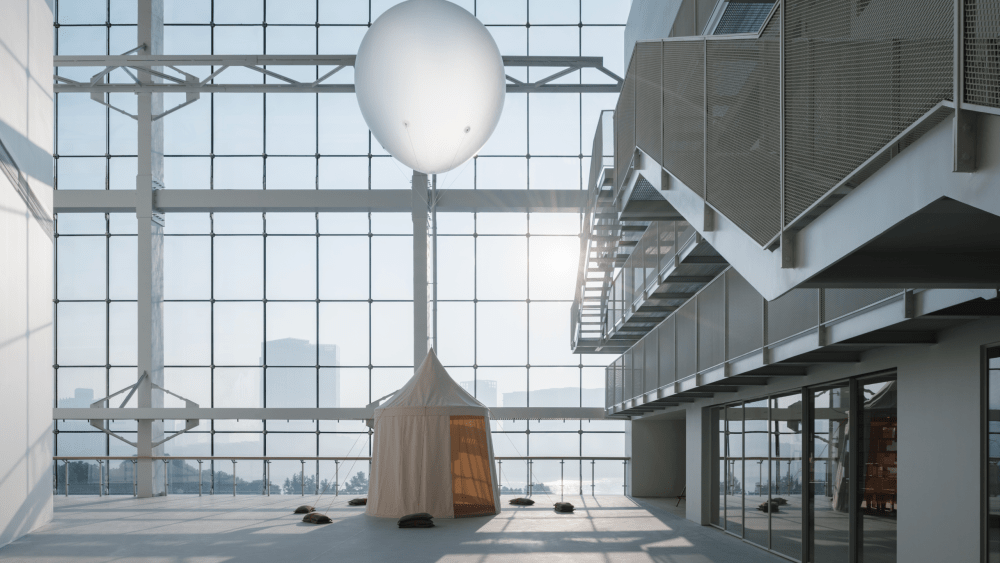
Power Station of Art, the Chinese contemporary art museum housed in a former electric plant in Shanghai, is expanding its cultural footprint with the introduction of a library, a theater, a new design center and a leisurely terrace, all with support from Chanel, which began working with the museum in 2021.
The renovated space, dubbed Espace Gabrielle Chanel, spans 5,466 square meters, occupies the entire third floor of the colossal structure and was unveiled on Monday.
Related Articles

The project is part of a long-term strategic partnership between Chanel and PSA, which was announced in May 2024.
You May Also Like
“It has been such a beautiful, organic evolution of our partnership with PSA’s Gong Yan and with PSA, beginning with the ‘Next Cultural Producer’ program in 2021 — it was our first program in Asia, where we focused on craftsmanship, on architecture in a very intellectual way — in a very local way,” recalled Yana Peel, president of Arts, Culture and Heritage at Chanel.
“Espace Gabrielle Chanel is really a manifestation of our dreams and the very large commitment that we are making to the future cultural producers, the future readers and the future enthusiasts of arts and culture across China,” Peel said.
Peel emphasized Chanel’s approach of partnering with top institutions around the world — now totaling 50 — instead of building its own dedicated spaces.
“Our model is based on really elevating institutions and artists and cultural leaders, and really accelerating the ideas that advance culture,” said Peel. “So we think Espace Gabrielle Chanel will provide the hardware and the software to drive this next century as a beacon of inspiration.”
At the heart of the project is the library, which spans 1,700 square meters and was designed by the renowned Japanese architect Kazunari Sakamoto.
The library is a kind of horizontal extension of the Huangpu River, which the PSA overlooks. Sakamoto created a maze-like space with an expressive flatness — made up of gentle ramps and bookshelves of various heights — that lends a sense of stability to the imposing contours of the factory.
“We do hope this library will become another landscape in our urban environment, with its valley of books,” said Sakamoto.
Ten years in the making, the library — with a focus on contemporary art and design — gathers imprints from institutions, galleries and more from across Asia, and includes a section about Coco Chanel herself.
One of the first projects of its kind in China, the library will be able to hold 50,000 books or audiobooks. Upon its inauguration on Tuesday, more than 10,000 books will be accessible to the public; visitors can register to visit via the museum’s WeChat Mini Program or by email.
Gong, the museum’s director and artistic director, said by working with Chanel across three specific artistic fields, the museum will be able to strengthen its educational and functional roles, expand its research capacity, and incorporate “an imaginative art space.”
“We want visitors to experience how the reality of contemporary life can have a different texture and possibility at PSA,” said Gong.
“This collaboration will help fill a long-standing gap between China’s contemporary art scene and the world,” said Gong, referring to organic, artist-led attempts, such as do-it-yourself printouts and clumsy translations that helped forge initial connections with the West since China’s Reform and Opening Up policy in 1979.
“At a time when global conflicts and various uncertainties unfold around us almost on a daily basis, we want to send out a very positive signal, one that puts culture first. After all, any kind of conflict or competition ultimately stems from a kind of misalignment or misinterpretation between cultures and civilizations,” Gong explained.
Gong said the blueprint for the library was completed in 2015, following the architect’s exhibition at PSA, which explored the relationship between private and public spaces.
“Then we began waiting,” said Gong, a process that inspired the name of the library, which is “Dengdeng” in Chinese. “We can’t help but wonder, if this project was completed 10 years ago, the details probably wouldn’t be as exacting — we realized how fast China’s construction capacity has grown in the last 10 years,” said Gong.
For Gong, technological advancement on all fronts also meant that she could incorporate e-books into the archive by teaming up with the best online databases. In addition to contemporary art, contemporary design, architecture, the social sciences, literature and craftsmanship, the library will allow space to present its own research findings.
Described by Gong as an “atypical library,” the space is meant to serve both a professional audience and the public — reinstating art’s purpose as a public good.
To inaugurate the space, an exhibition called “Home and Beyond” opened on Tuesday, focusing on the works of the esteemed art curator Hou Hanru.
“One of his first exhibitions was staged inside his own apartment. Just like the design concept behind the library, his work is about exploring how personal space and public life coincide,” Gong said.
As for the state-of-the-art theater, Peel sees it as planting a seed as a space for community engagement. During Monday’s opening ceremony, an immersive performance of “Poème symphonique,” a 1962 composition by modern music pioneer György Ligeti, directed by the local artist Yin Yi, filled the cavernous theater with the sound of 100 swinging metronomes for 10 minutes, playing witness to the inauguration of the space.
“As my dear late friend Zaha Hadid used to say, there should be no end to experimentation,” said Peel. “So I think what we are seeing here is that we hope to build it and they will come.”
“We’re also very excited to embrace technology, and we’re very, very excited about the possibilities of stretching the program very wide,” added Peel.
PSA, a seven-story, 450,000-square-foot contemporary art museum, was launched in 2012 after a $64 million renovation.
The institution is administered by the Shanghai Municipal Administration of Culture and Tourism.
Last year, Chanel’s itinerant retrospective, “Gabrielle Chanel. Fashion Manifesto,” landed at the museum.
Apart from PSA, Chanel has established long-term public programs with Hong Kong’s M+, Seoul’s Leeum Museum of Art, and will soon be unveiling a partnership with a Thailand art institute.