
Technology’s not only bearing down on brick-and-mortar retailers, it’s also offering them a path through a relentless, rapidly changing marketplace.
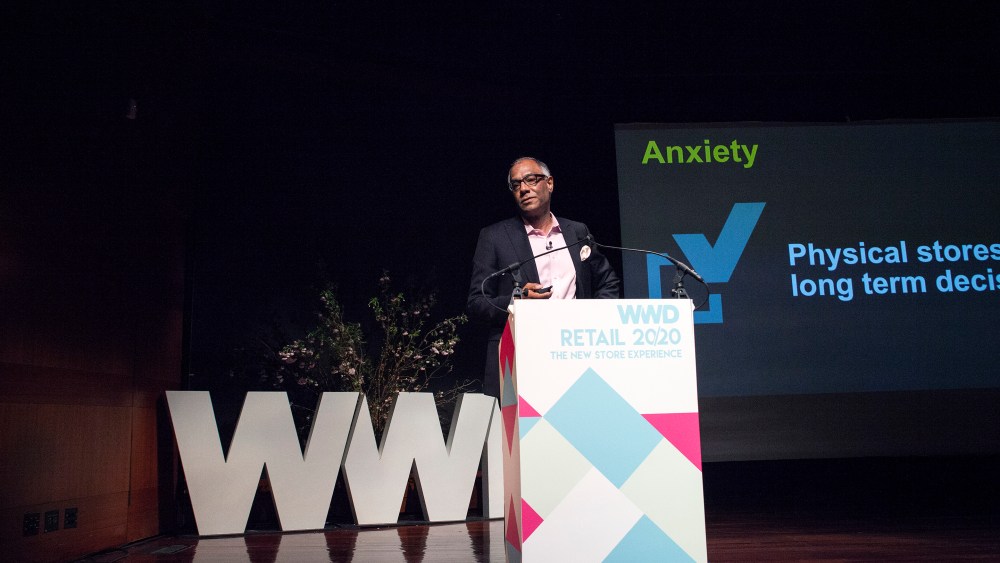
Shyam Gidumal, principal and Northeast consumer products and retail market segment leader at consultancy EY, encouraged executives at the WWD Retail 20/20 conference to reconsider the roll of mobile phones in their businesses.
“A lot of physical retailers think this is your enemy, that the phone is one of the things that’s causing retail to be under the pressure that it’s under,” he said. “But what I’d like you to do is I’d like you to hug it close. The use of phones in the store will actually help the resurgence of physical retail.”
Related Articles
Gidumal said that while transactions on mobile devices account for about $30 billion in annual sales, mobile-assisted purchases in stores tally $1 trillion.
You May Also Like
“Fifty-nine percent of consumers in stores with smartphones prefer looking up info on the phone rather than ask a salesperson,” he said. “What we’re seeing is leading companies view mobile less as an online substitute and more as a complement to physical, a key to providing one uniform experience.”
Increasingly, retailers are trying to figure out how to work with technology and not against it.
“This is not just a matter of holding back the tide, competing against technology,” Gidumal said. “The store exists in a world of multiple consumer — physical, online and mobile — choices. An important question is, ‘How can you leverage your footprint to your great advantage? How do you make the overall experience seamless across channels and appealing to the customers?’”
This is possible, he said, pointing to both movie theaters and banks for perspective — and some retail encouragement.
The number of movie theaters has risen 77 percent over the past 30 years while the number of bank branches has also increased despite a barrage of technology challenges to both industries, Gidumal said.
That doesn’t mean retailers aren’t going to have to deal with their legacy stores in the U.S., where the market has for years been seen as overstored with nearly 50-square-feet of retail space per capita.
“Clearly, part of what’s happening to stores is that we already have too many of them,” Gidumal said.
Chains that used to wait and examine stores on traditional measures as their leases expired are starting to take a more sophisticated approach.
“Retailers are now looking at a more integrated set of measures that are customer focused,” Gidumal said. “[They’re] looking to evaluate bought in store, returned online; bought online, pick up in store; conversion; basket; upsell; customer retention, looking at the combination of physical and online combined to evaluate stores.”
Retailers are also taking a more predictive outlook, seeing where trends are leading stores and preparing for that future. He said that, through that lens, a larger set of stores require some sort of action.
“There are thankfully more tools that retailers are employing to try to fix the predicted performance, taking advantage of data analytics and cognitive computing to drive traffic, target promotions and adjust mix,” Gidumal said. “[And] looking at alternative uses of store labor and store space, including using them for pick, pack and ship and to support online, looking at options to marry the physical experience with mobile, looking at aligning supply chain with the predictive footprint.”