
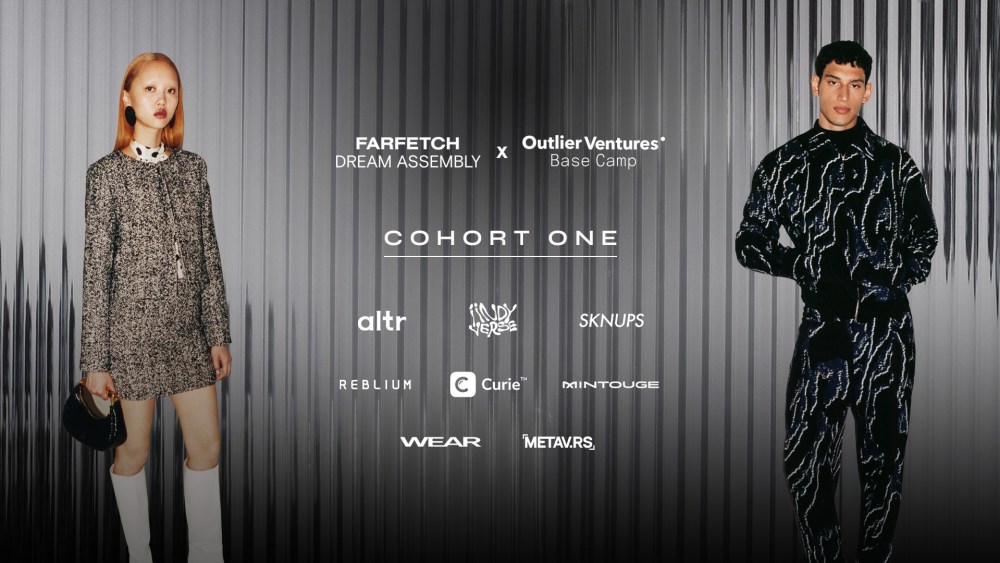
Farfetch is leaning just a little bit further into the future, welcoming the first eight Web3 start-ups to the Dream Assembly Base Camp — an accelerator program that brings the luxury platform together with Web3 specialist Outlier Ventures.
Web3 is a new frontier at the cutting edge of high tech, the next iteration of the web that’s seen bringing the physical and digital closer together and is powering the still-forthcoming metaverse.
It’s a world that is full of promise — or peril — but is still ill-defined, developing and, at least by some estimations, not quite here yet.
You May Also Like
Related Articles
That makes it not just hard to pin down, but a potentially industry-changing force that’s still too complex, too out there and too filled with pitfalls for most fashion brands to really take on by themselves in a serious way.
So Farfetch, which sees itself as a kind of operating system for fashion, is digging in and staying close to the pioneers so it can keep virtually connecting boutiques and brands with luxury consumers.
“We’re really looking for that next wave of thinking,” said Carol Hilsum, senior director of product innovation at Farfetch.
Hilsum said “Web3 is about culture change,” but Farfetch is more interested in supporting the start-up world operating in the space instead of determining its exact boundaries.
“For us specifically, we don’t necessarily try to define Web3, we look at how the areas are emerging,” Hilsum said. “What we are always driven by is the consumer…looking at how consumers want to engage with luxury experiences and luxury product.”
The potential seems to be growing.
Hilsum said of the accelerator process so far with Outlier: “It really gave us some very good insights. That Web3 fashion tech start-up ecosystem is incredibly healthy. There’s certainly no stopping the wave from the start-up community.”
The first companies in the accelerator program — from an NFT platform purpose built for luxury brands to a specialist in gamified shoppable experiences to a platform dedicated to unlocking the value of cultural heritage and archival fashion — were chosen from more than 200 applicants.
Jamie Burke, founder and chief executive officer of Outlier Ventures, said Web3 players might really be a collection of related related entities with, for instance, one focused on commercial operations and another open source component and then a nonprofit wing.
That complexity brings its own kinds of challenges when it comes to connecting traditional businesses with Web3.
“How does this digital economy function because, principally, when people are launching a Web3 proposition, they’re really launching a digital economy,” Burke said.
Luckily, some of the future is going to seem familiar.
Burke said scarcity — a concept that luxury thrives on — will become only more important as the purpose of e-commerce platforms evolve in the next phase of the web.
“Really what we’re talking about here is an economic system where we’re increasingly going to transact with consumers, where we’re going to socialize, where we’re going to work, where we’re going to play,” he said. “A lot of that on the internet today has been controlled by a handful of platforms.”
And while that has led to big-time efficiencies, like those that let Amazon deliver most things to one’s doorstep in a day or two, it also sets up a clash between the interests of users and shareholders, he said.
“Our argument is, Web3 is a new economic paradigm,” Burke said. “It is the first and only truly universal economic system, permissionless economic system that’s ever existed. Nobody can stop you from using it. In this permissionless environment, anyone can join in, anyone can scare out economic activity in it and no one can deplatform you.”
During the 12-week remote accelerator program, each start-up will hit topics like luxury commerce and token design and also get access to and support from Web3 mentors who are experts in gaming, retail, marketing, talent management and venture capital.
Among the mentors are Adriana Hoppenbrouwer-Pereira, cofounder of The Fabricant; Daria Shapovalova, a founder of DressX; Kadine James, metaverse strategist at Accenture, and Mireille Paquet, CEO of the Learning Lab Paris.
The first cohort in the Dream Assembly Base Camp includes:
- altr — a digital fashion platform focusing on the value of cultural heritage and archival fashion.
- Curie — a start-up with proprietary AI that automate the production of 3D assets using only photos as a starting point.
- Iindyverse — a no-code SaaS platform helping fashion creators to engage their audiences with gamified shoppable experiences.
- Metav.rs — an all-in-one metaverse management platform.
- Mintouge — an e-commerce plug-in allowing brands bring their product catalogues to Web3.
- Reblium — the developer of a premium avatar experience.
- Sknups — a platform for high-quality digital collectibles that connect into multiple games and experiences.
- Wear NFT — a premium NFT platform for luxury brands and artists.