Cop or drop? It’s a question destined to fall into disuse thanks to Drip, the Italian online rental platform devoted to streetwear enthusiasts.
Although Statista forecasts a compound annual growth rate of the fashion rental market of just under 20 percent to $7.03 billion by 2025, it is still a business model that is facing challenges not only because of its operations but also since many consumers remain reluctant to rent clothes.
That’s why Drip’s chief executive officer Augusto D’Auria avoids using the term “rental” and describes the experiential shopping platform as a fashion subscription service or, more ambitiously, as a “club.”
Related Articles
Based on a by-invitation-only or “velvet rope” model, Drip has borrowed its launch strategy from Clubhouse “to guarantee a certain level of exclusivity and establish a member club in which word of mouth is crucial.”
You May Also Like

The platform offers three fashion subscription packages priced between 69 and 129 euros, allowing customers to secure one to three pieces a month. Each month, users are given one opportunity to “swap,” returning their clothes and renting new ones for the following 30 days.
The rental site carries pieces by the who’s who of the streetwear world, spanning from Off-White and Palm Angels, to 1017 Alyx 9SM, Balenciaga and Marine Serre, as well as niche names such as Paria Farzaneh and Youths in Balaclava.
“We’re aiming to bring discovery to our customers, to educate them on the new names of the streetwear scene, beyond the usual suspects,” D’Auria explained.
The company was established in 2019 by a group of like-minded Gen Z talents who channeled their passions for the digital and streetwear worlds into the project, all the while hoping to advance customers’ purchase habits toward sustainable practices like fashion rental.
“We examined the market and found out that there was already a brisk activity in the sector in the U.S. and China but not so much in Italy,” D’Auria said.
It all started with a 200-euro budget in advertising and a test, which demonstrated the appeal of such a formula in Italy, but it took two years of fine-tuning for the platform to officially launch last June, thanks to a Series A funding of 110,000 euros obtained as part of the Fashion Technology Accelerator program.
“The winning formula here is that we’re not offering rental for occasion wear, as is often the case. All our products can be worn on a daily basis and tap into the fast-growing niche of Gen Z and Millennial customers who are both streetwear enthusiasts and into responsible purchases,” D’Auria said.
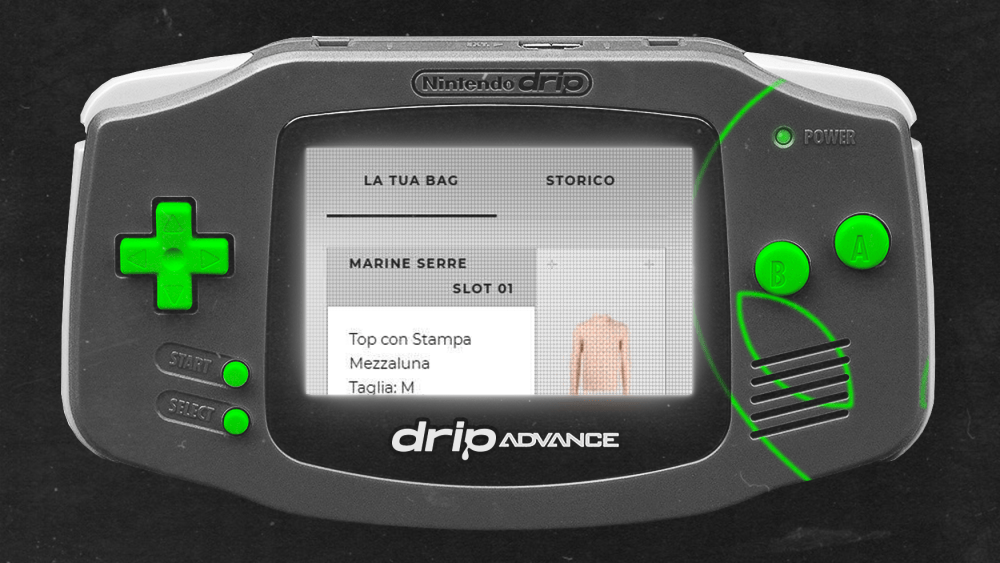
The gaming-inflected and meme-rich platform’s communication strategy further taps into younger generations, which are said to be twice more likely to embrace fashion rental platforms compared to older consumers, offering an additional boost to an already burgeoning market. To this end, Drip is expecting to close a Series B funding of 350,000 euros comprising bank loans and the injection of capital by private equity firms.
The day of its launch, with inventory of just 150 items, Drip’s available rental packages sold out and 5,000 people were placed on a waiting list. D’Auria acknowledged that bulking up the stock is key to better serve customers looking for on-trend fashion pieces to wear immediately, but insisted that they have favored quality over quantity to attract a better target.
Fashion pieces are purchased by the company via retailers or secondhand sources, “which makes the model even more sustainable,” D’Auria said. According to an internal audit, Drip’s business model is eight times more sustainable than regular retailers, yet the team knows there are challenges to face — and industry concerns that it may have a higher-than-expected climate impact.
“We are very attentive to sustainability but haven’t ‘exploited’ it as a marketing lever yet. The real burden for rental businesses is the impact of logistics-related carbon dioxide emissions,” D’Auria said. As the scale of business grows, the company plans to internalize its logistics and laundry to have control on the processes, as well as implement RFID technology to keep track of clothing and ascertain its authenticity when returned.
While its current 25 active users don’t allow for a strong business evaluation and forecasts, D’Auria explained that one third of original customers never churned the service, and with a low customer acquisition cost of 80 percent, he is confident the company will reach total revenues of 100,000 euros in 2022 with 100 active users.
SEE ALSO:
How This Italian Streetwear Brand Reached 5M Euros in Less Than a Year