
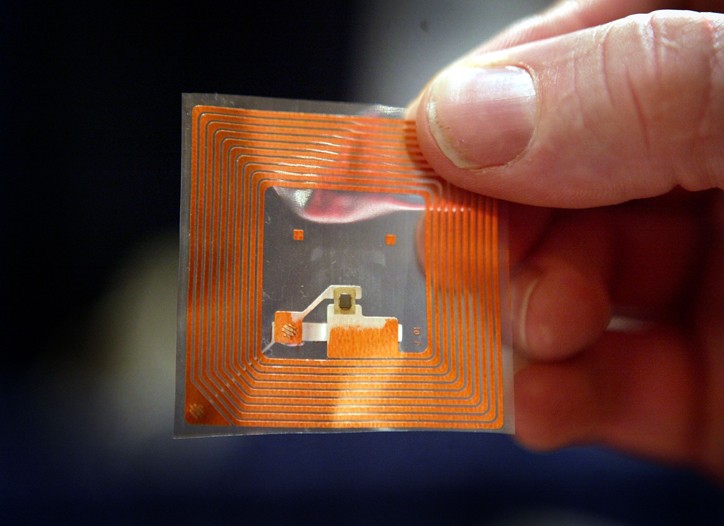
Radio frequency identification was supposed to be the next big thing. But that hasn’t proven to be the case.
Six years after Wal-Mart Stores Inc. announced its wide-ranging mandate, RFID has yet to gain traction in U.S. retail, although a handful of international retailers have had modest success using the tags on a smaller scale to reduce out-of-stocks on certain types of items.
A picture is slowly emerging of a technology that may not be ideal to track every paper towel roll and can of soup through the world, as was originally envisioned, but can lift sales by the low-single or double digits when it is used to manage inventory with size complexity, such as jeans and shoes, or high shrinkage.
Related Articles
RFID could get a boost in the U.S. based on the experience of Nine West and American Apparel Inc., both of which are using the technology in pilots. A handful of other U.S. retailers are contemplating pilots, according to Mark O’Donoghue, director of marketing communications for tag maker Avery Dennison’s Retail Information Services Group.
You May Also Like
While Nine West has not yet shared the results from its year-old pilot, American Apparel has lifted sales by 14.36 percent and experienced a slew of other benefits, said Zander Livingston, the retailer’s director of RFID, at a conference on RFID in fashion in New York last week.
Anyone who’s ever been inside an American Apparel store knows the boutique-size outlets are bursting with an unusually large number of styles, with one of each size hanging on the rack. The company has been using RFID for a year in seven stores to help keep those sizes on the shelves and organized with less work for employees.
American Apparel now has about 94 percent stock accuracy, lowered labor costs, a happier staff and customers, and the stores look better, said Livingston. Employees no longer arrive at 7 a.m. and count stock in the stockroom for hours.
Each store saved about 168 hours of labor a month, said Livingston. Stores that use RFID no longer clock overtime hours. Two people can take inventory in a store with 14,000 items in 1.5 hours, down from 25. A store twice that size takes about five hours, down from 120.
The company’s Los Angeles manufacturing facility tags every item bound for stores that use RFID. Six are in New York and one is in Santa Monica, Calif. At the stores, the goods are scanned when they are received in the stockroom, as they are carried on to the floor and at the cash register.
But the company’s rollout schedule is uncertain because of the recession. “RFID is at the top of the list along with new store openings,” said Livingston. “We’re in a little bit of a dogfight to see if they’re going to invest in expansion or improve with RFID some of the current inefficiencies we have.”
Wal-Mart, meanwhile, has not admitted publicly that its requirements have changed, but is focusing on tagging certain key items rather than asking all vendors to tag all goods. At Sam’s Club stores, all vendors are required to tag every pallet, since pallets are often put directly on the sales floor.
“Our goals have remained pretty consistent,” said Simon Langford, Wal-Mart’s director of EPC RFID strategies, who spoke at the conference. “We’ve seen a reduction in out-of-stocks; inventory accuracy. Our goal has always been to serve the customer better. People want to find what they need efficiently and be on their way. As we’ve moved along, we’ve had some learnings. We’ve done some pilots around categories. We started with asking the top 100 suppliers to tag what they could. Now more categories are tagged, so associates are not dealing with two different worlds. It’s one process. It’s a little more targeted as the technology has matured. Our vision is the same in terms of having the whole store enabled with RFID.”
Other retailers adopting RFID for a variety of uses include Marks & Spencer, Tesco, Levi Strauss Co. in Mexico, Metro, Carrefour, Mitsukoshi department store and Throttleman’s.
Portuguese retailer Throttleman’s has chopped a week out of the time it takes to ship goods from overseas factories to stores, according to RFID Journal.
U.K retailer Marks & Spencer is using RFID in more than 78 stores in product areas with complex sizing, such as women’s suits. Benefits include increased sales, fewer out-of-stocks, accurate inventory, reduced markdowns, fewer special orders and increased customer satisfaction, the company said.
At Mitsukoshi department stores in Japan, the retailer uses RFID in select departments to tell customers right away whether their size is in stock. In the shoe department, sales have increased. At the beauty counter, customer reviews pop up on a display when a customer picks up a tagged item such as a lipstick.
Nine West’s pilot is similar to Mitsukoshi’s. Last year, the brand started tagging every item in one store. Sales clerks use a handheld device on the sales floor to tell a customer whether a shoe is in stock in their size before they retrieve it from the stockroom. The conversion rate is higher, according to Avery Dennison’s O’Donoghue.
“This is a technology that changes how you think about your business,” said Rick Bauer, director of RFID program development for Avery Dennison. “You can expand into more stores and more product lines.”
“RFID technology is maturing rapidly, and this is sector where it has obvious benefits,” said Mark Roberti, founder and editor of RFID Journal, which, along with the American Apparel & Footwear Association, organized the RFID in Fashion conference.
Ironically, the Wal-Mart mandate jump-started the use of RFID in U.S. retail, but the company’s experiences with the technology may have inadvertently dissuaded other retailers from trying it.
Livingston blamed education and, in the last 12 months, the economy. Retailers are waiting for a technology leader to prove the benefits of RFID before proceeding, he said. “They want a lead person to go out and prove it.”