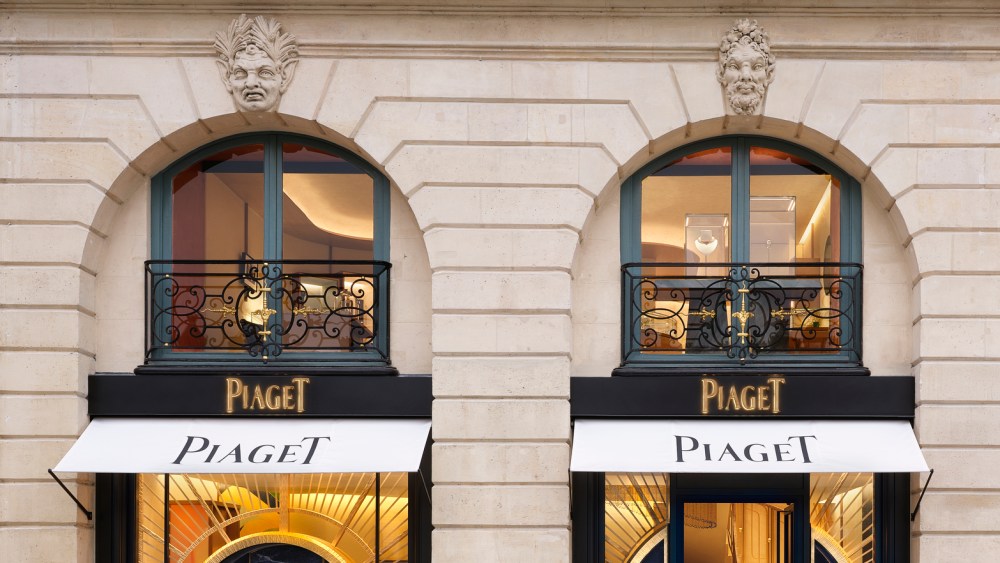
PARIS — For its newest flagship, Piaget took the rather unusual step of sizing down.
Instead of a two-boutique configuration that saw it occupy a slip of a space in the epicenter of high jewelry and a larger address on Rue de la Paix, the Swiss brand now has a single address: 16 Place Vendôme.
But that was a deliberate trade-off that’s just fine by chief executive officer Benjamin Comar.
“Honestly, we didn’t really ask ourselves that question,” he told WWD in an exclusive interview. “We prefer Place Vendôme. So we wanted to merge the two boutiques into one.”
Related Articles
The expansion project was five years in the making, which Comar explained, “it’s Place Vendôme, so you have to respect its customs and practices,” said the executive.
You May Also Like
Gone is the logistic complication of having multiple locations, in favor of a 1,900-square-foot unit on two levels, revamped by New York-based architect Rafael de Cárdenas.

Structured as a home, the new store has turned its erstwhile 540-square-foot ground floor into a reception area of sorts, with a mirrored ceiling giving the impression of an open skylight — a technical impossibility in the listed building, one is told.
There is now a curving staircase that leads to a further 1,360 square feet, imagined as a succession of salons, all with arched windows giving a view on the square and its famous column.
One space can be turned into a dining room, while a curving sofa set against a floor-to-ceiling wall modeled as a mosaic of various “Décor Palace” surfaces, a signature Piaget technique, invites more relaxed moments.
De Cárdenas described the boutique’s new architecture as moving “between discipline and delight,” as a way to “hold two essential Piaget energies in equilibrium: the exacting precision of Swiss watchmaking and the liberated glamour of the maison’s spirit and sybaritic legacy.”
“It is a space where technical mastery and a life of pleasure are not opposites, but partners; where time is measured with rigor but experienced with exuberant passion,” the architect added.
Throughout, the vibe is redolent of the experience already unfurled in the temporary “Piaget Apartment” the watchmaker-turned-jeweler set up in the final steps of its transition from Rue de la Paix to Place Vendôme.
“Jewelry is also an experience,” Comar noted. “You always remember when you bought a piece.”
Hence the home-like approach of the second level, intended to encourage time and conversation rather than browsing. “We want people to feel at ease,” Comar said. “To want to stay, to talk, to see pieces — vintage and new.”
“Classic yet creative,” in keeping with the brand’s design language, is what Piaget and de Cárdenas went for.
Hence circular wall displays with striking brass frames, jade tables in the window supporting transparent glass cases, sightlines that preserve a view on the Vendôme column, wherever one is seated or standing.
“You see the jewelry but you don’t close it off behind walls; you still have the view onto the square,” Comar said.
An art curation by Alexandra Fain, founder and leader of contemporary art fair Asia Now, will rotate every six months, underscoring Piaget’s long-standing relationship with artistic circles and its 1970s legacy of creative crossovers.
All this is central to positioning the watchmaker-turned-jeweler in a neighborhood dense with jewelry competitors. The brand’s jewelry side has been catching up with its watch business in the past 10 years, with a desire to be balanced across both segments of hard luxury, Comar told WWD in 2024.
Asked how Piaget is angling in an increasingly crowded market that spans from luxury conglomerate like its parent Compagnie Financière Richemont to independent upstarts, Comar maintains a positive outlook.
“I’m very happy there’s competition,” said the executive. “When the market is active, it attracts attention and brings more people. It’s an emulation; it pushes you to do better.”
Piaget’s uniqueness lies in a design vernacular filled with ornamental stones and textured gold, “that very chic ’70s vibe…unusual striking pieces that are still beautiful to wear, designs that make an impact but remain very elegant,” as Comar put it.
In watchmaking, it’s ultra-thin watches, such as the record-beating 2mm-thick Altiplano Ultimate Concept Tourbillon from 2024, which tapped into the house’s penchant for ultra-thin components initiated by founder Georges-Edouard Piaget.
“We have our characteristics, and we stay within them,” he added. “It’s quite recognizable.”
For the executive, that’s how clients continue to be the drawn to the 152-year-old brand because “people want to see Piaget [style] at Piaget.”
Crucially, having jewelry and watchmaking on an equal style footing is central. “Even a watch is first and foremost a piece of jewelry,” the CEO said. “The same people design them, the same people make them.”
That coherence extends across price points, too. “Someone buying a more accessible piece is making just as much personal investment as someone buying a big piece,” he reminded. “So we need impeccable service for everyone.”
As gold prices raise fresh challenges for brands, is it prime timing for a brand known as “the House of Gold”?
Although Comar would not be drawn into discussing the precious metal’s meteoric increase, he emphasized the enduring appeal of Piaget’s star material.
“Everyone is talking about it,” he said. “We see that the value of gold creates a desire for gold.”
Its expertise in goldsmithing, which has yielded twisted gold chains seen in its high jewelry collections old and new as well as surface treatments such as its “Décor Palace” textured finish, remains an asset.
“Working gold is a passion for us,” Comar said. “You add value by working it and not always [merely] polished.”
The Paris opening kicks off a busy year for the Swiss house, which is preparing to release a raft of novelties at Watches and Wonders in April, before unveiling a new high jewelry collection in June with a showcase on the French Riviera.
Retail projects are also aplenty, although focusing on revamps and repositionings rather than new openings, although it recently opened new stores in markets such as Thailand and Vietnam.
Recently, it upgraded its boutique in Hanoï, Vietnam, to a two-story unit. The flagships in Tokyo and Hong Kong will be overhauled this year, while the one in Geneva is on the cards for 2027.
Bar for a handful of cities such as New York and Miami where the brand doesn’t yet have a flagship, Piaget is “not particularly trying to expand its network,” Comar said. “We try to build loyalty.”