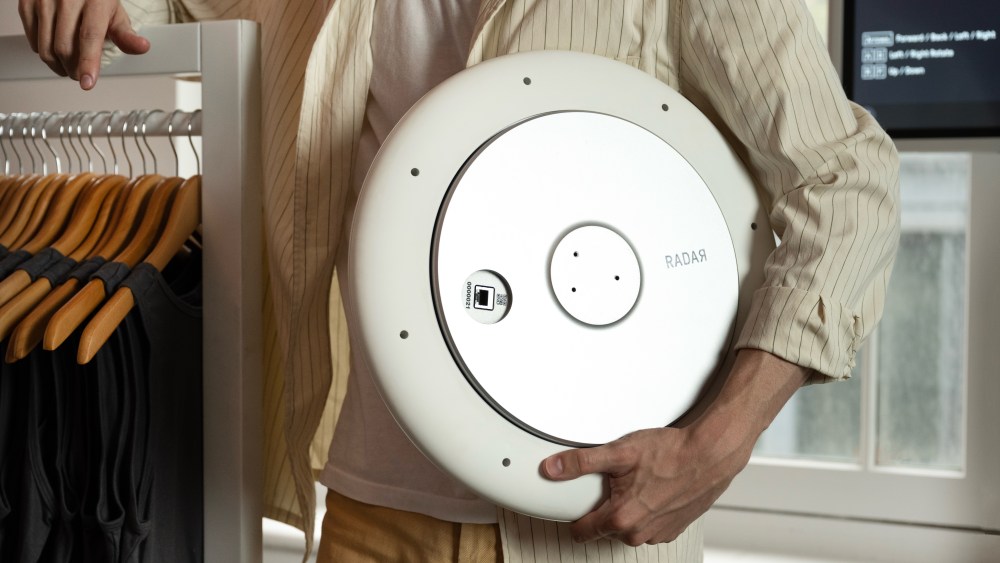
Retailers are beginning to adopt an advanced radio frequency identification platform designed to track inventory in real-time with greater accuracy and provide improved customer service and inventory management.
The platform, called Radar, is being phased in at Old Navy stores, following a successful pilot program. The AI-powered Radar technology utilizes disk-shaped overhead scanners that are always on, constantly tracking garments embedded with RFID chips. Store associates receive RFID-generated product data on their mobile devices, enabling them to quickly locate items when they’re requested by customers, whether the item is on the selling floor, in storage or being picked up in store from an online order.
Related Articles
Radar has already been rolled out in about 500 American Eagle Outfitters stores and to other retailers to varying degrees. Similarly, the H&M store located at 591 Broadway in Manhattan’s SoHo neighborhood is rigged with RFID readers suspended from its ceiling throughout the store to capture data from the assortment and locate product styles, sizes and colors, though the H&M system is not from Radar.
You May Also Like
Radar’s RFID platform is an alternative to the conventional labor-intensive handheld RFID readers, or wands, that store associates use to read RFID tags in garments to take inventory, typically done twice a year for accounting purposes. The RFID technology provides real-time data on what’s selling, what’s hot and what items need to replenished, to improve selling, reduce stockouts and help retailers in their merchandise planning. With Radar, retailers can get a real-time read on the inventory continuously, and provides the kind of data for stores that otherwise could only be attained online through e-commerce.

Radar executives say their RFID platform is 99 percent accurate. Depending on the height of the ceiling, Radar’s scanners can cover 750 to 1,000 square feet. The devices also have cameras to anonymously monitor shopper traffic patterns. Executives would not disclose the costs of implementation. However, the price of RFID chips has dropped dramatically over the last 12 years or so from 15 cents or higher, to under 4 cents for large retailers purchasing them in mass.
Managing retail inventories and maintaining proper levels in line with consumer demand is challenging and subject to often unpredictable, fluctuating sales trends, fast-moving fashion cycles, and shipping issues like bottlenecks. Old Navy’s plunge into plus sizes in 2021 led to overzealous investing in inventory, which was complicated by pandemic and supply chain disruptions. But the situation was temporary and inventories have since come under control.
“We’re excited to partner with Radar, which offers a sophisticated platform and analytics that will give our teams greater real-time inventory visibility to provide an even better in-store shopping experience,” Haio Barbeito, Old Navy’s president and chief executive officer, said in a statement. “Building on the rigor and discipline that is now core to how we operate, this new technology can place power in the hands of our frontline teams to better serve our customers.”
“In 2025, we are focused on innovating as we pave the way for momentum in the years ahead,” added Sven Gerjets, Gap Inc.’s chief technology officer, in a statement. “This partnership brings proven capabilities that can generate value over time as we take a strategic, multiyear approach to merging technology and retail to deliver a human-centered, digitally led shopping experience. With Radar’s always-on RFID technology, we will look to transform our stores into truly connected spaces, starting with Old Navy. Continuous product tracking can help us optimize inventory replenishment, improve customer and team member experiences, and give us more real-time insights that can support product design and innovation.”
Spencer Hewett, founder and CEO of Radar, said the technology will provide Old Navy store teams with “e-commerce-level inventory and product insights, enabling them to manage physical stores with the same precision as their online operations. This will help them optimize operations and ensure customers find what they want, when and where they need it.” He also said that Radar’s AI and data analytics will help inform inventory decisions, so companies can stock the right products in the right locations at the right times while minimizing shrinkage, stockouts and overstocks.
“Radar’s platform enables granular measurement of product movement down to the shelf, which enables retailers to optimize their floor sets and item locations for more effective sell-through,” Hewett said. “This is something that has been happening for decades in e-commerce and Radar is excited to finally bring the same capabilities to physical stores, with Old Navy at the forefront.”
Radar, which has offices in New York, San Diego and the San Francisco Bay area, indicated that it has raised more than $100 million from retailers, funds and individual investors for its operations, including American Eagle, Gap Inc., Lojas Renner, Align Ventures, Founders Fund, Y Combinator, Sound Ventures, Beanstalk, Gideon VC, the Agnelli family and the family offices behind Michael Kors and Tommy Hilfiger, among other sources.