MILAN — “The buying process is always evolving, you can never stop.”
So said Matilde Ratti on a video call with WWD ahead of the celebrations that over the weekend marked the 80th anniversary of the historic Italian multibrand retailer bearing her surname.
Ratti is part of the third generation running the family business, serving as chief executive officer of the retailer, flanked by her mother Silvana, who acts as president of the company. Their stores — three grouped under one roof in Pesaro, in Italy’s Marche region; one in Bologna in partnership with fellow multibrand banner Folli Follie, and an e-commerce site showcasing more than 200 brands — make a case for longevity in the retail world, which is even more noteworthy given the decline in consumption and disruption in the global retail landscape.
Related Articles

Passion, intuition and a customer-centric approach have been the ingredients of Ratti’s success since Day One, when founders and real-life couple Pietro and Licia Ratti opened their first outpost in Pesaro to showcase international brands, being among the first to sell brands such as Hermès and Chanel in Italy and to host in-store events and runway shows walked by the likes of Pat Cleveland, Inès de la Fressange and Benedetta Barzini from the ‘70s to the end of the ‘90s, all the while drawing A-list clients ranging from Marta Marzotto to Luciano Pavarotti and Dario Fo, to cite a few.
You May Also Like
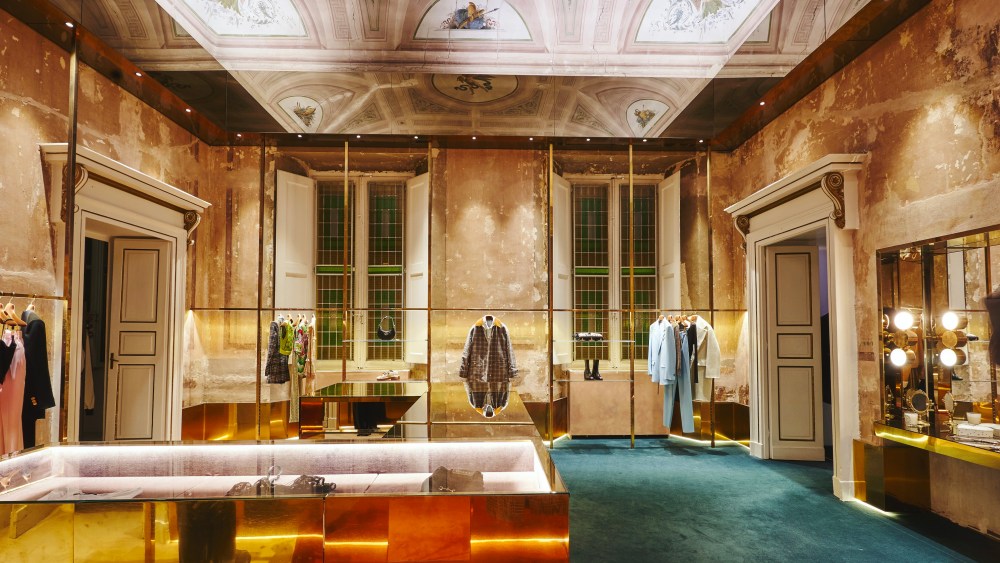
Ratti’s evolution has been at the core of the celebrations in Pesaro this weekend, when the store became the stage for different installations and activations. The “Time Capsule” section retracing the history of the company through archival pictures and videos was only one stop on the multisensory journey set up across the building, which was enriched with site-specific installations and windows by Ratti’s historic partner brands, such as Prada, Miu Miu, Bottega Veneta, Gucci, Jil Sander, Maison Margiela and Valentino, to cite a few.
A lush garden dotted with looks from McQueen and Givenchy and replete with sound and olfactory effects was set up in one of the frescoed halls of the store while the “Crafted Room” spotlighted craftsmanship by grouping the likes of Brunello Cucinelli, Burberry and Church’s, which additionally brought its artisans for live demonstrations for guests. Max Mara highlighted its iconic garment — the coat — in its special installation, and so did Moncler and Stone Island. Meanwhile, Ferragamo and Etro added a playful twist with scaled-up versions of shoes and a paisley teddy bear, respectively.
“We wanted to offer our guests a slightly different event and make them experience our spaces in a less conventional way,” Ratti said. “That’s why we asked for the support of our most strategic partners, those brands we’ve been working with for many years and that have responded to our call really in an enthusiastic way, which obviously filled us with pride, because it was not a given to have the most important brands in the luxury sector committed to this event.”
Brands’ activations added to music performances, such as two DJ sets and a karaoke booth, along with other immersive corners. All areas were illustrated in a map by artist Teresa Cherubini that guests were handed at the entrance to navigate through the different experiences.
“To put customers at the center, offering a service and experiences that he or she can find here and not elsewhere is one of the key factors of our longevity,” Ratti said. “This is flanked of course by our assortment, which is tailor-made on our clientele as we know them very well, so we know which are the brands we can enhance and where we can risk more.”
Ratti highlighted how the buying process has inevitably changed throughout the decades. “When 20 years ago I joined the company, the luxury brands were the ones to have and you didn’t even need to do much research. Now it’s essential,” she said. “But that doesn’t mean not to enhance a luxury brand: On the contrary, the mix makes them even more relevant for today. For example, the most interesting aspect right now are the synergies between luxury names and sport or technical players, which results in a compelling mix, just like 10 years ago we had with contemporary brands.”
The executive underscored that customer behavior is polarized, split between those remaining loyal to luxury names and the more eclectic ones who favor high-low combinations by “buying important pieces from Dior, for instance, and at the same time requesting sneakers by On.”
“So it’s really the mix of products what they look after, and if we wouldn’t have that, we wouldn’t be able to fulfill our clients’ wishes,” said Ratti, who oversees a team of four buyers.
Another layer of complexity is given by the differences in demand between Pesaro and Bologna, with women in the former town willing to risk more in their fashion choices, while those in the latter are “very attentive to trends but also mindful toward fits, as they had a harder time in accepting the oversize wave of the recent past, for one.”
In particular, the buying process for the Bologna store makes for a unique case in Italian retail. The boutique the Ratti family opened more than four decades ago became the object of an innovative strategic partnership. As reported, in 2017 Ratti joined forces with family-run competitor Folli Follie, forming a new company and launching the first FR store in the former Ratti unit.
As part of the agreement, which was enabled by the shared values and business goals, Ratti’s buyers are now in charge of selecting the womenswear brands, while Folli Follie’s buyers are focused on the menswear pieces.
Ratti believes similar operations can be the soothing balm for retailers’ current ills. “This is a challenging time in retail, because the luxury industry at-large is currently experiencing a challenge. Brands need to find their way in their creativity and strategies,” Ratti said. “We’ve always had our own strategy, our own soul, our own identity, but obviously it’s very important for us that the brands we represent are strong and deliver objects of desire for the customer….And through all these changes in creative directions, I think they’re aiming to recreate that sort of interest.
“But it’s also important to create strong synergies,” she continued. “I truly believe the fashion system needs them. The experience we had with our partners in Bologna is an absolutely positive one, and it could be another key for success in the future.”
She didn’t exclude that such a strategy could be replicated and teased opportunities to expand Ratti’s footprint in Italy in the near future, as she described the operation with Folli Follie as one of the pivotal moments in the company’s history, along with the launch of its own e-commerce in 2020.
Key in the internationalization of the retailer, the platform currently generates 10 million euros in sales, accounting for 30 percent of the Pesaro store’s total revenues.
That said, the executive is a firm believer in the power of brick-and-mortar. She included the time her grandfather relocated from a small shop in Pesaro to an entire building in the city’s center and the recent investment in revamping such spaces as among the turning points of Ratti’s history.
While the restyling respected the tradition of the family business, it also opened doors to possible future developments. For one, last year the store welcomed a long-term pop-up of renowned Italian pastry chef Iginio Massari. “This could be the beginning of something more structured in the food and beverage category, that could offer a more complete experience to our customer. That’s a part we’re still missing and now taking into consideration,” Ratti concluded.