
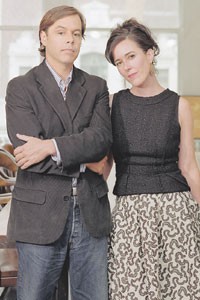
NEW YORK — Four months after giving birth to her first child, Kate Spade has put plans in motion to increase her freestanding stores to as many as 50 from 18 within three to five years and has expanded the company flagship in SoHo.
All this is occurring amid speculation that the company’s prospective majority owner might position it for sale. Kate Spade was purchased by The Neiman Marcus Group in 1999, but in May, Neiman Marcus was sold for $5.1 billion to Texas Pacific Group and Warburg Pincus LLC, two equity firms. The deal is expected to close after the NM shareholders’ meeting Aug. 16. Neither Spade nor Texas Pacific Group would comment.
Spade, whose core handbag business has faced challenges from Coach, among others, is pushing ahead on several fronts despite the ownership question.
This fall the company will open stores in Troy, Mich.; Newport Beach, Calif., and Princeton, N.J. It is also considering markets such as Bellevue, Wash.; McLean, Va., and Honolulu.
Spade has stores in Chicago, San Francisco, Las Vegas, Greenwich, Conn., and Scottsdale, Ariz. In addition, the company has retained its first site on Thompson Street, which is now the location of Jack Spade, the pet project of Andy Spade, chief executive officer and creative director, as well as Spade’s husband. Jack Spade specializes in men’s accessories such as utilitarian messenger bags.
Spade also has a presence in Asia, with stores in Japan and Hong Kong, and an e-commerce Web site that was redesigned from an informational Web site in 2004.
Spade will generate some $275 million in retail sales for the fiscal year ending July 31, a 25 percent increase from 2004, industry sources said. The company anticipates a 40 percent increase in retail sales in the next fiscal year, 35 percent of which is pegged to new store growth.
“While we’ve been relatively conservative, retail is important for what you have to say as a company,” Kate Spade said in an interview. “But nothing is set in stone. When you run a business, you have to be nimble to be successful. I’m not opening stores [just to open stores]. We are building stores where our customers are and where they might not be getting the whole
This slideshow could not be started. Try refreshing the page or viewing it in another browser.
Related Articles
You May Also Like
Spade started her business in 1993 with nylon knapsacks and carryalls bearing her name on a black-and-white logo. Her business, which has had its ups and downs, has since grown to offer a full collection of fashion handbags, as well as lifestyle categories such as tabletop, bridal, footwear, stationery, eyewear and even baby carriages, several of which are under license. She is also considering new categories such as jewelry.
For the past year, Spade has been renovating its Broome Street store — expanding it to 2,600 square feet from 835 square feet — at an estimated cost of $2.2 million, industry sources said. The shop houses the entire Spade assortment. Yabu Pushelberg, an interior design firm that created interiors for Tiffany & Co., Bergdorf Goodman and the Four Seasons Hotels & Resorts, oversaw the design.
Rogers Marvel Architects, a Cody, Wyo.-based firm, worked on Spade’s other stores and will continue to design new Spade stores.
The Broome Street boutique has been updated with a Sixties vibe. The concrete walls are embellished with a tonal white chevron pattern. The shop houses a collection of contemporary and modern art that includes photographer Richard Avedon’s “Chanel,” David Bailey’s “Penelope Tree in a Tree” and a contemporary painting by Agnes Barley.
Handbags and giftware are merchandised throughout the boutique, and there are multiple cases for vintage and costume jewelry. Modern glass and metal screens divide the rooms that encase bags and other trinkets. The extensive shoe collection is housed against a wall opposite a banquette of sofas. Other seating options include a Billy Haines tufted crackled leather chair with metal accents.
Of all the Spade boutiques, the Broome Street store has the lion’s share of tabletop items, with jeweled colored martini glasses. Shelves displaying place settings are suspended from the ceiling. There is also crisp white bedding in an alcove toward the back of the store.
Eclectic items such as Allegra Hicks’ caftans, Lee Angel’s macramé and wood bead necklaces and Macintosh coats from Jungal round out the assortment. Vintage books like “Zazie in the Metro” by Raymond Queneau and Cecil Beaton’s “Beaton In Vogue” from vintage dealer Tom Carey are also offered for sale.
“I’m not afraid of experimenting with things,” Spade said of the retail mix. “I don’t like being too tightly merchandised. Everything has a common thread. Just because I design, doesn’t mean I can’t appreciate other people’s designs. Our customers aren’t going to stand still; they need some unpredictability.”
In terms of Spade’s wholesale business, no changes are foreseen. Spade sells to stores such as Bloomingdale’s, Saks Fifth Avenue, Neiman Marcus and Bergdorf Goodman.
Kal Ruttenstein, senior vice president for fashion direction at Bloomingdale’s, said he feels positive about the future of the Kate Spade business.
“Our Kate Spade business has been good for a long time,” he said. “Our business increased, especially since she started working on different categories like tabletop and bedding.”
Robert Burke, vice president and senior fashion director of Bergdorf Goodman, agreed.
“Kate is without a doubt a style icon,” he said. “She’s always stayed true to her design aesthetic. She represents a modern feminine sensibility. There’s always going to be a customer that embraces color and whimsy.”