Macy’s Inc. has hired AlixPartners to review a potential separation of its dot-com and brick-and-mortar businesses à la Saks and Saks Fifth Avenue.
Jeff Gennette, Macy’s chairman and chief executive officer, confirmed that the retailer has tapped AlixPartners to examine the ramifications of the move. An activist investor, Jana Partners, has been pushing for the reengineering at Macy’s with the goal of raising shareholder value. Earlier this year, Saks Fifth Avenue separated its dot-com and store fleet into two separate companies, putting pressure on many retailers to examine the possibility.
“We have been looking at the costs, benefits, execution risks and [potential] of additional shareholder value getting unlocked. We have been working with our board and advisers on this for some time,” Gennette told WWD.
Related Articles
He said the purpose of taking the further step of hiring AlixPartners is to “pressure test all those assumptions.…The whole focus is on how we ensure the omnichannel behavior of customers is respected at all costs.”
You May Also Like
But that isn’t the only major structural change Macy’s is making. The retailer also revealed Thursday it will launch a marketplace, powered by Mirakl, in the second half of 2022 to rev up digital sales and provide customers with much greater merchandise choices. Mirakl will integrate into Macy’s and Bloomingdale’s architecture and allow for evolving strategies over time. Macy’s digital sales are “on track” to reach $10 billion in 2023 excluding any gains from the future marketplace.
On the brick-and-mortar front, Macy’s said it’s delaying store closures and that only 10 stores, of the 60 left to be closed, will shut down in the beginning of 2022. “We respect the omnichannel behavior of our customers,” said Gennette. “When we close a store we are firing the customers.”
Gennette said the 60 stores are all cash flow positive, and the company has been noticing customers returning to stores in “C” and “D” malls, which are less productive, because shoppers feel safer there because they are less trafficked.
Macy’s three-year “Polaris” strategy, unveiled in February 2020, called for closing 125 stores, enhancing personalization and the loyalty program, expanding assortments, accelerating digital growth, opening smaller scale off-mall stores, boosting some private brands into billion-dollar businesses, and reducing costs.
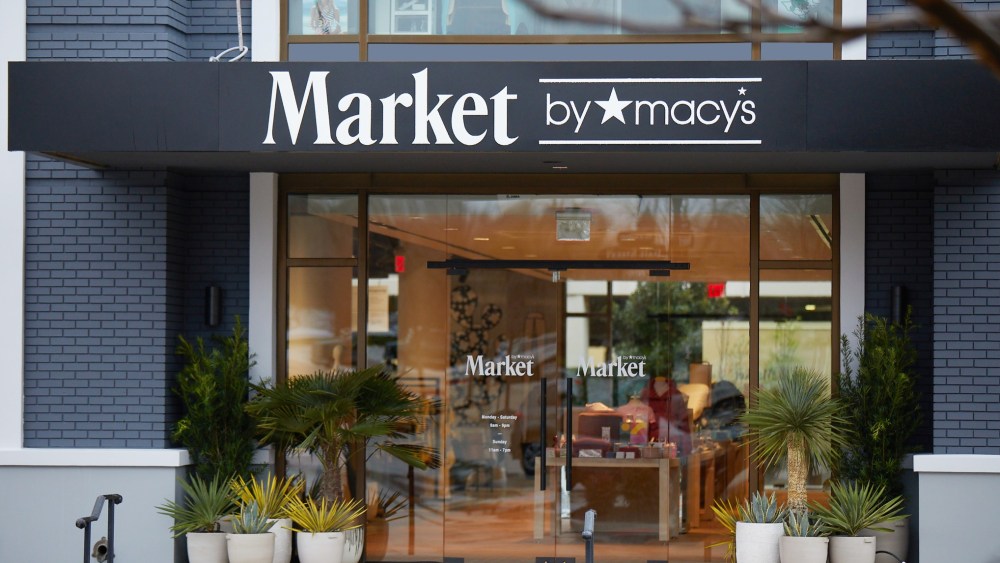
Gennette said next year the company will be rolling out more of its smaller store specialty formats, which include the five Market by Macy’s in Dallas and Atlanta, and one Bloomies store in Fairfax, Va. already operating. Macy’s also operates several Backstage off-price stores and Bloomingdale’s the Outlet units. Specifics on the rollout were not given.
The review of its operations and new platform were revealed as the retailer reported strong results for the third quarter. As a result of the moves and a bullish outlook on holiday, Macy’s shares soared on Thursday, closing up 21.2 percent to $37.37.
The retailer is headed into the heart of the holiday season with confidence, inventories in a good position and expectations that business on Black Friday will be big, despite the confluence of headwinds confronting the industry and the earlier onset of gift shopping.
“October was our best-performing month in the third quarter and November started off well,” Gennette told WWD, underscoring the retailer’s momentum in the wake of its strong showing for the third quarter ended Oct. 30.
Macy’s reported Thursday that sales were robust across all of its divisions, and that net income in the third quarter rose to $239 million, or 78 cents a share, compared to a loss of $91 million or 29 cents, in the year-ago period.
Total sales for the quarter rose to $5.44 billion, compared to $3.99 billion in the year-ago period. Comparable sales were up 35.6 percent versus the 2020 period and 8.7 percent versus the 2019 period. Part of the sales lifts was due to earlier holiday shopping and Macy’s running a friends and family promotion in the third quarter, instead of the fourth quarter.
Digital sales increased 19 percent versus third quarter 2020, and 49 percent versus third quarter 2019.
Last year, Macy’s generated $17.34 billion in sales, versus $24.56 billion in 2019.

On Black Friday, Gennette will be greeting shoppers, first at the Herald Square flagship at 6 a.m., then at the Queens Boulevard and Roosevelt Avenue stores in Queens, N.Y.
Asked if Black Friday will see less of a sales spike this year because of the extended holiday shopping season, Gennette answered, “I don’t think so. Black Friday is always kind of an event in itself. It’s a pilgrimage. Customers after spending Thanksgiving Day with their families are looking to get out of the house. America is going to get out there.” And Macy’s, he said, “shows up really well on Black Friday because of the Macy’s Thanksgiving Day parade.”
He noted that Macy’s is closed on Thanksgiving Day this year, which will benefit business the day after. Two years ago, Macy’s kept its stores open on Thanksgiving Day.
“The big question is with what we always call the lull,” said Gennette, referring to days immediately following Thanksgiving weekend and Cyber Monday, when store traffic slows. “Then it picks up in the 10 days before Christmas,” Gennette said.
Macy’s CEO said that for the holiday season, “Our inventory level is in a really good place. We’re running with leaner inventories and customers are responding to less clutter and more curation, which is fueling better sell-throughs and higher AURs,” said Gennette, referring to average unit retail prices. “Inventory was up 19.4 percent from third quarter 2020 but down 15.4 percent from third-quarter 2019.”
In 2020 amid the pandemic, “Our vendors and merchants were reeling, but we’ve since had lots of time to sit with vendors to work through values, prices, new categories and exclusive content,” Gennette said.
“With certain brands that are super hot, there is not enough supply,” said Gennette, though he emphasized that with bestselling categories — fragrance, jewelry, watches, sleepwear and beauty gift sets — “we really jumped on them early and we are in great position.” In other key holiday categories — fleece, sweaters and outerwear — “We are relatively good there,” said Gennette. He does not expect Macy’s to be materially impacted by supply chain issues during the critical holiday season.
“In the aggregate we feel we have enough content to satisfy all the holiday demand.”
To mitigate bottlenecks in the supply chain, “First and foremost, we moved up ship dates 30 days to allow ourselves more cushion,” Gennette said. “We are also taking less freight through the port of Los Angeles,” where ships have been lined up for miles unable to unload goods. “We used to import 80 percent of our Far East freight out of L.A. It’s down to 60 percent. We are using smaller ports and smaller vessels. With our own private brands, we have been consolidating our sourcing in the other countries making sure we get predictability of supply.”
He said there won’t be any easing of supply bottlenecks until mid-to-late 2022, based on actions being taken at the port of Los Angeles to transit more goods more efficiently.
The nation’s labor shortage could hamper some holiday selling, but Gennette said Macy’s announcement Nov. 8 about upping its minimum wage to $15 helped fill job vacancies. “We still have some vacancies in some stores, but the situation is much better than a week ago.”
By division, Macy’s comparable sales rose 35.1. percent from the year-ago quarter and 8.4 percent from the 2019 period, fueled by categories that were “solid” throughout the pandemic, including home, fragrances, jewelry, watches and sleepwear. Occasion-based categories, such as dresses, men’s tailored and luggage, continued to recover, and emerging categories, such as toys and pets, showed “encouraging results and the company continues to expand on those categories and related brands.”
Bloomingdale’s comparable sales were up 38.5 percent compared to the third quarter of 2020 and ahead 11.2 percent compared to the 2019 period. Results were driven by strong sales of luxury handbags, fine jewelry, home, men’s shoes and contemporary apparel.
Bluemercury’s comparable sales were up 39.5 percent compared to the third quarter of 2020, but down 2.2 percent compared to the third quarter of 2019. Private brands, home fragrance and treatment showed strong sales performance during the quarter.
Gross margin for the quarter was 41 percent, up from 35.6 percent in third quarter 2020 and up 100 basis points from the 2019 quarter. Improvements were largely due to benefits from pricing, promotion and inventory productivity enhanced by the Polaris strategy.
Macy’s raised its full-year guidance. Net sales are seen reaching $24.12 billion to $24.28 billion, versus previous guidance of $23.55 billion to $23.95 billion. Adjusted diluted earnings per share are seen at $4.57 to $4.76, compared to the previous guidance of $3.41 to $3.75.