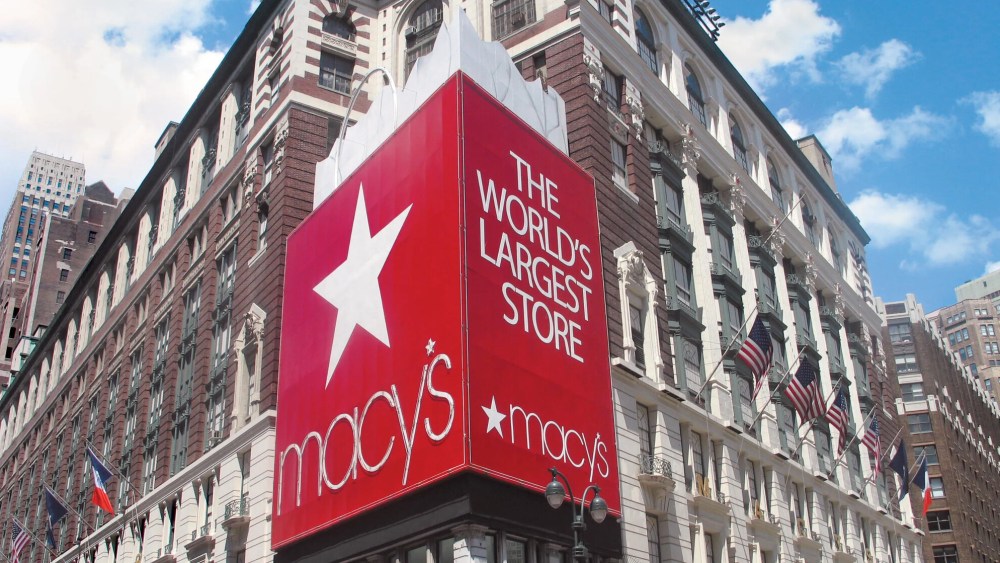
Macy’s Inc., continuing to aggressively close underperforming department stores, reported drops in profits and sales for the first quarter of 2025 but said the performance was better than expected.
Net income dropped to $38 million, or 13 cents per diluted share, in the quarter ended May 3, from $62 million, or 22 cents per diluted share, in the year-ago quarter. Adjusted diluted earnings per share was 16 cents, surpassing Macy’s guidance of 12 cents to 15 cents.
Operating income declined to $94 million last quarter, from $125 million in the year-ago period.
Related Articles
Net sales slipped to $4.6 billion in the latest quarter, from $4.85 billion in the year-ago period, but the first-quarter sales surpassed Macy’s guidance of $4.4 billion to $4.5 billion.
You May Also Like
Based on the dynamic situation with tariffs, and what the company sees as some moderation in discretionary spending and a heightened competitive promotional landscape, Macy’s reduced its earnings guidance for the year, but maintained its sales projection and stated it feels “confident” it can adapt to the changes.
The results and the outlook did little for Macy’s stock price, which by the end of trading Wednesday was down 0.4 percent, or 5 cents, to $11.99.
“A lot of uncertainty hangs over us,” Macy’s Inc. chairman and chief executive officer Tony Spring told WWD. “We have to stay true to our core tenets, flow newness in, maintain a better balance of top and bottom funnel marketing. If we stick to the fundamentals of the business, we will be rewarded as we go through this period and come out the other end.
“Reaffirming our sales outlook and appropriately adjusting our earnings outlook for the year gives us the latitude to navigate tariffs and the uncertainty regarding consumer demand.”
Spring said he’s “cautiously optimistic” on how the rest of the year plays out, that there’s been sequential monthly improvement in the business since March and that the business was performing better in May than it did in April.
He also said Macy’s Inc. is “not backing away” from investing in the business and its key strategies, which includes improving presentations and service levels at the retailer’s top 350 stores over time, and “opportunistically” investing in merchandise areas where the demand is greater. Spring said the retailer entered the second quarter with inventories down 0.5 percent, leaving the company with sufficient open-to-buy to chase high-quality assortments at compelling values.
Macy’s Inc., he said, takes a “surgical” approach to managing new tariffs, including working with vendors and factories individually to figure out how much of the burden each party absorbs, what the price increases should be, and to be able to commit to orders as late as possible without sacrificing much of the selling season. He also said Macy’s placed certain second-half orders earlier to avoid some tariff impact, which he thinks going forward won’t be any more significant in apparel than other categories. So far, the impact has been minimal but “kind of progresses as the year moves on,” Spring said. Macy’s has also canceled some orders.
Roughly 20 percent of total Macy’s Inc.’s product originates in China, with national brands carried by the retailer sourcing 18 percent of their product out of China, and Macy’s private brands sourcing 27 percent of their product out of China, which is down from 32 percent last year and over 50 percent pre-pandemic.
While there’s been wide industry concern about low consumer confidence levels and discretionary spending waning, Spring said consumers are still responding to newness, particularly in contemporary fashion. Contemporary apparel brands recently introduced to the assortment include Good American, Fiori and Nic+Zoe, while Coach and Donna Karan continue to resonate with shoppers, Spring said. Among other categories, denim, men’s tailored clothing, pockets of fine jewelry, furniture, mattresses, sheets, and towels have been selling, he noted. Macy’s off-price business, Backstage, and the Macy’s online marketplace format online also performed well.
“We continued to execute against our ‘Bold New Chapter’ strategy during the quarter, scaling key initiatives that improved our customer experience and contributed to stronger than expected performance across all three of our nameplates,” Spring said in a statement issued Wednesday morning.
“Our first-quarter results give us confidence that we have the right strategy and team in place to navigate the current environment while we continue to invest in our customer on the path to returning Macy’s Inc. to sustainable profitable growth.”

Macy’s Bold New Chapter strategy, introduced in February 2024, involves investing in “go-forward” stores with increased staffing in high-traffic areas such as women’s shoes and fitting room areas, fresher products and improved visuals. Macy’s has so far “reimagined” 125 department stores, and will invest in more since 350 have been designated as go-forward units. The strategy also calls for closing about 150 poor-performing department stores over a three-year period (many of which have already shut down) while “accelerating and differentiating luxury,” striving for organic growth and store expansion at both Bloomingdale’s and Bluemercury, including opening the Bloomie’s scaled-down, specialized versions of the full-line Bloomingdale’s department stores.
By division last quarter, Macy’s net sales, including owned and licensed and through the store’s marketplace format, were down 0.9 percent. For the Macy’s “go-forward” department stores, comparable sales were down 1.9 percent.
Bloomingdale’s comparable sales rose 3.8 percent on an owned, licensed and marketplace basis. “It’s an exciting time at Bloomingdale’s,” Spring said during a conference call with analysts. “As strategic initiatives bear fruit and the competitive landscape continues to shift in our favor, there’s no question we are taking share. Our aspirational to luxury positioning, compelling on-trend assortments, and service orientation continue to attract new customers and new vendor partners. In addition, our Bloomie’s and Bloomingdale’s the Outlet concepts are allowing us to enter new markets, and expand our presence as well as share of wallet in existing markets.”
Bluemercury’s net sales rose 0.8 percent, and on a comparable basis were up 1.5 percent. “Bluemercury achieved a positive 1.5 percent comp, its 17th consecutive quarter of gains. Results were driven by the 24 new and remodeled locations opened last year, ongoing strength in dermatological skin care, recent brand launches and a more targeted approach to loyalty and communications and offers,” Spring said.
Macy’s now expects adjusted earnings before interest, taxes, depreciation and amortization, as a percent of total revenue, to range between 7.4 percent to 7.9 percent, down from its previous forecast of 8.4 percent to 8.6 percent. Adjusted diluted earnings per share are seen coming in at $1.60 to $2, down from the previous forecast of $2.05 to $2.25 per diluted earnings per share.
However, the company’s forecast for sales is unchanged at $21 billion to $21.4 billion for this year.