
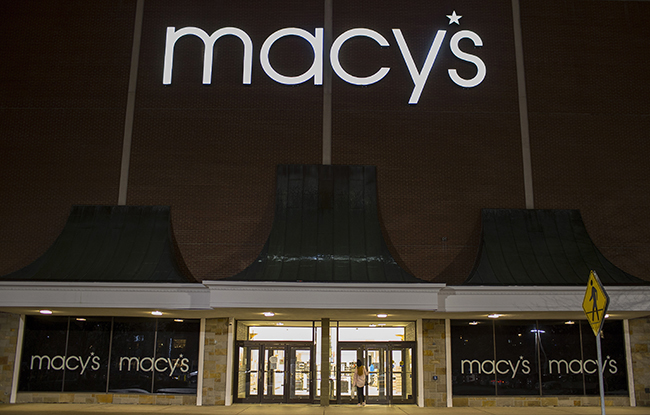
Macy’s Inc. is headed for another challenging year — and one that could potentially be complicated by a takeover bid from Hudson’s Bay Co.
Nevertheless, on Tuesday, after disclosing sharp declines in sales and earnings for the fourth quarter and 2016 overall, Macy’s made the case for a better future ahead, citing several initiatives and test projects in the works that are intended to drive greater traffic to its stores and web site.
“We will be developing and testing new categories, new services, entertainment [formats] and new technology to improve the customer’s experience and our ability to operate more efficiently,” said Terry J. Lundgren, Macy’s chairman and chief executive officer, during a conference call. “We will partner with developers and vendors and form new collaborations. We’ve got test stores lined up. We’ve got a lot of exciting things we are testing and doing.”
Related Articles
For 2017, Macy’s expects a 2 to 3 percent comparable store sales decline, with total sales falling about 3.2 to 4.3 percent, reflecting the 66 stores closed in 2016. Another 34 stores are expected to close over the next few years.
You May Also Like
Adjusted diluted earnings per share of between $3.37 and $3.62 are expected in 2017, excluding the impact of the anticipated settlement charges related to benefit plans. Excluding the impact of the anticipated fourth-quarter gain on the sale of the men’s store on Union Square in San Francisco and the anticipated charges related to benefit plans, adjusted diluted earnings per share of $2.90 to $3.15 are expected.
Capital expenditures for 2017 will be roughly $900 million, similar to 2016, though more money can be spent per store due to the high level of store closings. Macy’s has been focusing renewal efforts at its top stores around the country yet industry experts have noted that many other of its stores show serious wear and tear.
“Last year wasn’t the year we expected or hoped for,” Lundgren said. “We are not happy at all with 2.9 percent decline in comp sales and $3.11 in diluted earnings per share. We thought we could be better.”
The ceo, true to form, put a positive spin on the company and its future, citing “significant progress in a number of areas,” including restructuring the retailer down to fewer stores and a leaner team, the company’s growing digital and Backstage off-price businesses, stepped up experimentation on new formats and experiences, and creating “meaningful value out of our real estate portfolio.”
Lundgren also said, “We are working on a strategy to transform our beauty business as we have done with furniture, mattresses, fine jewelry and shoes. Bluemercury [which Macy’s bought in 2015] and our Impulse Beauty concept will be part of the strategy.”
He indicated that Macy’s is testing a new pricing format to be more responsive to competitive prices made transparent by the Internet, and reducing the dependence on coupons. No details of the pricing or beauty projects were cited for competitive reasons.
Backstage, the retailer’s new off-price strategy, is increasing the productivity in the Macy’s stores where they’re housed, giving current customers more reasons to make trips to Macy’s stores and bringing in new customers. “We are still working on refining the format. It could add a lot of value to a certain set of stores,” Lundgren said. One concern about Backstage is that it dilutes the image of the Macy’s brand.
The company also disclosed that its previously announced management transition will occur on March 23, when Jeff Gennette, president, steps up to ceo, succeeding Lundgren who will remain executive chairman. The transition is seen as smooth considering Gennette and Lundgren have longed worked together, although Gennette is seen as a change agent despite being an insider.
While the transition has so far been smooth, business could be disrupted by the Hudson’s Bay, which is said to have lined up a partner in China to make an offer for Macy’s which would be a lot for HBC to swallow, considering it’s less than half the size of Macy’s. Macy’s could pursue other strategies if it wants to fight a takeover, such as selling off pieces of the business.
Though the fourth-quarter numbers were not good, they did beat Wall Street estimates. Soft sales trends and charges related to store closings and severances pulled fourth-quarter net earnings down 13.1 percent to $472 million from $543 million.
Comparable sales in the quarter ended Jan. 28 were down 2.1 percent, while total sales were down 4 percent to $8.52 billion, from $8.87 billion.
The full-year results saw an even steeper decline in net income, which dove 43 percent to $611 million, from $1.07 billion. Total sales came to $25.78 billion, down 4.8 percent from $27.1 billion in the year before. Comparable sales declined by 2.9 percent.
For the full year 2016, adjusted earnings were $3.11 a diluted share, exceeding the most recent guidance of $2.95 to $3.10.
Fourth quarter 2015 operating income included $177 million of impairments, store closing and other costs. Excluding these items, operating income for the fourth quarter of 2015 was $1.113 billion or 12.6 percent of sales.
For 2016, operating income totaled $1.32 billion, or 5.1 percent of sales, compared with operating income of $2 billion, or 7.5 percent of sales in 2015.
Tuesday marked Lundgren’s last earnings call on behalf of Macy’s, after 14 years heading the company. As he has throughout his career, he defended the long-term viability of brick-and-mortar stores, stating, “Physical stores will continue to play an extremely important role.” He said 90 percent of the retail business is done through physical stores. “A lot of people don’t believe or understand that,” Lundgren said, though he did note the percentage is somewhat lower at Macy’s and Bloomingdale’s due to their relatively mature online businesses.
Lundgren recounted how Macy’s weathered difficult stretches in the past, including a bankruptcy in the Nineties and the Great Recession. “In 2008, we all know what happened. We were hit very hard but we made the needed adjustments and had an effective winning streak for five years in a row. Now seven years later, we are once again faced with challenges and lots of concern out there about our ability to bounce back. Yet internally, several on our team have seen this movie [before]. We are not standing still. We made a lot of strategic decisions last year that have set us up well for 2017.”
Without getting too emotional, Lundgren, one of the industry’s longest-serving and most popular ceo’s, said, “It’s been a privilege for me to lead this company for the past 14 years.” He said Gennette, since appointed president three years ago, has taken on increasing responsibilities. “He has a deep knowledge of our business coupled with the vision and determination to reinvent Macy’s. Jeff has a terrific team around him — a mix of Macy veterans with some fresh hires with some new perspectives. The veterans on this team, including Jeff and Karen have a long track record of winning,” Lundgren said, referring to Karen Hoguet, Macy’s chief financial officer.
One of the surprises in the Macy’s call was Lundgren’s citing strength in apparel — men’s, women’s and kids included — for the last two quarters while most other retailers have suffered declines. He also cited fine jewelry, shoes, intimate apparel and fragrance as performing well recently, while handbags, fashion watches and fashion jewelry and most of home were weak, with the exception of furniture, mattresses, luggage and textiles.
“The reality is you are hearing consistently from other retailers that apparel is difficult, yet we called it out as our strength,” Lundgren said. “Apparel is the category that, when you have the right product at the right time at the right price, you get the response you need…exclusive, unique product — those are clearly the leaders in the performance of the whole store and certainly in the apparel area. Not everybody can do that.” Private brands account for 20 percent of Macy’s total sales; another 20 percent of Macy’s sales are from exclusive products provided by market brands.
Moving the discussion to real estate, Lundgren said with the sell-off of its men’s store in San Francisco, a “more exciting environment in the main store” is being created involving carving out space to lease to luxury retail brands. No specific luxury brands were cited.
Macy’s is also working on plans to downsize the State Street flagship in Chicago, and monetize space at the Manhattan Herald Square flagship, with the possibility of converting some areas to offices, as was done in the Seattle flagship.
Next year, Lundgren said, “many of the industry challenges will continue, but the actions we have taken over the past year will serve us well….This time the positive is that consumers have money to spend. They are spending on automobiles, health care and home improvement. I actually thought they would spend less on these items in 2016. At some point in time, these dollars are going to be freed up for other categories of spending.”