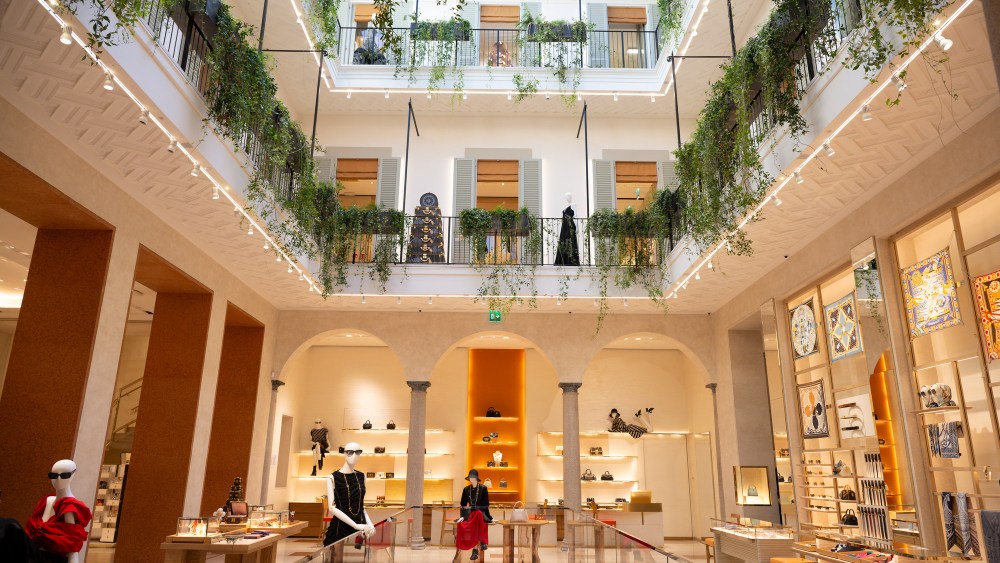
MILAN — Louis Vuitton is paying tribute to the city of Milan, its history of design and the architecture of the Lombardy region with its newly renovated and sprawling flagship in the Neoclassical Palazzo Taverna on Via Montenapoleone.
Opening Friday, the striking store, designed by Peter Marino, is the first to carry the new comprehensive Louis Vuitton Home collection, which will be unveiled at Palazzo Serbelloni and open to the public for the duration of Milan Design Week and Salone del Mobile, which runs from Tuesday to April 13.
Related Articles
The flagship is also the first in Italy to include a restaurant and a café, both in partnership with Da Vittorio, the Cerea family’s three-Michelin star restaurant and catering establishment.
You May Also Like
“This is all aligned with our concept of Louis Vuitton as a cultural brand,” said Pietro Beccari, chairman and chief executive officer. “This is a special store, also in terms of its spatial volume, and it further strengthens the link between the brand and Italy.”
The flagship covers almost 50,000 square feet.
There are 22 Louis Vuitton stores in Italy and, in Milan, the existing unit in luxury shopping arcade Galleria Vittorio Emanuele II and the shop at Rinascente will remain open. Including Milan and temporary and seasonal restaurants and cafés around the world, Louis Vuitton has opened 24 dining experiences in cities ranging from Tokyo, Osaka, Shanghai and Seoul to New York, Paris and London since 2020.
It took three years to redevelop the Palazzo Taverna location and Beccari conceded that the temporary store, which opened in 2023 in the renovated 1930s building known as the former Traversi garage, helped preserve the brand’s business during that time. However, “while it was a nice parenthesis, we are happy to return to Via Montenapoleone with such a special project, since the street is the city’s beating heart” for luxury shopping, he said.
“There is a lot of excitement in the air, and over the years, Milan has asserted itself as a capital of high-end and high-quality luxury shopping,” Beccari said. “Milan is important for the Milanese and for the Italians who shop there, the latter among the most important customers in Europe for us and, despite the fact that we are not Italian, we have a market leadership here that we have to defend and consolidate,” Beccari said.
At the same time, Milan is a major tourist attraction and in particular events such as Salone del Mobile further confirm the city as a global capital, he continued.
As an Italian, Beccari was proud of the statement the brand is making in Milan and he praised the expertise of Marino — a longtime Vuitton collaborator — and his knowledge of the city. Marino has several design projects under his belt in Milan, from Giorgio Armani’s residence to the Ermenegildo Zegna headquarters, among others.
“We wanted to keep the decor and the spirit of the store as Milanese as possible. Italy is full of inspiration for us, as is Milan,” Beccari continued.
Design and Art Inside the Flagship
The facade of the building erected in 1835 based on the design by Ferdinando Albertolli features Ionic columns and tympani, and the main entrance remains an arched door framed by structural decoration.
The floor area has nearly doubled and walking into the store, the space has greater height than before. The new store’s entrance design reproduces a Italian casa di ringhiera, which typically has several apartments sharing the same open gallery on each floor. Greenery cascades from the long surrounding balconies, and a glass skylight serves as the ceiling.
All the carpentry was done locally and as many as 15 different varieties of stone, including the yellow Giallo di Siena that is traditionally used in the region, was cut in workshops in Lombardy.
The stairs leading to the first floor draw inspiration from Milanese Rationalist architect Piero Portaluppi’s Villa Necchi Campiglio, built between 1932 and 1935. The three flights are set in a stairwell lined in lacquered parchment — an unusual artisanal technique, which Portaluppi had done in a dark color but which here has been modernized with more light and a checkerboard pattern — one of the brand’s signature symbols.

Every detail of the staircase is a reference to Milanese architecture including, for example, the hanging structure of the steps and the half-arch where the keystone sits — echoing the grand staircase at Palazzo Bagatti Valsecchi, the 19th century stately building a few steps away that houses a museum featuring permanent collections of Italian Renaissance decorative arts, sculptures and paintings.
Footwear is displayed on the first floor, where the ceiling is inspired by Milanese entrance halls, with a linear design in stucco and plaster.
Womenswear is lodged in a room with elements reminiscent of Casa Corbellini-Wassermann, another Portaluppi design. The lounge reserved for appointments is clad in metal panels in colors ranging from white to gold, made by the American artist Elisabett Gudmann.
The flagship displays a collection of contemporary art by the likes of Mimmo Paladino, Carla Accardi, Peter Halley and Alfonso Clerici.
Italian furniture acquired and restored by the house includes a desk by Luciano Frigerio, and pieces by Gio Ponti, Ico Parisi, Osvaldo Borsani and Angelo Mangiarotti.
During the construction work, Louis Vuitton discovered the 19th century foundations of Palazzo Taverna, with the cross and barrel vaulting of the rooms. The old architecture has been emphasized, with the clay bricks restored, protected and left visible. The menswear collections are available in this basement.
The First Home Collection
The second floor is completely dedicated to furnishing, textiles and cushions.
The Objets Nomades collection will have a permanent sales space. A large corner is dedicated to the Exceptional Games: table football, a card table, backgammon and a chessboard. There is a room for the Art de la Table pieces, with a faithful reproduction of a dining room at the historic house at Asnières, which belonged to the family of the brand’s founder, adding a direct and distinctive reference to the personal history of the Vuitton family.
Dining With Da Vittorio
Except for a summer pop-up café at the Louis Vuitton store in Taormina, Sicily, the first dining experience in Italy is also a major development for the brand and Beccari praised Da Vittorio as “an Italian excellence. The family has embraced dining as a religion for so many years. We are obsessed with quality as they are and we are always looking for innovation that can surprise the customer, so this partnership was quite natural.”
He was noncommittal about the potential for future restaurants in other stores. “We take things step by step, experimenting, and we shall see what happens.”
The DaV by Da Vittorio Louis Vuitton restaurant stands where the former Paper Moon restaurant used to operate, with an evening entrance on Via Bagutta, also designed by Portaluppi, or through the store during the day. There are 48 seats in total, laid out across two floors.
On the main wall on the Via Bagutta entrance is a tongue-in-cheek artwork by Katherine Bernhardt of the Pink Panther, holding a pizza and wearing Nikes.
Inside, there are chairs by Carlo de Carli and iroko wood panels, which reproduce Louis Vuitton’s signature leather graining. The star-design parquet flooring was made of wood salvaged from old Lombardy houses. The plates, glasses and cutlery are part of Louis Vuitton’s Art de la Table, which here — for the first time — comes in orange and pink.
The Da Vittorio Café Louis Vuitton is located in what was the central courtyard of Palazzo Taverna. A railing and a colonnade mark the entrance from Via Montenapoleone — but access can also be gained through the main atrium of the store.
A glass ceiling covers the courtyard to create a veranda feel, a glasshouse that drew inspiration from an old Cecil Beaton photograph. The flooring uses stones in gradated colors from white to black to reproduce a design by Martin Kline.
Original arches were recovered when the walls were restored.
All the furniture has been produced following new designs, in workshops in Lombardy, while the textiles are hand-painted.
Greenery will be predominant — a mix of asparagus, ferns, laurels, Alexander palms, bushes, flowers and leafy plants — both here and throughout the shop handled by Milanese landscape architect Marco Bay.
The chefs of the Da Vittorio Restaurant, led on site by Edoardo Tizzanini, oversee the gastronomy. They are today part of the LV Culinary Community, after spending time with longstanding friends of the house, the French chefs Arnaud Donckele and Maxime Frederic.
The café menu includes toasted sandwiches with three kinds of tomato — confit, dried and fresh — mozzarella and pesto; a king crab gaufrette; a carpaccio beef with shavings of grana cheese; scrambled chicken eggs; poached quail eggs; salmon eggs, and caviar served with potato mousse, sour cream and a compôte of sautéed apple. Desserts range from a vanilla triptych (blue, Madagascar and Mexican vanilla) to a hazelnut entremets, also dark chocolate, and a seasonal fruit charlotte flavored with tonka beans and vanilla.