Retail real estate in the U.S. is on firm footing.
Occupancy rates are at or near record levels. Consumer spending was surprisingly resilient through 2025 and has been into 2026 so far even as inflation leaps. And redevelopments across North America are transforming mundane malls into relevant mixed-use destinations.
But while industry metrics at Simon, Tanger, Regency Centers and other owners and operators of retail destinations are healthy, there’s an undercurrent of concern about the impact of the Iran and Ukraine wars on the world economy; rising prices; the Federal Reserve pausing rate cuts, and Americans cutting back on shopping. Consumers are spending more on essentials, mostly due to higher prices, while reducing spending on non-essentials.
Related Articles
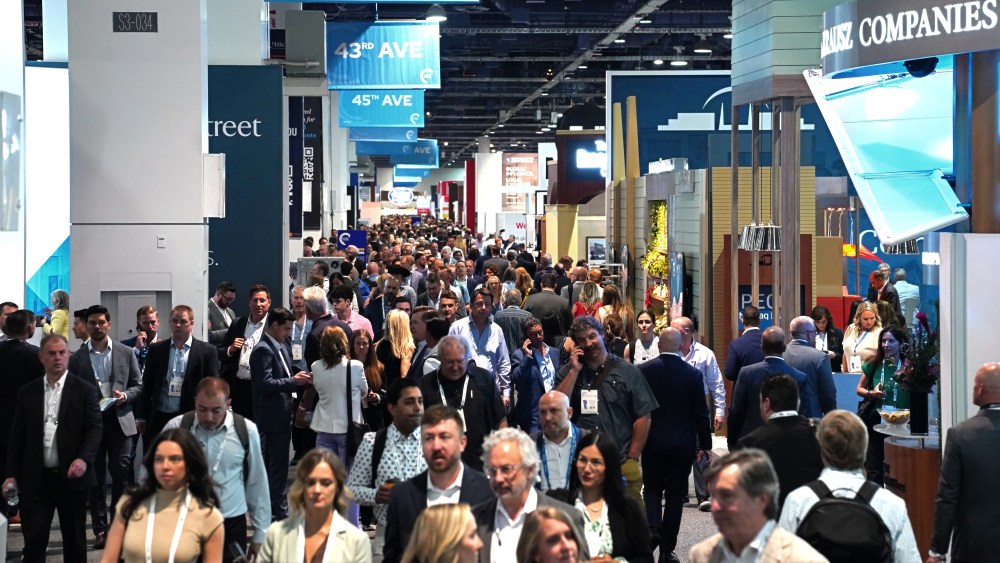
Against this climate of business uncertainty, which seems be growing as the year progresses, the ICSC trade organization stages its largest event of the year — ICSC Las Vegas — Monday through Wednesday. An expected crowd of 25,000 developers, property owners, retailers, brands, tech suppliers and other service providers will convene at the Central and South Halls of the Las Vegas Convention Center, matching the attendance seen at last year’s event. Over 900 exhibitors will be on the trade show floor and professional development sessions are being held Monday at the Wynn Hotel.
You May Also Like
Among the innovations at the convention this year is a “Women in CRE” (commercial real estate) program happening Monday and featuring Randi Zuckerberg, the sister of Meta founder Mark Zuckerberg. She’ll be speaking about technology and leadership. Also speaking will be Erin Andrews, the football commentator on the Fox Network who has her own sports apparel brand called EA. She’ll discuss leadership and navigating the male-dominated sports industry.
Speaking later in the day will be Mike “Coach K” Krzyzewski, one of the winningest coaches in college basketball who served as the head coach at Duke University from 1980 to 2022.
Another innovation is an ICSC+Proptech event featuring sessions on property technologies and the latest iterations. About 100 exhibitors will be promoting their technologies and explaining how to utilize them.
“Any sort of technology, from parking garage cameras tracking open spaces to AI, will be there,” said Stephanie Cegielski, ICSC’s vice president of public relations and industry education. She said Terminal A at Newark International Airport and the Asheville, N.C., airport are early adopters of new parking technology.
“Of course, AI is top of mind. AI is creating efficiencies without really costing jobs,” Cegielski said. “What we are seeing from our members is they’re just using AI to make their people better and more efficient. But you will be seeing people who don’t know how to use AI getting replaced by people who do know how to use it, because it creates efficiencies.”
Applications like personalized recommendations, dynamic pricing and automated inventory management have been around for years, but AI advancements are taking personalization; payment systems; search; insights into consumer behavior; marketing; ordering and replenishment; store design, and product information for store associates to new levels. And AI is opening up opportunities for workers to be retrained for roles requiring more of the human touch, for operational efficiencies, for eliminating costs after initial investments, and for making it quicker and easier for people to shop and find what they want — even parking their cars before shopping.
On the other hand, AI is seen increasingly replacing jobs, reducing traffic in stores and shopping centers, raising cybersecurity concerns, and is costly to implement. Ironically, as consumers habitually use AI agents to shop and transact, they are also expected to develop a greater appetite for live experiences interacting with humanity in stores and shopping centers.
ICSC recently released a report on AI in conjunction with McKinsey, the management consulting firm, highlighting how AI has become a big part of the customer journey to search, compare, and even automate purchases, leading to more intentional and higher value trips to shopping centers. The report projected $1 trillion in U.S. retail revenue from agentic commerce by 2030, and $3 trillion to $5 trillion globally.
Meanwhile, mall owners are using AI to review leases and help them write leases. “There are all sorts of back office uses for AI being utilized, whether to streamline accounting functions or human resources functions. AI can consolidate and analyze large amounts of data quickly. That’s becoming a valuable tool for brokers to use when they’re trying to get leases signed. We’re seeing a lot there,” said Cegielski.
Property owners and operators are also using AI to increase productivity by providing solutions for layout designs and adjacencies, a change from relying on traditional methods of designing layouts. “AI is now taking it a step further from even what CAD can do,” said Cegielski.
Asked how the Iran and Ukraine wars and inflation are affecting property owners and developers, Cegielski replied, “From a consumer perspective, we haven’t really seen any change to retail sales since the end of February. But we are seeing consumers shift how they’re spending so they are really focusing on essentials more than non-essentials. We did a survey recently that said about 55 percent of consumers are spending more on essentials than they had previously, in part due to inflation.

“From a industry perspective, we haven’t seen anything yet,” Cegielski added. “Our members play a very long game” when it comes to setting goals and budgets revolving around redevelopments and renovations typically involving anywhere from three to 10 years.
“When they’re in Las Vegas, they’re looking at signing leases for space that isn’t going to come due until next year,” said Cegielski. “They’re always looking 12 to 24 months out.” If the Iran war drags on and on, some impact could be felt, she suggested.
“The bigger concern as when it comes to development or redevelopment, or even buying and selling of properties is with what the Fed decides to do with interest rates. That said, obviously, with a prolonged war, we’re not going to probably see any rate cuts, which could inform decisions,” Cegielski said.
Rates at 4.5 percent to 5 percent have come way down from the ’80s when they stood in the mid-teens, but they remain far above the historic 0 percent to 0.25 percent set by the Fed during the pandemic, which was the ideal time to borrow.
On occupancy rates, “They can’t go up much more,” Cegielski said. “They are at record highs right now. The biggest problem our industry has at the moment is there’s not enough space, unless it’s in an undesirable location. Occupancy rates are in the mid 90s, which is incredible. There are some lower-performing malls that have lower occupancy rates, but on average across all 1,100 enclosed malls in the U.S., it’s in the low 90 percents. Retailers are clamoring for space, and there’s not enough of it at the moment.”
Pervading North America’s retail landscape are redevelopments recasting shopping centers into mixed-use destinations. As Cegielski observed, the grand opening of the 5-million-square-foot Oakridge Park in Vancouver, set for May 28, is a case in point. It’s a redevelopment of the former Oakridge Center, and a reflection the direction many owner/developers are going — bringing retail, food and beverage, residential, services and entertainment features all into one property. Owners are also responding more to local communities by leasing to local groceries and restaurants on the main streets of America. This is giving them opportunities, so they open second locations in larger shopping destinations, giving shoppers alternatives from national chains, while strengthening community ties and attracting more customers.
Cegielski also sees those retailers that offer the best value and discounts as being most aggressive in rolling out new stores. Count Burlington, Aritzia, Nordstrom Rack, TJX Cos., Dollar General, Five Below, Tractor Supply, Aldi, Primark, and Academy Sports as most expansion-minded. “They’re taking advantage of store closings by Macy’s, Saks Global, Jo-Ann Fabrics, and others,” Cegielski said.