
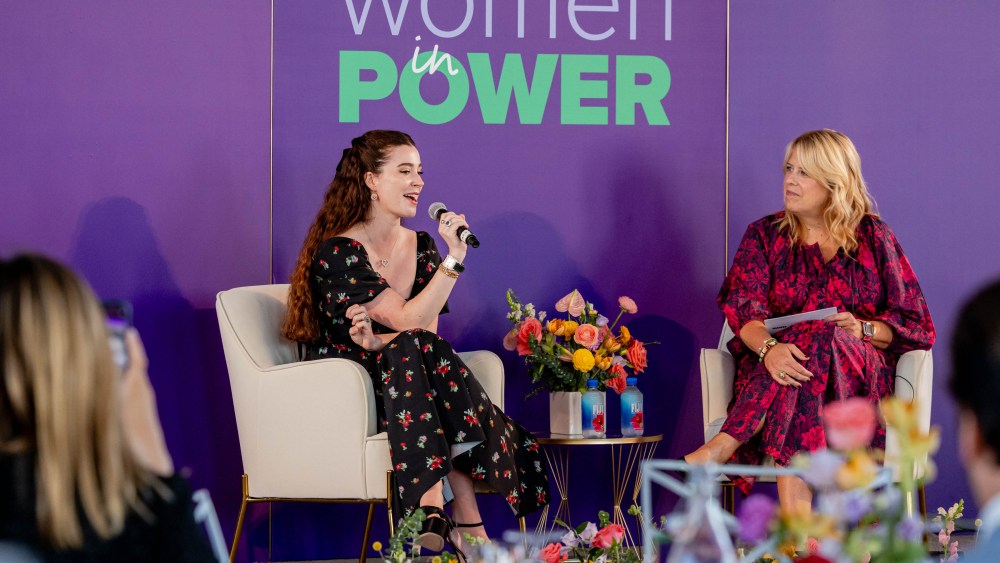
Nell Diamond, founder and chief executive officer of Hill House Home, didn’t take parental leave when her twins were born because she didn’t want to pass up the once-in-a-lifetime opportunity to build her fast-growing company.
But she wouldn’t recommend others do that.
Since Diamond founded Hill House in 2016, she has had ups and downs in financing the company. At first, she was unsuccessful, and spent the next few years bootstrapping while she tried to build a profitable business. Then, in 2019, she introduced the Nap Dress (intended more for comfort than literal naps), and it went viral, Diamond told Booth Moore, executive editor, West Coast of WWD at the WWD x FN x Beauty Inc Women in Power event in New York earlier in September.
Related Articles
At the time, Diamond had five employees and two of them were on vacation. “One of them was sitting in my kitchen with me right after I dropped my son at school. And we did $1 million in sales in two minutes,” she said — it was the same volume the brand had done in the entire year prior.
You May Also Like
“It was totally the wildest thing ever,” Diamond said. “And then from that moment, we basically had three consecutive years of 300 percent year-over-year growth, every single year.” She said Hill House went from five people to 50 people, expanded categories and transformed the company from 90 percent homewares to 90 percent fashion. “It’s been a very busy six or seven years,” she said, a period during which she also had three children.
The pandemic greatly contributed to the brand’s popularity. When people were at home, they were looking for comfortable garments to wear on Zoom and doing things around the house, while they still felt put together, Diamond said.
During the lockdown, Hill House created “The Nap Room,” which is basically a waiting room on its site before a product drop. Tens of thousands of people would linger on the Hill House site waiting for noon drops, so at 11:30, the brand launched a fun, interactive experience for the crowd with a chat room, Snap destination and playlists before Diamond would sign on and livestream-sell products.
To avoid flaming out, Diamond said she and her team continue to listen to their customers. People were looking for fun fashion and clothing that makes them feel polished and comfortable, she said. “And it’s a great price point,” she said. Hill House’s core price is $150, and the brand keeps everything under $300.
Nodding to fashion within the brand’s core aesthetic, which includes prints and ruffles, is a “huge challenge,” she said.
The company spent less than 3 percent on marketing for most of its years in business.
‘It’s really all organic marketing. And because of that we have this very engaged group of customers who would tell us what they wanted. There’s no greater gift,” Diamond said.
Last fall, Hill House closed a series B funding, which went a lot better than Diamond’s first fundraising efforts.
“The first round was by far the hardest. And I would always say that as an entrepreneur, I always felt this was just like a thing that people say, but the first $1 million in revenue was significantly harder than the first $40 [million]. And I think the same thing about the funding rounds,” she said.
Hill House’s first funding round was $1.5 million, and in the latest was $20 million at a $150 million valuation. “That was significantly easier than the first few. And I think that’s because we had traction. And because we had investors who understood our product, loved the product and wore the product, which I think was huge.” She said that even though it was a very challenging and emotional process for her personally to go through, “I’m very happy with the investors we have now.”
It’s been well documented that very little venture capital goes to female entrepreneurs. Diamond was asked whether she had to work harder to convince investors.
“The stat I read today is 1.9 percent of venture funding went to women in 2022. And that’s the lowest amount since 2016. So you know, even though we’ve had all conversation about it, more funding for women, it’s significantly decreased. And I am a white, privileged New York City woman. So if I have found it incredibly challenging, it would be significantly more challenging for somebody who does not look like and doesn’t come from my background.” Her largest investors are female investors, she said.
As the business has grown, the once direct-to-consumer business has opened stores in Rockefeller Center; Nantucket, Mass.; and Palm Beach, Fla., with plans to open in Dallas at North Park Center and in Charleston, S.C., in the fourth quarter. “And then we just signed a lease just outside of Chicago,” she said.
Hill House has also started expanding its wholesale operation, and launched several accounts such as Saks and Shopbop. “And retail has been really amazing. Our retail stores are 70 percent new customers,” she said. “New customer acquisition is especially scary for a business that wants to be profitable,” she said.
Diamond noted that her company is 100 percent female, and when asked how that happened, she said, “We never had a guy apply.” The company’s entire leadership team is women with children under 6 years old.
“We’re not picking people because they’re women, we’re picking people because they’re ambitious and they work hard and are motivated, and they’re great at what they do. It just so happens a lot of those people are women,” she said.
Diamond, who was pregnant at the same time as two other early employees, gave birth on a Saturday and was back to work on Monday. “We were still like seven employees at that point,” she said, noting how she had to take medication for postpartum depression. But, she figured: “You’re not handed an opportunity like this many times in your life. We’ve just gone viral.”
“I said, ‘I can either, you know, lean on my village’ — luckily my parents live in the city — ‘and figure out a way to get back to work and take this one shot I have, or take maternity leave,’ and I knew I would never kind of forgive myself.”
That was October 2020, and she was able to pump underneath the Zoom screen. “But it was really hard. I would never, ever recommend it.”