
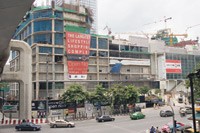
BANGKOK — Thai faith in the power of retailing has not been shaken by a slowing economy or recent outbreaks of bird flu.
CentralWorld, billed as the largest shopping center in Southeast Asia, just opened its doors to an economy plagued with rising inflation, higher gas prices, reduced consumer spending and political uncertainty. Recent reports of bird flu deaths also pose a threat to the health of retailing.
At almost 6 million square feet, with more than 500 stores, 16 cinemas and more than 50 restaurants, CentralWorld is still under construction and expected to be completed by the end of the year. It cost the country’s biggest retail company, Central Group, $2.6 billion.
Just 60 percent of the shops are operating. The mall’s opening on July 21 came eight months after a 5.4 million-square-foot mall, Siam Paragon, opened right next door.
CentralWorld also includes an additional 1 million-square-foot five-star hotel, a 183,000-square-foot convention center and an 861,000-square-foot 45-story office building. Total project area, including the retail space, is 8 million square feet.
Annual rent per square foot ranges from about $28 to $112, according to Promruck Limsodsai, vice president of marketing for CentralWorld. The center, anchored by Zen, a Central Group-owned department store, and Isetan, a Japanese department store, is aimed at the “yo-cos,” or young cosmopolitans, said Wallaya Chirathivat, executive vice president of business development for Central Pattana Public Co. Ltd., in an interview. Central Pattana is controlled by Central Group.
“Our shopping center is targeting the mass market, and provides a real shopping experience,” she said, in a not-so-subtle swipe at the upscale Siam Paragon, which lurks outside her 33rd-floor window. Siam Paragon, with its designer boutiques and luxury shops, is geared toward high-end shoppers, and has been criticized for attracting huge crowds of Thais and tourists who do more strolling than shopping.
“The economy goes up and down,” Chirathivat said. “We are investing for the long term, and our returns are longer than other industries.” Noting that there are no mass layoffs in Thailand, banks are not closing and that the local currency, the baht, has not been devalued, Chirathivat acknowledged that growth is “not as we expected, but it’s not that bad, either.”
Related Articles
You May Also Like
Inflation hovers around 6 percent and is blamed on higher world crude oil prices. Consumer confidence, according to the Bank of Thailand, slipped for the sixth month in June to the lowest level in more than four years. Economic growth is expected to slow to as little as 3 percent in the second half of the year.
Thailand’s government is treading water as April elections were nullified by the nation’s top court for being undemocratic and unconstitutional. Thailand has no working legislature and only a caretaker government under Prime Minister Thaksin Shinawatra. Elections have been rescheduled for October.
Bird flu also threatens the local economy. The number of suspected human cases is more than 150 and the most recent fatality, as of press time, occurred on Aug. 3. The last weekend in July, the government slaughtered 300,000 fowl in provinces along the Thailand-Laos border. It is considering activating a mobile unit to test for bird flu in the region, and health officials have been put on high alert.
On Aug. 3, the Thailand Hotels Association warned that if the government doesn’t resolve the spread of bird flu before peak tourism season begins in October, the economy could suffer.
CentralWorld and Siam Paragon are banking on tourist expenditures in addition to locals to turn a profit. The malls tower over the Sky Train, and stretch along Bangkok’s central retail corridor, which is ringed by four- and five-star hotels. While the train stop at Siam Paragon is one of the busiest stations on the system, there is no stop for CentralWorld, as it is between stations.
Kriengsak Tantiphipop, chief operating officer of Siam Paragon Development Co., said the absence of a Sky Train stop could hurt the new megamall. CentralWorld shoppers will be forced to walk several blocks on the sky walk in Bangkok’s heat, which dips into the 90s in winter.
Tantiphipop does not view CentralWorld as a threat to his luxury center, where he said shoppers spend on average $125 per visit. “We have a different target market,” he said in a telephone interview. He declined to say whether visitors have reached the 100,000 daily target, but noted, “Traffic is increasing every day.” He questioned whether CentralWorld could keep prices low, given the high cost of doing business downtown.
CentralWorld expects 54.7 million visitors in its first year, translating into 100,000 local shoppers and 50,000 foreign tourists daily. Mall officials project locals will spend from $50 to $75 a visit, while international guests are expected to spend $100 per shopping trip.
Given the current economic downturn and the bird flu threat, Bangkok retail analyst Suttatip Peerasub, with Kim Eng Securities, said luxury brands and high-end retailing are in the most jeopardy.
“Premium retailing could be hurt,” she said. “Retailers that offer good prices should still do well.” Peerasub does not foresee improvements in Thailand’s economy until 2007, but warned that a resolution of the current political and health problems must be resolved for that to happen.
CentralWorld is designed to attract the Asian market, Chirathivat said. To attract Chinese travelers, CentralWorld has agreed to accept the China Union Pay credit card, which has 800 million cards in circulation, she said.
CentralWorld is also being positioned to appeal to young consumers, and Thailand’s large ex-patriot community, Chirathivat noted. The department store Zen appeals more to a young crowd and the renovated unit here will cover 538,000 square feet over seven floors. A spa, fitness center, yoga and beauty center, public library and tourist center will be included on another six floors. Isetan, which has not closed during the massive renovation, covers 292,000 square feet.
Flagships to be opened include Marks & Spencer, Liz Claiborne, Zara, MNG, Massimo Dutti, Miss Sixty, Sasch, Timberland, CK Jeans, Castro, G-Star Raw, Lee X Line, Louis Feraud and Next. Other stores include: the Spanish shoe brand Camper, the Australian clothier Country Road, Ted Baker men’s and women’s apparel from the United Kingdom, Izzue and 5cm teenage fashions from Hong Kong and Raoul, a Singapore clothing label.
Other retailers in CentralWorld are SuperSports; PowerBuy, selling consumer electronics and featuring a Karaoke room where shoppers can record their own CDs; B2S bookstore; SB Furniture, and Toys ‘R’ Us.
CentralWorld was designed by Los Angeles architects Altoon+Porter, the team behind the Las Vegas Fashion Show Mall. Like the Las Vegas mall, CentralWorld also features a retractable runway for fashion presentations.
Even long-term, Central Retail Group is not intimidated by Thailand’s economic, political or health threats. It plans 10 more shopping centers by 2010. One of the biggest is a 2.1 million-square-foot mall expected to open in 2010 in Bangkok. Chirathivat declined to say where in the city it is planned. Already this year, the Central Group bought almost five acres from the British Embassy in Bangkok’s prime business district. It also is a finalist in the bidding for almost 60 acres that houses a night market in the downtown area.