
ZURICH, Switzerland — How do you capture the borderless consumer?
That question was at the center of discussions at the 2016 Global Department Store Summit, which gathered retail executives in Zurich last week.
Titled “Delighting Global Travelers at Home & Away,” the gathering heard that tourist numbers are rising but travel patterns are shifting all the time, buffeted by factors as diverse as currency devaluations, slowing economies, oil price swings, the U.S. presidential elections, the Brexit referendum and the Zika virus.
Stephen Sadove, principal at Stephen Sadove and Associates and former chairman and chief executive officer of Saks Fifth Avenue, said retailers need to be well-informed to keep pace.
Related Articles
“The consumer has perfect information relative to the pricing of goods,” he noted. “I guarantee you that with all of this cross-border shopping, if we’re not cognizant of what’s happening on the cross-border pricing, we’re dead.”
You May Also Like
The number of tourists traveling the world is set to grow by 43 million per year on average between now and 2030, according to the United Nations World Tourism Organization.
The Chinese remained the world’s top spenders in 2015, with expenditure rising 25 percent to $292 billion, said Yolanda Perdomo, director of the UNWTO Affiliate Members Program. Chinese travelers accounted for 24 percent of worldwide tourism receipts, she added.
Dai Bin, president of China Tourism Academy, said the number of outbound visits from China is set to increase to 200 million by 2020 from 120 million in 2015, with many Chinese people traveling abroad more than once a year.
While shopping accounts for 45 percent of their travel budget on average, Chinese shoppers are becoming more discerning, he noted.
“Tourists will shop more often but spend less per trip, as they develop an appetite for local brands and tier-two and tier-three brands with best price value,” Bin said in his presentation.
“Another trend is the shift of shopping venues from boutiques, factory stores, duty-free stores and outlets in suburban areas to department stores, electronics and household appliance retailers, community shops, convenience stores and even wet markets for locals,” he added.
Chinese tourists are not the only ones whose buying patterns are shifting. Panelists detailed solutions for capturing highly mobile, channel-hopping consumers in the digital age. They included store renovations; use of big data; social media outreach, and a locally tailored product offer.
“The reality is, in recent years the global retail landscape has become boring. There is very little to discover or explore in another country that you’ve not already seen online or in a store near you,” argued Anne Pitcher, managing director of Selfridges. She suggested this could be an opportunity for department stores to stand out.
“Our point of view is our point of difference,” she said. “This local point of view is particularly significant at the moment. We know that people are beginning to prefer to buy from brands in the country in which they originate. Over 60 percent of global shoppers now prefer to buy British brands in Britain, for example.”
Selfridges has opted for initiatives that reflect its identity, including a gender-neutral concept space launched last year. The retailer won the GDSS Award for World’s Best Sustainability/CSR Campaign by a Department Store for its “Buying Better, Inspiring Change” campaign.
RELATED STORY: Selfridges Wins Sustainability Award at Global Department Store Summit >>
The prizes, handed out at a dinner on May 26, also distinguished Harvey Nichols for World’s Best Store Window Campaign at a Department Store for its “Avoid Gift Face” holiday campaign. La Rinascente was crowned Best Department Store in the World.
“Stay true to yourself. Do not conform to the order of the day. Do not try to be all things to all people. Be brave, celebrate your differences and amplify your point of view,” Pitcher recommended.
“Be real, not virtual. The antidote to the faceless digital world is the human touch. Play to the strengths of your bricks-and-mortar and connect with people at a human level,” she added.
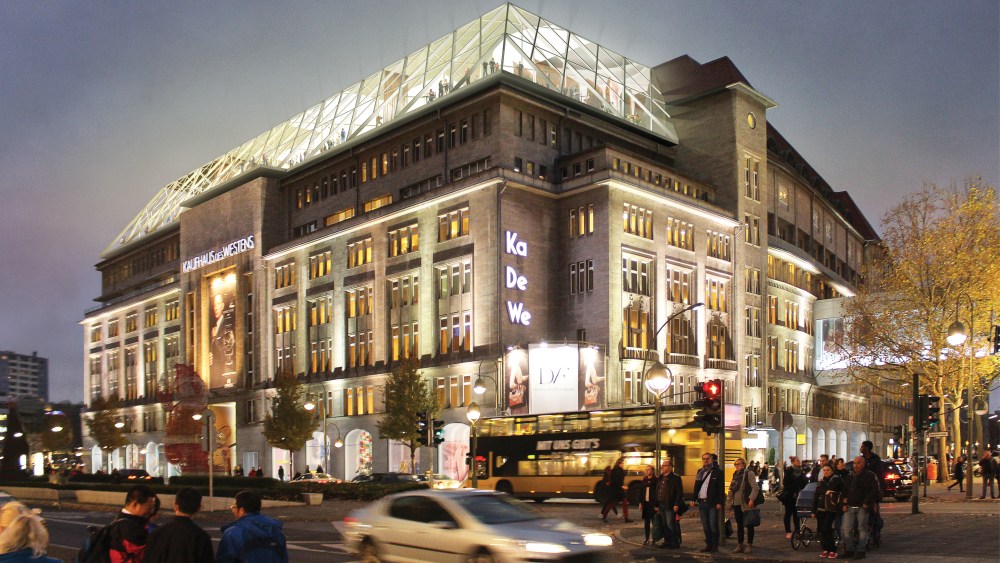
André Maeder, chief executive officer of KaDeWe premium department store group, agreed.
“I’m very happy to hear that local is the key, because for us, that’s absolutely the pièce de résistance. We want to be a local store, to attract visitors from around the world, absolutely, but we want our stores to be something special for our customers who live in our cities,” he said.
“Everything in store has its own DNA. We buy separately for every single store,” Maeder added.
Its three locations — KaDeWe in Berlin, Alsterhaus in Hamburg and Oberpollinger in Munich — have launched renovations that are expected to cost between 300 million euros and 400 million euros, or $334 million to $445 million at current exchange.
KaDeWe in April hosted a live photo shoot with British photographer Rankin for members of the public. His portraits of Berliners now adorn a temporary wall surrounding the store as it undergoes renovation by Dutch architect Rem Koolhaas.
“We have to be special and we have to do things nobody expects,” said Maeder. “We don’t sell products. We sell experience, we sell entertainment, atmosphere and memories. We offer nothing that you really need, but we offer lifestyle and great moments. The point of sale was yesterday. The point of excitement is the future.”
Frédéric de Narp, ceo of Swiss shoemaker Bally, says it has leveraged events on digital channels in order to reach a younger clientele. For example, a Periscope takeover by fashion blogger Bryanboy during the fall women’s wear presentation in Milan last February won Bally 9,000 new fans in three hours, the executive said.
“One client needs to be reached out to by the same brand on different devices and with different contents. This is what we call ATAWAD: Anytime, Anywhere, Any Device — and that’s a revolution in the way we think in luxury goods,” De Narp said.
Georges Kern, ceo of Swiss watchmaker IWC, said brands needed intellectual flexibility to constantly adapt.
“Today, you have to become an entertainment company. You create content digitally on all your content areas every day all the time. We have calculated that we post 55,000 times a year,” he said.
Daniel Grieder, ceo of Tommy Hilfiger, noted it has seen tangible benefits from digital campaigns conducted with tennis star Rafael Nadal and model Gigi Hadid (the latter collaborated on a capsule collection for the brand.)
“Gigi Hadid had a halo effect on the overall women’s business, improving selling across the entire category. We actually increased our women’s sales by more than 35 percent sell-in in the season, which is phenomenal,” he divulged.
Tommy Hilfiger plans to unveil a new store concept, including a digital café with connected tables, in London this fall.
“In today’s society, 50 percent of the in-store sales are influenced by digital interactions and up to 35 percent of the fashion consumers rely on recommendations from social networks,” Grieder said. “To be successful in the digital world, you need to increase the speed in everything you do.”
Australian retailer Myer has gone one step further, partnering with eBay on what it dubbed the world’s first virtual reality department store. Using a headset and a dedicated app, it allows shoppers to look through thousands of Myer products without leaving home.
Richard Umbers, ceo and managing director of Myer Holdings, said digital was also at the heart of its New Myer turnaround plan unveiled last September.
“Customer-centricity is a plan to deliver a leading omnichannel offer. The word is misleading though. It implies that it’s about channels,” Umbers said. “Don’t talk omnichannel, don’t talk physical retail — think about a mash-up of physical and digital. It’s called ‘new retail.’”
He described combining the physical and digital to create new in-store products, such as the Myer Hub, which groups traditional services such as gift registry and personal shopping with new options such as online ordering and click-and-collect.
“It’s not technology for its own sake. It’s technology in the service of service, technology to bring customer service to life, technology to reinforce the competitive advantage of what department stores are all about. That’s what physical-digital is all about,” he argued.
Other participants said retailers need to be open to new destinations and formats. Kern at IWC noted that 65 percent of sales in the luxury industry are non-domestic.
“Duty-free travel will be a huge element of growth,” he predicted. “Travel increases, but flows are changing rapidly, so we need also mobile concepts which are following the customers in malls, or in hotels, or in exhibition areas.”
Michele Norsa, the outgoing ceo of Salvatore Ferragamo, noted traffic in some traditional luxury hubs was falling, while secondary locations were overperforming. “All of a sudden, cities which were not ranked in the top cities, like Mexico City and Sydney, are becoming incredibly interesting,” he said.
Ferragamo has opened stores in Phuket, Thailand; and Siem Reap, Cambodia. “The Chinese travelers are extending their traveling inside China, but also in new destinations in Asia, and we have to be fast enough to follow our consumers,” Norsa explained. “We have to be ready and we have to be curious.”