
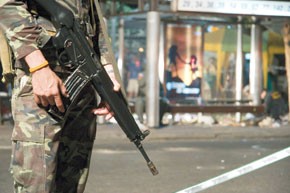
BANGKOK — Retailers are mounting aggressive marketing campaigns to restore consumer confidence, and one major mall is reaching out to a younger clientele to recover from New Year’s Eve bombings that have kept shoppers away from Bangkok’s glittering shopping centers.
Retail sales for 2007 are down 10 to 20 percent from 2006 and are slowly recovering from the bombings that resulted in a drop of almost 40 percent in retail sales in early January, according to Thanapon Tangkanan, president of the Thai Retailers Association.
Kitti Nathisuwan, an analyst at Macquarie Securities, said consumer confidence in Thailand was at a seven-year low. While it hasn’t dropped as low as it was during the 1997 Asian economic crisis, it’s getting uncomfortably close to that low point, Nathisuwan added.
“The economic catalyst needed is successful political reform,” Nathisuwan said.
Thailand’s military overthrew its democratically elected government in September, and martial law was in place until it was lifted by the king on Jan. 26. Military leaders initially promised to hold elections within a year, but that deadline has since passed. The government has also blundered on some economic decisions that have spooked foreign investors. In December, it unexpectedly announced changes in foreign investment controls that shook the Thai stock market, and it’s now considering other changes in foreign investment that could force massive restructuring of foreign companies operating in Thailand. Changes in retailing laws also are under consideration (see page 10).
The accompanying jolts in the Thai economy could push Thailand’s gross domestic product growth rate below 4.5 percent this year, said Vikas Kawatra, an analyst at Kim Eng Securities. At that rate, it could slow the market’s ability to absorb the more than 12 million square feet of retail space that has been added in the past two years.
“If the economy improves and starts to grow at least 7 percent to 8 percent a year, it will take two years for all of these shops to start making money,” he said.
Kawatra said Bangkok’s retail market is close to overcapacity and that there isn’t room for any more major retailers.
“American retailers looked at coming here, but decided it wasn’t attractive enough,” Kawatra said. “Retailers in Bangkok are relying on tourist shoppers and that won’t happen in the short term. People aren’t rushing to these new malls just because there are more shops to visit.”
Related Articles
You May Also Like
Nathisuwan noted that it was the luxury retailing market that was particularly “overcrowded.”
To restore consumer confidence that it’s safe to return to Bangkok’s shopping centers, retailers have on average increased their spending on security by 20 percent, said Tangkanan of the Thai Retailers Association. Vehicles entering mall parking lots are searched, more security is in place in stores and some malls have set up checkpoints at entrances to check consumer’s bags. Also, because many of the New Year’s bombs were dropped in trash bins, malls have removed bins or are using transparent ones that make it more difficult to hide explosives.
“It will take a few months, but confidence will come back,” said Tangkanan, adding that shoppers were spending less time in malls, and that cinemas and mall restaurants also were hurting.
At Gaysorn, a luxury shopping center that sits at the Ratchaprasong intersection in the midst of Bangkok’s shopping district, the retail mix has been shifted and almost $4 million has been budgeted for a 2007 marketing campaign aimed at youth, said Satima Tanabe, marketing director of G.S. Management Co., which runs Gaysorn.
“We are expanding our market,” Tanabe said, noting that Gaysorn’s traffic was down almost 20 percent since the New Year’s bombings and a separate Jan. 3 bomb threat at the mall.
While the center has traditionally appealed to older shoppers, she said demographics were changing.
“We need to rejuvenate the center,” Tanabe said. “We need to improve our merchandising lines. It’s a global strategy for luxury brands to offer affordable luxuries, like I-Pod cases, and we need to synchronize our strategy with theirs.”
Retailers at Gaysorn include Burberry, Celine, Christian Dior, Christian Lacroix, Emilio Pucci, Emporio Armani, Fendi, Givenchy, Lacoste, Louis Vuitton, MaxMara, Moschino, Prada, Salvatore Ferragamo and the Thai designers Greyhound, Fly Now, Sarit and Sretsis.
While cars entering the mall garage are checked, shoppers’ bags aren’t, she said. Also, surveillance cameras have been installed and security checks are conducted every other day, she said.
At the nearby upscale Siam Paragon, sales are down 10 percent, said chief operating officer Kriengsak Tantiphipop. The bombings seem to have kept Thais from the malls, but tourist traffic has not declined, he said.
“We’re confident that in the next two months everything will be settled down,” he said. “After some period, people will return and business will be back on track.”
Siam Paragon has boosted its security force by 30 percent and has spent $500,000 on new security equipment such as bomb blankets that can be thrown over suspicious packages, Tantiphipop said. Promotions at Siam Paragon this year will shift from building the mall’s image to boosting sales. Also efforts will be made to assure customers that the mall is safe and more attention will be given to individual shoppers.
“We’re telling them that they’re special people and we’ll look after them,” he said.
At Central Pattana, the largest retailer in Thailand, weekend traffic was returning to normal but weekday traffic was down, said Nattakit Tangpoonsinthana, executive president of marketing. Overall, he said business was still down about 8 percent. Central Chidlom, the centerpiece of Central Pattana, is offering end-of-year discounts of 30 to 90 percent through February to bring shoppers back.
Tangpoonsinthana also said much of retailers’ recovery depended on government action and political stability. He said the mid-January arrest of 19 suspects in the bombings would help retailers’ recovery. However, police subsequently released all the suspects for lack of evidence.
“In the near future, if the government can handle this crisis, Thai people will come back,” he said.
Tangpoonsinthana also said Central Pattana did not view the retail market as saturated and was planning to open four malls across the country in 2007.
“We’re expanding,” he said. “People still need to shop.”