
After ringing in the New Year with some of the heaviest rainfall in California’s recorded history, cautious retailers here may have reason to take a second look in their crystal balls when predicting their fortunes for 2005.
The Los Angeles area was hit with an unprecedented 17 inches of rain during the first two weeks of the year, causing mudslides, destruction of homes and at least 20 deaths — and all this after a drought that persisted for seven years.
And like the deluge on the heels of the drought, the retailing climate in California has also been one of extremes: Luxury and better specialty stores have been flourishing along with the growth of mass-market retailers like Wal-Mart and Sears, while players in the middle of the market continue to struggle to regain their footing after significant declines.
The challenge for retailers in the upcoming year will be to distinguish themselves in a climate accustomed to such dramatic opposites. Yet despite such global uncertainties as the tsunami disaster in South Asia and the war in Iraq, economists are surprisingly bullish about the future of the state’s retailers for the year ahead.
“This [past] year was the best [for economic gains] since 2000,” said Howard Roth, chief economist at the California Department of Finance. “And 2005 will consolidate the gains we made this year.”
Roth said that he expects it to be a particularly good year for retailers that are already on track, because personal income growth improved in the state as well as taxable income sales, which grew at a rate of about 6 percent. He is projecting that 2005 will be similar.
Blue Skies
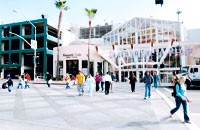
Like few other places in the U.S., Golden State mall-goers should be advised to wear sunscreen in the winter, as typically warm temperatures and a high number of “lifestyle centers” — malls that mix large department stores with smaller retailers in an al fresco setting — are turning shopping into a peculiar (for Californians) outdoor activity.
Lifestyle centers have been edging out traditional malls and will continue to do so in the coming years, said Patrice Duker, spokeswoman for the International Council of Shopping Centers. Only about 20 traditional malls were built in 2004.
Related Articles
You May Also Like
“We’re expecting to see double-digit growth in that format at least through 2007,” she said.
Key to the popularity of lifestyle centers is their relatively compact size. At an average of about 150,000 to 500,000 square feet, compared with the 400,000 to 799,999 square feet for traditional regional malls, these structures are not only more economical but often more charming than their regional mall cousins.
Strip malls — generally lacking in the aesthetics department — continue to seduce customers from all economic brackets with the addition of superstore concepts.
Wal-Mart opened three Supercenters in the state this past year, and the company has said it wants to build 40 more in California over the next few years. It may not be so easy, however. The Bentonville, Ark., giant has come under fire from state residents who say the 200,000-square-foot Supercenters, which combine a traditional Wal-Mart store with a supermarket, hurt small businesses and that the retailer pays unfair wages, causes more crime and traffic and discriminates against women. Last April, voters in the Los Angeles suburb of Inglewood rejected a ballot initiative that would have allowed construction of a 60-acre Wal-Mart.
Yet, it’s still full steam ahead for the world’s largest retailer in 2005, said Wal-Mart spokesman Pete Kanelos. “We’re still on track for the openings.”
But the company might be facing competition from the opening of Sears Grand locations — a similar superstore concept that offers convenience and household merchandise to rival Wal-Mart’s selection. The first California location opened last fall in Rancho Cucamonga, and Sears is testing the waters to determine how many more can be supported.
Mostly Sunny
California’s fabled image as a mecca for the young, beautiful and affluent — that shows like “The O.C.” and “Desperate Housewives” continue to propagate — is a theme that luxury retailers have been exploiting. Though Rodeo Drive continues to thrive, other areas have long been giving the tony shopping street a run for its bling.
“It’s all about luxury,” said Debra Gunn Downing, a spokeswoman for the South Coast Plaza mall in Costa Mesa, Calif., which saw its best year and best Christmas season ever in 2004. “We draw from a radius of about 100 miles, so we get shoppers from Santa Barbara, San Diego and Los Angeles.”
Barneys New York is scheduled to open its first mall-based Co-op location in March there. South Coast already counts Gucci, Ralph Lauren and Jimmy Choo among its tenants. Sources familiar with real estate in Los Angeles said Barneys has also scouted for Co-ops at or near the seaside Third Street Promenade shopping area in Santa Monica.
A hotly anticipated opening on Rodeo Drive is Roberto Cavalli, set to bow in mid-February. The street has undergone an $18 million renovation that widened sidewalks, improved lighting and replaced aging fichus trees with leafy palms, and has seen the addition of new flagships from Prada, Louis Vuitton and most recently, Bally.
“Demand is strong, inventory is low and pricing is firm,” said Chuck Dembo of Dembo & Associates, a Beverly Hills-based real estate firm that handles numerous commercial leases on Rodeo and the surrounding areas. “There is a lot of demand for the 2,000- to 3,000-square-foot spaces and fewer tenants willing to take 5,000 to 7,000 square feet.”
Some of those would-be tenants are flocking a couple of miles west to Los Angeles’ Melrose Place, a quiet side promenade off Melrose Avenue. Tracy Feith and Marc Jacobs are among them, with Jacobs’ store slated to open in March. His accessories store opened on Melrose Place in November.
Among the biggest coming attractions in California retail are in the Inland Empire and downtown Los Angeles, said Jack Kyser, chief economist at the Los Angeles County Economic Development Corporation.
The Inland Empire, a sprawling, loosely defined area east of Los Angeles that includes Riverside and San Bernardino Counties, is expected to build on its lead over Orange County in sales, with $40.12 billion in taxable retail sales projected for 2005, up from $35.7 billion in 2004. Orange County’s sales in 2004 were $35.3 billion, and projections for 2005 are $38.2 billion.
“You have rapid population growth, and it’s still relatively untapped territory for major retailers,” said Kyser. “The problem is that the size [of the area] overwhelms them.”
The issue downtown isn’t size — but rather awareness that an affluent market exists. Sources familiar with downtown Los Angeles development said, according to a survey that went out to nearly 3,000 housing units, the median household income for the area is about $90,000. It is a neighborhood in transition, with many buildings being converted into high-end residential lofts.
“Whoever gets their foot in the door first there is going to be very well rewarded,” said Kyser.
Partly Cloudy
The luxury market isn’t as hot in the coastal climate of Northern California, which has been reeling from the financial chill that set in around 2000 when the dot-com boom went bust. The region has been the state’s slowest to recover from the recession of the early 2000s, and the San Jose metropolitan area has lost more than 230,000 jobs.
“Northern California will largely determine how good a year 2005 will be,” said economist Roth. “They will be contributing to job growth next year, but the big unknown is how many of the high-tech jobs will come back.”
Job losses are narrowing somewhat. In 2003, the San Jose Metropolitan area, the center of Silicon Valley, lost 31,000 jobs. In 2004, it lost 10,000 jobs.
The employment losses have translated to slower growth than hoped for in key retail areas such as San Francisco’s Union Square, said Linda Mjellem, executive director of the Union Square Association. “The commercial vacancy left over from the dot-com collapse has left fewer shoppers with the income to shop downtown,” she said.
Some areas are looking up, however. Several stores have either opened or expanded in the Union Square area, notably Burberry, which remodeled and expanded its Post Street location last fall. Two of the most anticipated openings include the first West Coast location of H&M, which will bow in late 2005, and a Bloomingdale’s in the San Francisco Center mall, which currently houses a Nordstrom.
The LAEDC’s Kyser is particularly baffled, however, at the H&M opening.
“Why is H&M coming to San Francisco and not where the real action is?” he asked. “San Francisco County had $7.8 billion in taxable retail sales in 2003 versus Los Angeles County’s $79.4 billion. Yes, San Francisco has a city center and is more glamorous, but the south is really the seat of business.”
Storm Coverage
Middle-market retailers are the ones who will be challenged most in 2005, said Kyser, who has dubbed them “me-too” retailers. They include Mervyn’s, Robinsons-May and Macy’s,and are distinguished by a lack of compelling fashion options or tantalizing price points.
While Macy’s West chief executive Robert Mettler would not, for obvious reasons, list Macy’s among the me-too’s, he agreed that presenting a strong point of view to the customer is key.
“I think distinguishing yourself in the right channel is absolutely crucial to having a resonance with the core customer. And we have to give them a better reason to shop with us.”
Mettler said he is more intent than ever on pulling in a younger, more trend-conscious customer. “I think young is going to lead the way now, particularly young contemporary, where denim continues to be a highlight.”
Although the me-too’s have taken a beating, it has rained acid on California’s juniors’ retailers, some of which have been juggling top-level management shake-ups while simultaneously trying to hit the right mark with fickle teens.
Wet Seal and Hot Topic are refocusing their efforts in the coming year on courting their core customers back into stores through fresher, more on-trend merchandise.
Foothill Ranch, Calif.,-based Wet Seal announced in December a new chief executive officer, Joel Waller, will take the helm in February to help resuscitate the troubled company. In August, Wet Seal posted a loss of $102.8 million for the second quarter. Sources have said that the company is looking to provide on-trend fashion at rock-bottom prices on a par with teen retailer Forever 21.
Similarly, Hot Topic, the City Of Industry, Calif.,-based teen chain, reported a December comp-store sales decrease of 6.2 percent over a 10.1 percent increase last year. The retailer, which made a name as a purveyor of trendy rock ’n’ roll and punk looks for teens, may be suffering from the return to softer, more feminine looks, analysts said.
Hot Topic ceo Betsy McLaughlin indicated that the company might be poised to crawl out of its also-ran status, saying that it is indeed possible to address the trends in a way that is relevant to the company’s core consumer.
“The more feminine look is actually applicable to us,” said Mclaughlin at this month’s ICR XChange retail conference in Carlsbad, Calif. “But not frilly feminine. More romantic feminine.”
Like all the struggling retailers, Mclaughlin is hoping that if the sky falls again on Hot Topic in 2005, it’ll be raining money.