
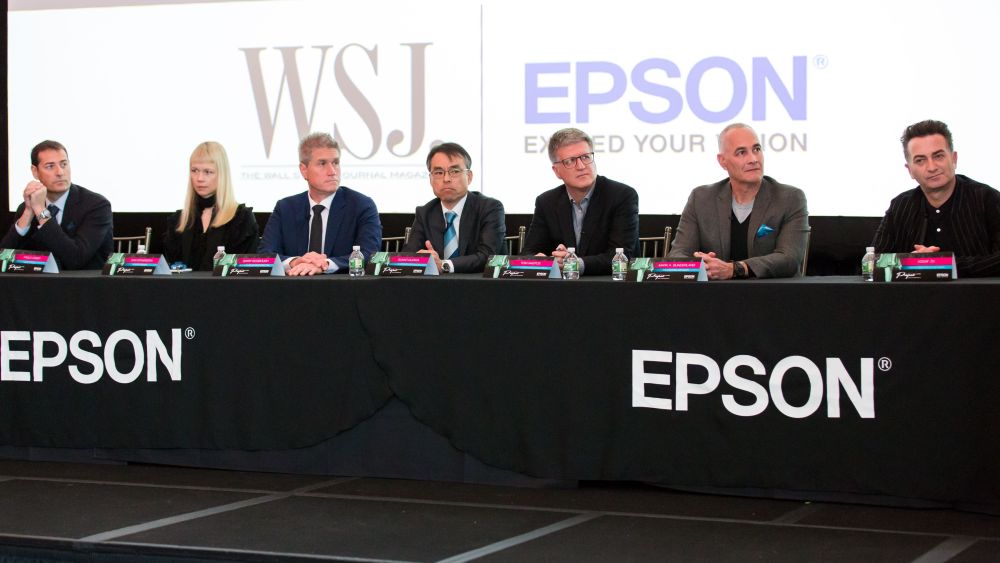
Epson Manufacturing, a printing, imaging and technology services company hosted a panel this week with Wall Street Journal vice president Anthony Cenname to discuss the role of technology in the fashion and retail industry.
The primary takeaway was that across the product life cycle and supply chain, technology will help fashion brands and retailers thrive in a more complex, competitive market.
The panel was comprised of designer Erin Fetherston of her namesake line; Assaf Ziv of Elie Tahari; Barry McGeough, group vice president at Innovation Next of PVH; Mark Sunderland of Philadelphia University; Tom Nastos, president of women’s fashion at UBM Americas; Paolo Crespi, commercial director of Fortex-Textile Solutions Centers at Robustelli/Epson Italy, and Sunao Murata, chief operations officer of pro printing operation division at Seiko Epson Corporation.
Related Articles
The topics centered on the panel members’ perspective and experiences with the benefits and drawbacks of technology within their specific sectors of the market. Indicative of the industry at large, the panel was a divisive set with opinions on how technology is pushing manufacturing forward while challenging creative integrity to remain unblemished in the face of obstacles to capture consumers’ attention.
You May Also Like
The underlying issue, however, was the shift in the market to one dictated by socially savvy and self-informed shoppers who hungrily devour trends and products at an increasingly rapid rate.
The discussion kicked off on how technology continues to cause the most disruption in certain sectors. McGeough said, “When you think of what technology has meant for the supply chain, for the consumer online experience, see-now-buy-now, the need for immediate gratification — the iPhone-ization of our industry — technology has affected the market through the retail experience. We’re looking into what’s happening with artificial intelligence and machine-learning.”
Retailers are gridlocked on how to navigate avid e-commerce shoppers and a cooling in-store customer presence — some like Macy’s have shuttered hundreds of locations, while others such as H&M have aimed to open 400 stores recently.
When compared to PVH — the parent company of Calvin Klein and Tommy Hilfiger — Erin Fetherston’s operation is near mom-and-pop scale. But this doesn’t mean that technology’s significance is any smaller — quite the opposite. It’s alleviated time spent on inspiration trips and streamlined inventory production for more accurate fulfillment for retailers and direct-to-consumer sales.
“It’s changed the way we do business and connect with our customer. I feel that our customers’ demand and expectation has set the bar high. When the expectation of see-now-buy-now becomes the norm, we have to look at how we can do everything faster, that’s where technology has become our greatest aid,” said Fetherston. “It’s very much affected the inspiration phase of the process for better and for worse. I spend a lot of time on devices looking at images. When I think back to 2005, you didn’t have Pinterest or Instagram, you didn’t have these huge databases for visual research so you had to go about it in a different way. Sometimes I miss having more live experiences.”
In order to meet hastening consumer demands, supply chains need to be as agile as possible. Crespi said that processes of cutting and printing that once took up to three weeks now take only four days with the implementation of digital programs. “There are new possibilities, it gives designers the possibilities to create something new and bring something new to the market,” added Crespi.
This in turn allows for fluid creativity on a smaller scale, regardless of the size of the brand. “From the design perspective we’re looking at design tools in a different way. We’re moving from two-dimensional world to three-dimension to four-dimensional world. We’re looking at the digitization of manufacturing. We’re able to make smaller collections and more capsule collections,” said McGeough.
Despite some obvious hesitation among some of the panel members to share their true opinions on technology’s influence on the industry — it was sponsored by Epson, after all — it was clear that brands and retailers are slowly waking from the conviction that technology is not a dreaded investment, but in fact the only way to survive the shrinking market.