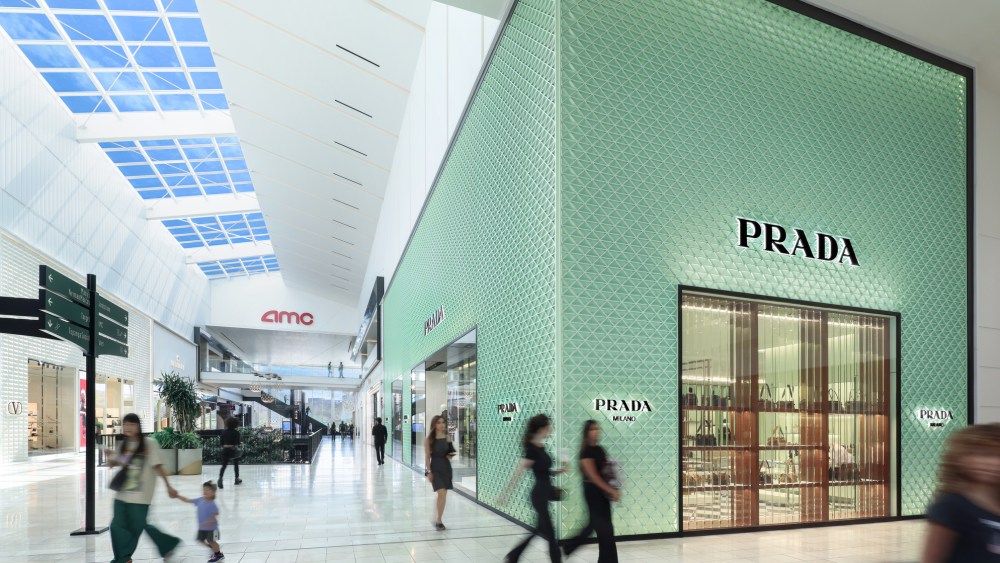
Take another look at Westfield Topanga.
Within the sprawling, 1.6 million-square-foot shopping center, located in the San Fernando Valley in Los Angeles, there’s been an impressive, multiyear buildup of luxury and high-end brands, bringing in Prada in September, and earlier this year, Dolce & Gabbana, Rolex, Camilla, Mejuri, Vuori, Kendra Scott, Good American, Coach, Rothy’s, and FP Movement.
Within the past three years, 16 luxury houses have opened, bringing the total to 30, including Hermès, Dior, Valentino, Saint Laurent, Tiffany & Co., Versace, Louis Vuitton, Gucci, Ferragamo, Christian Dior, Celine, Bottega Veneta, Cartier, Bulgari and Balenciaga.
Related Articles
Adding to the luxury appeal are two of the center’s four department store anchors, Nordstrom and Neiman Marcus. Macy’s and Target are the other two anchor tenants, and the mall does house many better-to-moderate priced brands such as Uniqlo, Abercrombie & Fitch, Aritzia, Zara, Foot Locker, Gap, H&M, Lego, Lululemon, Victoria’s Secret and Tommy Bahama.
You May Also Like
“Luxury has existed in Westfield Topanga for the last 18 years, with just a handful of luxury tenants. But over the last couple of years post-COVID, we’ve been able to triple the number of luxury stores,” Colin Shaughnessy, executive vice president, director of leasing in the U.S., for Unibail-Rodamco Westfield, told WWD.

The development of a $200 million, 200,000-square-foot, three-level wing, converted from a former Sears, and Westfield’s ability to invest more in the sector in the wake of divesting “low-tier” properties over the last decade and a half, have spurred the luxury buildup. Westfield once had over 70 properties in the U.S. and is currently down to 15.
In 2018, Unibail-Rodamco completed its acquisition of Westfield, becoming Unibail-Rodamco Westfield. The company operates 66 shopping centers in 11 countries, including 40 that carry the Westfield branding. Along with Westfield Topanga, Westfield Century City in Los Angeles, Westfield Valley Fair in Silicon Valley, Westfield Garden State Plaza in New Jersey, and Westfield World Trade Center in lower Manhattan are among URW’s key centers in the U.S.
The wing, which opened to the public a couple of years ago, houses luxury brands on its second level with a valet drop-off, food and beverage on one, and a cinema on three.
“We didn’t just put a gym in, or a Dick’s Sporting Goods. We tore Sears down and built brand new,” Shaughnessy said. “So today, when you show up at Topanga, you’ve got some of the most sought-after luxury brands in the world. Hermès and Dior are right at the front door.” Down the escalator to the middle of the shopping center are additional luxury brands.
Shaughnessy said the $200 million or so spent to create the luxury wing is “a lot of money when you’re talking about just replacing one department store, but fortunately, we got some commitments from some really great luxury partners early on. Hermès was one of the first to commit to the project and see the vision. And then it all started to follow from there.”
The $200 million was just for the construction of the wing by Westfield. The build-out of stores by the retailers and some other aspects of the development would have added costs.
“In 2019, before COVID, we had just torn the building down, and we had some some serious internal debates on, do we pause, or do we keep going with the uncertainty of COVID? We made the decision to keep going, and we were able to start opening things up in 2020, late 2021 and 2022, took a couple years to get through the whole project,” said Shaughnessy. “From conception to total opening, it took a decade, from when we purchased the Sears box, to getting the final plan down to what we have landed with today.”
Westfield Topanga is situated in the Warner Center district where billionaire Stan Kroenke is developing residential, hospitality and entertainment components and a new headquarters and practice facilities for the Los Angeles Rams football team, which will bring more people, brands and other businesses to the area. The area, Shaughnessy said, “is not as sexy or as fancy as Beverly Hills, Hollywood or the west side of Los Angeles, but you’ve had a mass proliferation of people and wealth, as well as a lot of the ‘who’s who’ in L.A. moving to the valley over the last decade.
“Fortunately for us, we sit at the epicenter of everything happening in the valley. The traffic and the market share has pivoted towards Topanga over the last five years in a major way, post-COVID. The brands have seen that, and they’ve decided to open up.”
Along with the 30 luxury openings in the past three years, another 30 or so other retailers and restaurants opened during that period.
He said Westfield Topanga has evolved into the second-largest luxury collection in Los Angeles, behind Beverly Hills, and that the regional mall pulls from a 50-mile radius including such markets as Calabasas, Malibu, Ventura and Santa Barbara.
“Beverly Hills is a very unique shopping experience, and it’s not necessarily for everybody,” Shaughnessy maintained. “So what Topanga provides is that second [luxury] outlet for everybody north of the west side coming down into L.A.” Some key competition comes from Simon’s Beverly Center, and The Grove, owned by Rick Caruso.
Westfield Topanga generates close to $800 million in total sales, Shaughnessy said. “How do we grow this to become the next billion-dollar asset in this country. That’s our aspiration. I think we could hit $1 billion in gross sales in the next five years. There are very few billion-dollar destinations, but Topanga has that ability based upon the market it resides in.”
According to information provided by the center, the mall draws 13.4 million visits annually, with an average of eight visits a customer each year.
Westfield’s strategy, as Shaughnessy put it, “of only holding on to the best assets in the best markets is winning and taking market share from competitors.”
In the L.A. market, aside from its Topanga mall, Unibail-Rodamco Westfield has three shopping centers — Westfield Century City, Westfield Culver City, and Westfield Fashion Square. “Sales are up at all four of them, while I know there are other assets in L.A. where traffic and sales are down,” said Shaughnessy. “So we feel fortunate. If we were having to focus on 70 shopping centers still today, we would have probably an equal number of winners and losers. But right now, because we’re only focused on our flagships, we can put enough attention into them where they’re able to take a meaningful chunk of the marketplace and battle through online retailing that started occurring a little more than a decade ago.”