
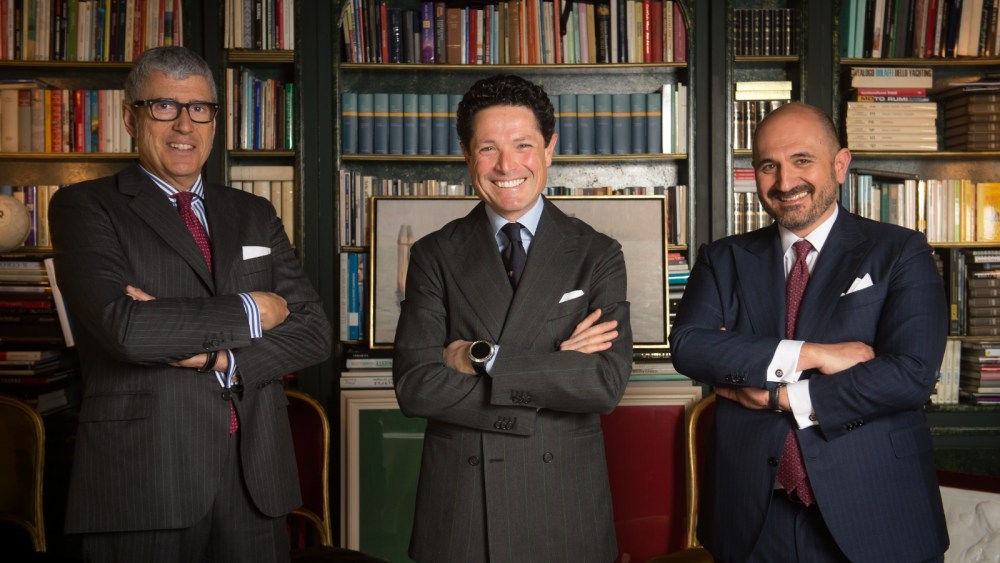
MILAN — Matteo Marzotto believes “beauty will save the world.”
In his efforts to protect a number of Italian manufacturers that help create apparel and accessories for leading global luxury brands, the entrepreneur is investing in a new project, a holding company called Minerva Hub.
The group was presented on Thursday by Marzotto and his partners — Franco Prestigiacomo, chief executive officer and founding partner of Xenon Private Equity, and Gianfranco Piras, president of XPP Seven.
Minerva Hub stems from the fusion of XPP Seven and Ambria Holding, which Marzotto formed last year, as reported, taking majority stakes in Italian companies Zeta Catene and Galvanica Formelli, both located in the Arezzo, Tuscany area. Zeta Catene produces more than 2,000 types of chains of different shapes, sizes and materials, such as brass and silver, as accessories for bags and shoes. Galvanica Formelli offers metal details, components and galvanic treatments for fashion accessories.
Related Articles
XPP Seven was founded in 2019, and grew to comprise Koverlux (based outside Bergamo); Quake (near Vicenza); Sp Plast Creating (Fermo), and Zuma Pelli Pregiate (Pisa). Koverlux is a leader in surface finishing for the fashion and accessories business, touted by Marzotto as the only company able to apply multiple finishes, from lacquering to flocking or engraving, to a single object. Quake is a specialist in automatic embroideries; SP Plast deals with the transformation of plastic materials, mold design and construction and product engineering, and Zuma is a tannery specialized in precious hides.
You May Also Like
Xenon, which Marzotto praised for having an industrial vision, was the “catalyst,” he said, and will have a majority stake in the holding, headquartered in Milan.
“This is the first time a brand is set up to offer its service to the best Italian know how and creativity, in an effort to avoid the dispersion of the skills built over generations that, on the contrary, we want to enhance and consolidate for the future,” contended Marzotto proudly.
Aggregating the activities of the above mentioned six companies, Minerva Hub has sales of more than 101 million euros, a portfolio of around 1,000 clients and 434 direct employees.
The first goal is to coordinate, integrate and strengthen the activities of these companies to supply top quality products and excellent service, explained Marzotto.
“This is a clear industrial project, to offer a platform that delivers strong artisanal and technological skills integrated with more efficient and flexible production processes, becoming an acceleration of an expansive and modern network of integrated companies.”
The companies under the Minerva Hub umbrella mainly work with the fashion and luxury industries, but also with the design, sportswear, cosmetics, jewelry and automotive sectors.
Prestigiacomo said three potential additional acquisitions are in the pipeline to be completed by the end of the year. While he declined to provide a figure for the initial investment in forming Minerva Hub, he said it was “almost equivalent to the holding’s sales.” He also underscored that Xenon, conversely to most private equity funds, operates within “an extremely long time frame” and exit strategy. “We will continue to invest until we can grow the industrial project.”
“Italy has missed the opportunity to consolidate the luxury brands in fashion poles, but its know how has remained unparalleled and Italian artisans and manufacturers find the best solutions to the creative ideas of the brands’ designers. We are here to support the artisans with a more solid, structured and sophisticated organization,” continued Prestigiacomo. He noted that the founders of the companies aggregated under the Minerva Hub umbrella all reinvested in the holding, becoming partners. “They realized we could offer more prospects, more focus and more managerial skills.”
Marzotto said investments will be made to support the artisans in ESG projects to become more sustainable, to trademark new products and to buy new machines, “concretely responding” to the current challenges in terms of innovation, production efficiency and competitiveness. Minerva Hub has also initiated a training project, he revealed. “We are investing in the protection of the skills that need to be passed on to the new generations. We have started an academy within three of the six companies and we will extend the project to all of them. We need to give continuity and this will be done through the help of the artisans with the most experience and outside consultants.”
Piras said a first meeting with Marzotto to propose a deal was held at the Hotel Minerva in Arezzo, hence the name of the holding, but also because Minerva was the goddess of handicrafts, the professions and the arts in ancient Rome. “We reached out to see if there was an interest in joining forces to become problem solvers for the brands,” he said. He touted the uniqueness of the holding, as he contended that other groups that have been formed to support the Italian pipeline did so by “vertically integrating,” while Minerva Hub cross-pollinates across the board, “responding to requests from different sectors.”
He said Minerva Hub will leverage the expertise of Marzotto, named president, as well as that of Marco Casone, who is taking on the role of chief executive officer. Marzotto and Casoni, a former Dondup and Marni executive, have worked together for years, first at Valentino and then at Vionnet. Marzotto is a former investor in Vionnet and Dondup and, before that, he was chairman of Valentino.
There has been brisk M&A activity in Italy’s supply chain, further triggered by the impact of COVID-19, and much of it meant to support the know-how and craftsmanship of the country’s fashion pipeline.
Earlier this month Brunello Cucinelli bought a 43 percent stake of Cariaggi Lanificio SpA, its longtime cashmere supplier.
Last year, the Prada and Ermenegildo Zegna groups joined forces to acquire a majority stake in Filati Biagioli Modesto SpA, which specializes in the production of cashmere and other precious yarns, sharing the goal to ensure continuity of the excellence of the company and to develop their own Made in Italy production chain.
It is similar to the rationale behind Gruppo Florence, the luxury production pole established in 2020 by industry veteran Francesco Trapani through private equity fund VAM Investments together with Fondo Italiano d’Investimento and Italmobiliare. The goal is to supply high-quality Made in Italy products to major luxury fashion brands by acquiring family-owned Italian SMEs.