
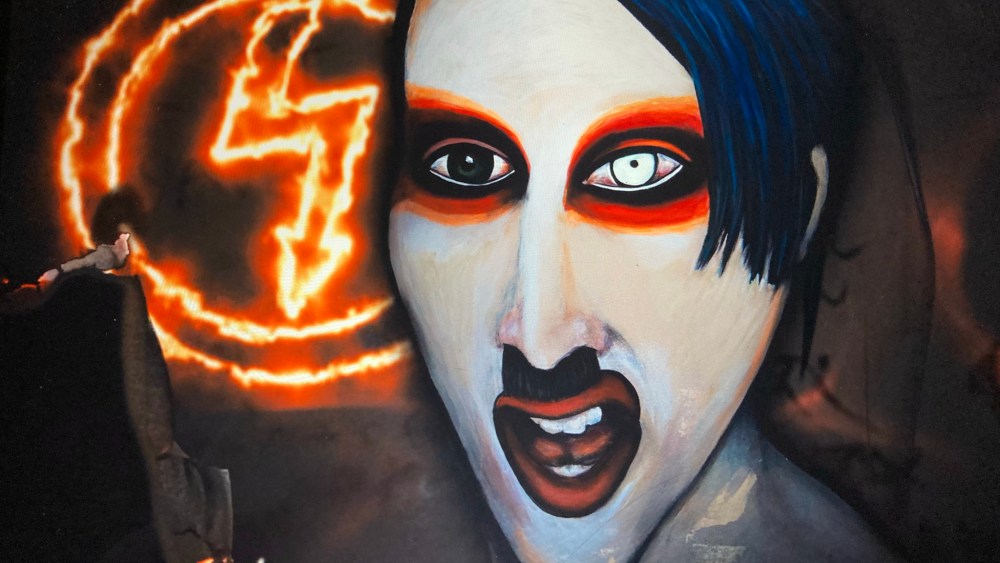
Many know Marc Bouwer as a fashion designer and now more are learning that he is also an artist.
Viewers of the two-part HBO series “Phoenix Rising” can find paintings of Marilyn Manson done by Bouwer that have been animated. The documentary’s producer and director Amy Berg, who is a friend and neighbor, enlisted Bouwer after seeing some of the portraits he had painted.
Already working with an Italian illustrator, Nicoletta Ceccoli, who created a fairy-tale feel for the Evan Rachel Wood imagery, Berg suggested that Bouwer’s darker, handsome art would fit the Manson side, the designer said. The series follows actress, activist and domestic violence survivor Wood as she coauthored and lobbied successfully for The Phoenix Act, legislation that extends the statute of limitations for domestic violence cases in California from three years to five years. It was signed into California state law in 2019. “Phoenix Rising” also chronicles how first as an 18-year-old, Wood became involved in a relationship with the-then 37-year-old Brian Warner, who is more commonly known as Marilyn Manson. Their relationship ended after four years and last year Wood publicly claimed that he was her abuser.
Related Articles
Warner has not faced any charges and he has denied abusing Wood or any other person.
You May Also Like
In an interview, Bouwer said beyond the opportunity to use his art, the project means a lot to him due to his own experience of sexual abuse in the South African Army during compulsory training in the 1970s.
“Obviously I was familiar with who Marilyn Manson was and his image was familiar to me. But I really did not know that much about him. When Amy gave me the details about what the film was going to be about, I was absolutely shocked and horrified at the stuff that was alleged in the series,” Bouwer said. “Then I became even more interested.”
HBO hired the designer to create portraits of Manson in various incarnations. Bouwer noted how Manson was heavily influenced by Marilyn Monroe, Charles Manson and David Bowie “with the painted face and the duality of a combined male-female persona.” He first did a painting of Warner as a young, handsome man with long dark hair that was later photographed. He then slowly painted on that image a series of different incarnations “right up until the strange, threatening person that he has become,” Bouwer claimed. The designer also created new paintings of him with different expressions and makeup.
Although he has painted pictures throughout his life, such serious portraiture for a professional endeavor was a first. Using bright colors including neon ones on a dark background, Bouwer said he didn’t want to paint Manson exactly as he is, preferring to take aspects of Manson and infuse them with his artistic style. An animator then incorporated the paintings into animation that was used in the film.
Bouwer studied art at the Johannesburg School of Art, Ballet and Music and had planned to build on that at a university. “Unfortunately, I had to go into the South African Army, because it was compulsory then at 17 years old. All males at that age were in the late ’70s. It was a horrifying experience for me and it really changed my life dramatically. It also made me want to leave South Africa. But that’s a whole other story,” he said.
(It will also be detailed in a book about Bouwer’s life that is in the works.)
One of the silver linings of the pandemic shutdown was that Bouwer had time to return to his roots and his love of painting — completing 30 pieces not including the Manson ones. An exhibition is in the works, although the fashion designer is now immersed in his next collection. “As soon as I get a breather, I’m going to finish the paintings that I have. It’s not a tremendous amount of work to finish them, but they need finishing,” he said. “Being involved with this project with HBO, has given me a step up into the art world. Hopefully, good things will come from this. But it’s the start of my career as an artist even though I’ve been an artist for many years. Now the public will see me besides a fashion designer, an artist as well.”
When COVID-19 restrictions and closings meant that there was nowhere to go beyond walking outdoors, Bouwer spent much of his time painting and found that to be very therapeutic. With an apartment near The Whitney Museum of American Art, he found 36-inch x 28-inch canvases on a regular basis that had been thrown out and repurposed them. When buying canvases new became easier, he did that, too.