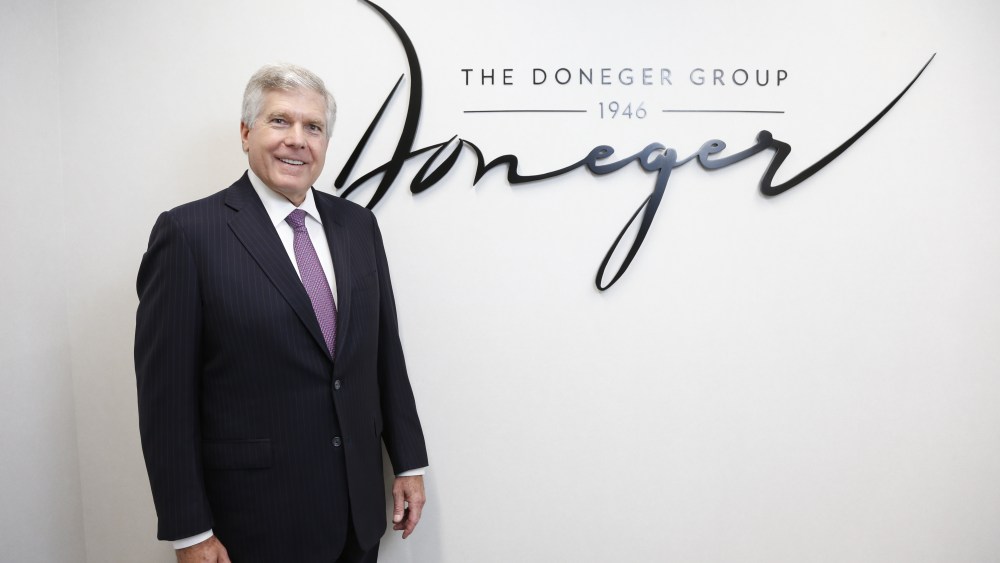
At The Doneger Group, there’s expertise in branding, design, fashion, stores, consumer culture and even a nose for trends two to five years out into the future.
Then there’s another area of proficiency that Abbey Doneger, chief executive officer of the firm bearing his name, doesn’t often discuss — the secret sauce of business longevity. But with the company celebrating 75 years in business, it’s just the right moment.
“My father used to say to me, ‘If you have good people, provide a good service and good information, you have a good business.’ That was his philosophy,” said Doneger. “I think we’ve done a great job of operating that way. We have a great mix of experienced professionals and people in the early stages of their career who are inquisitive and innovative. It’s the talent, the research that we do, and the method of delivery to our clients — that’s the mix,” Doneger said.
Related Articles

You May Also Like
He’s sitting in his office at 463 Seventh Avenue, along with his top two lieutenants, Leslie Ghize, executive vice president, and Tom Burns, senior vice president, where the research, consulting, trend and merchandising firm has been located for 31 years. In November 2020, the company relocated within the building from a 24,000-square-foot space to an 8,000-square-foot space that’s compact, contemporary and better suited for meetings with employees and clients.
Though the company is still formally named The Doneger Group, there is a new red logo on the entrance — TobeTDG by The Doneger Group. It conveys a rebranding of the business and its focus on creative consumer insights, which Doneger described as “a response to COVID-19 and analyzing our business needs.” The ability to evolve the business is another ingredient in the firm’s longevity.
Abbey’s father, the late Henry Doneger, founded the company in 1946 as a traditional fashion buying office, a format that’s virtually extinct now. Organizing group buys for retailers to save them money was a big part of the program but that revenue stream dried up when it became hard to get retailers to collaborate.
In 1973, at age 22, Abbey joined the firm as an entry-level assistant. He became president in 1980 and officially CEO after his father passed in 1995.
“By 1985, I was really active making the decisions to drive the company forward,” said Doneger. “Through the years we grew through acquisition. We acquired over 20 companies,” mostly competitors with the same buying office concept. “This was a time in my career where I was driven to grow the size and scale of the company and number of people in the company. Those acquisitions added talent, expanded services and added clients, and contributed to the financial picture. Today, we are actually in different kinds of business activities.”
In the first quarter this year, the firm became a minority partner in Brand Assembly, founded by its CEO Hillary France. Brand Assembly runs trade events in New York and Los Angeles for contemporary lifestyle brands and supports them in areas such as operations, logistics and marketing. Doneger called the deal “synergistic,” pointing to his company’s office in L.A. where there is a concentration of denim and contemporary brands.
In Q2 this year, Doneger formed an association (without making an investment) with Jennifer Powell Inc., an independent boutique talent agency that represents fashion and lifestyle influencers and specializes in branding strategies. Through the Powell agency and its pool of talent, Doneger has begun bringing influencers to his clients, and he connects his clients with the agency.
“I see opportunities for growth that may come in a different forms from what has been our historical acquisitions,” said Doneger. Though Doneger Group has moved to smaller digs, there’s apparently still room to grow the business. Doneger said he’s open to “collaborative relationships synergistic to our overall business and that provide opportunities for our clients. It has to be the right business with the right people. Hillary has an interesting business and she is the right person for us. Jennifer has an interesting business and she is the right person for us.”
In 2005, the Doneger firm bought Tobe, another well-known consulting organization that published “The Tobe Report” on fashion trends. It was founded in 1927.
“Leslie and the team repositioned Tobe eight years ago,” said Doneger. “With that, we really spread our wings into classifications and different businesses — real estate, entertainment, consumer products company, food and beverage, home, hospitality, toys, sporting goods, financial services. We work with clients in these industries. Leslie has spent a good amount of time in the last 90 days talking with two major toy companies. We’ve done projects for them. Apparel is still key but we are opening up our world. Not everyone is aware of that yet.”
“Leading with consumer intel and consumer insights is the grounding for everything we are doing,” said Ghize. “That’s our big shift. We are trying to really help our clients understand we are in a consumer-first environment.
“For the next two to five years, the narrative is of an independent consumer,” said Ghize. “They’re trusting their gut more. They’re exiting ‘group think.’ They’re crafting their own beliefs and ideology and that gives them the courage and fortification to evaluate what to invest in, who they do business with, what they support and what they participate in. That comes from a groundswell of anticapitalism we see in a much younger generation. In the end, it’s less materialistic, more thoughtful consumption. They kind of want it all. They want a real comfortable work-life balance. They want to be paid well. They want flexibility, and they have a very high level of social and environmental consciousness.”
The firm communicates with clients in various ways. “We send out one great idea a day to all our clients and that great idea is an observation, a great new brand, or a creative direction,” said Ghize. Collectively, those become a “portal” to generating reports at least 12 times a year, covering the sectors TobeTDG delves into. Reports get distributed and discussed with clients, and lead to an annual “a big consumer sweep” including two- to five-year projections on consumer behavior and interests, explained Ghize.
“The core capabilities of the company for many years have been on the creative and merchandising side. Those are still equally important buckets in the range of services we offer, but they are transformed for a more modern, commercial landscape. We’re not doing trends and merchandising based on the parameters of the industry or seasonal parameters. We are doing trends and merchandising based on the consumer cadence. Our core competencies now are consumer insights, business strategy, creative direction and merchandising,” said Ghize.
In 2010, Doneger sold the company to employees through an employee stock ownership plan, or ESOP. There’s currently a team of 35 primarily involved in research and reporting, as well as an art director and graphic designers for the website, special projects, custom work, marketing collateral and presentations.
“We’re also in the trenches, interacting with brands and retailers, visiting showrooms, attending fashion shows, and traveling to corporate offices of vendors and retail clients and visiting their stores,” said Burns. “This is happening all the time, at all different levels, from the C-suite to the gmm and dmm levels down to the buyers and assistant buyers. It’s very high touch.” Projects could involve tackling a big picture issue, such as helping a company understand their target customer, or expanding into new categories. The group also helps clients finesse store environments or identify things like sweet spots in pricing, emerging brands or the important colors for the season. “They want an opinion from us. We identify opportunities and look for fresh new ideas for our brand and retail clients,” said Burns.
Doneger acknowledged the client base has undergone some consolidating and is primarily in the Western Hemisphere. “It was happening pre-COVID-19 but COVID-19 accelerated that,” he said. He declined to mention any clients, citing confidentiality agreements.
“I learned a long time ago as CEO it’s not my job to be right. It’s my job to be effective, which means I’ve got to make tough decisions,” said Doneger. “Being effective means that you’ve got to have great people. Being effective means relationships matter, integrity matters, hard work and good core values matter. How we conduct ourselves through the years matter. It’s all of this stuff that contributes to the success of the company and I think it’s the difference between companies that make it and those that don’t during critical times.
The 70-year-old Doneger made clear he has no thoughts of retirement, though he did say, “The opportunity and challenge for us is to think about what the future looks like in terms of the team and leaders in the business. That is something we will be focused on.”
TobeTDG: Trends to Watch:
- “Workleisure,” a more put-together version of athleisure bridging the work-from-home, return-to-office gap.
- The “simple life” takes businesses to rural and suburban settings, e.g. Harrods opens a beauty store in Essex; Tory Burch shows in upstate New York.
- Consumers turn to pain-relieving slow movement-based training.
- Beautifying home exercise spaces: gym equipment resembles furniture; dumbbells resemble marble art objects.
- Pet market opportunities, such as additives to pet food.
- “Six-feet sports” where people play together but at a distance from each other, like pickleball.
- Wellness suites in hotels feature Peloton bikes, Bowflex weights and interactive Mirror systems.
- Studio space availability, e.g. Vans transforms empty storefronts and facilities for livestreaming.
- Maximizing home space, e.g. Kelly Wearstler turns the alcove under the stairs into a home bar; Hello Wood in Budapest designs custom cabins for backyards for WFH.
- Materialism increasingly questioned; antiquity overrides newness, old abandoned buildings convert to stores or hotels.