
NEW YORK — Can “america” beat the odds and become the first fashion-lifestyle magazine to make a successful dual-gender appeal to twentysomething readers?
The upstart title will take a crack at it, starting in February, with an oversize glossy, gold-leafed publication, majority-financed by hip-hop impresario Damon Dash and aimed at young adults with median household incomes of $147,000 annually, or more than twice the $54,000 averaged by magazine readers overall, based on data from the Magazine Publishers of America.
“We’re marrying entertainment with high fashion for a multicultural audience who will be seeing the films, hearing the music and wearing the clothes we’ll portray — the first generation to grow up with hip-hop culture,” said Smokey D. Fontaine, founder and editor in chief of america, which is set to begin quarterly publication on Feb. 1 with its spring 2004 issue. The publishing schedule will coincide with the fashion runway shows here and in Europe.
Related Articles
The magazine is counting on its glossy, 70-pound, 10-inch by 12-inch stock, bound between 100-pound glossy covers, to differentiate it with a luxurious appeal. Roughly 55 percent of america’s readers are projected to be women; 27 is their estimated median age.
You May Also Like
If america is to survive, however, it will need to attract a much larger share of women readers, predicted magazine industry expert Samir Husni. “They will need to get 70 to 80 percent of their readership from women,” Husni advised. “Very few lifestyle magazines aimed at both genders have made it, unless they are mass titles, like Vanity Fair.”
Otherwise, Husni reasoned, “Why wouldn’t Lucky magazine be catering to both women and men? Why would [Lucky publisher] Condé Nast be launching Cargo for men and Details be starting Vitals? It has always been an uphill battle to make the twentysomething male and female happy with the same magazine,” he recounted. “We know there’s nothing like [america], but sometimes you have to ask yourself why there isn’t. Either they’re geniuses or there’s no need for it.”
(Details is owned by WWD parent company Fairchild Publications, a unit of Advance Publications, which also owns Condé Nast.)
“We’re aiming at people who are eager not to live as segregated a life [by gender or race] as their parents did,” noted Fontaine, 32, a former music editor at The Source, whose parents named him after Motown legend Smokey Robinson. “I am part of this culture that has grown up with all forms of entertainment — from music videos to video games — and the marketing dominance of all things,” added the London-born son of an African-American father and British mother, who emigrated to New York’s Upper West Side with his family at age six.
The magazine anticipates launching with a rate base of 40,000 in the U.S. and another 10,000 abroad, said publisher Jeff Jones, former associate publisher at The Source. “Our goal is to reach circulation of 100,000 by yearend 2004.” Circulation will be controlled as the magazine will be available free in stores, spas, hotels, night clubs, galleries, film and music festivals, fashion shows, cafes and restaurants. Single copies will be sold on newsstands and in airports in New York, Miami, Chicago, Los Angeles and San Francisco and on newsstands in Rome, Milan, Paris, London and Tokyo. The magazine will be sold for $8 in the U.S., 4.95 pounds in London, 6.9 euros in Paris and Milan and about 900 yen in Tokyo.
During his days at The Source, Fontaine met Dash, and over the course of a half-dozen years, Dash encouraged him to start a magazine of his own. When inspiration struck Fontaine, the pair fashioned a limited partnership in which Dash, chief executive officer of Roc-A-Fella Records, Roc-A-Fella Films and Rocawear, signed on as america’s principal backer while ceding creative control to the magazine’s staff. “Damon has made a four-year commitment, and we expect to break even by then,” Fontaine said.
In addition, Dash revealed he aims to start up one or two other magazines, including a lifestyle title for men (“I like what Maxim’s doing”), also under the umbrella of the limited partnership, tentatively named Dash Publications.
Fontaine and Dash declined to specify their investment in america, but Husni estimated it will take at least $1.5 million to $2 million a year, in cash, to keep the quarterly afloat for the first eight issues. “Sixty percent of start-ups don’t make it after the first year; only 20 percent make it after four years and 10 percent make it after 10 years,” said Husni, a journalism professor at the University of Mississippi. “There are 919 start-ups this year, with a month still to go. People no longer think in terms of starting a lifestyle magazine with a life span of Playboy or Good Housekeeping or W [WWD’s sister publication].”
“It is easier than ever to launch a magazine, but harder than ever to stay in business,” Husni added, alluding to the economic pressures that outweigh the relative ease of desktop publishing. The 919 titles launched in the first 11 months of 2003 mark a 35 percent surge over the 681 launched in the first 11 months of 2002 and a 23 percent hop over the 745 launched in all of 2002, according to Husni.
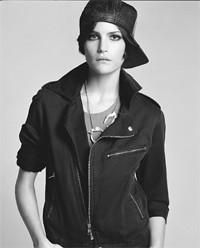
America’s plans for fashion coverage also are ambitious, encompassing new and well-known photographers and models, whose work will be shown in lengthy features, such as a 16-page essay slated for the premiere edition. Photographed by Michael Sanders, it will portray a diverse group of American-born models, selected to reflect similarities and differences in the nation’s faces. Among them: Erin Wasson, Susan Eldridge, Jessica White, Jessica Miller, Valerie Prince, Missy Rayder and Amanda Moore.
Fashion photographers whose work will be shown in the magazine, Fontaine said, include Terry Richardson, Bruce Weber, Steven Klein, David LaChapelle and Ellen Von Unwerth. A typical issue will carry four or five fashion stories and move from designer labels like Gucci and Prada, to urban brands like Sean Jean and Rocawear — but only if Fontaine and fashion director Heathermary Jackson, a celebrity stylist and former fashion editor at The Face, decide to show Dash’s apparel, Dash assured.
“If I notice from a distance that Smokey’s doing something corny,” Dash offered, “I might say something.”