
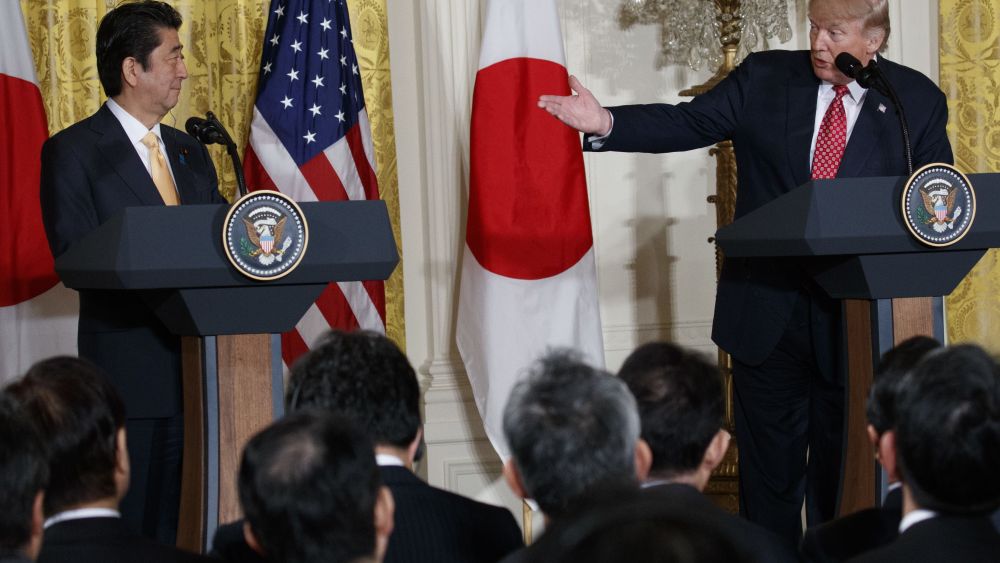
WASHINGTON — President Trump and Japanese Prime Minister Shinzo Abe stressed the importance of expanding the trade relationship between the two countries at a joint press conference Friday, announcing the launch of an economic dialogue in support of that goal.
While the two leaders talked about free and fair trade, they stopped short of announcing specifically that they are intent on launching bilateral trade negotiations.
Trump also touched on his approach to the other big player in Asia — China — and said the U.S. will continue seeking a level playing field when it comes to currency devaluation, which China has been accused of engaging in to gain an advantage over U.S. producers.
Related Articles
“To further deepen our bilateral economic relations…there will be a cross-sectoral dialogue to be held and we have agreed on this,” Abe said through an interpreter, noting that it will be conducted by Vice President Mike Pence and Japanese Deputy Prime Minister Taro Aso. “I am quite optimistic that good results will be seen from the dialogue.”
You May Also Like
“Furthermore, in Asia-Pacific, where we see dramatic growth to expand free trade and investment, this will be a big chance for both Japan and the United States, but of course it must be done in a fair manner,” Abe added.
Trump said in his opening remarks that the U.S. will “seek a trading relationship that is free, fair and reciprocal, benefiting both of our countries.”
The trade relationship between Japan and other Asia-Pacific countries was upended somewhat by Trump’s decision to withdraw the U.S. from the 12-nation Trans-Pacific Partnership trade pact that had been a cornerstone of President Obama’s administration.
Trade ministers signed TPP in February 2016. It included the U.S., Australia, Japan, Mexico, Canada, Vietnam, Malaysia, Peru, Singapore, Chile, Brunei and New Zealand and aimed to remove barriers to trade to encompass nearly 40 percent of the world’s gross domestic product if enacted.
But Trump railed against it on the campaign trail, saying the pact did not include enough for American workers and companies and vowed to pull the U.S. out of it. Once in office, he followed through on that pledge and signed an executive order formally withdrawing the U.S. from TPP.
Trump administration officials have said they plan to explore strengthening relations with countries that were part of the TPP and will consider bilateral trade agreements.
Abe was asked at the press conference if he felt it was a mistake for the U.S. to withdraw from TPP and whether it weakened America’s position in Asia.
“On TPP, of course we are fully aware of President Trump’s decision,” Abe said. “For the free and fair common set of rules to be created for the free-trade regime in the region, that was the purpose of TPP,” Abe said. “That importance has not changed.”
In a joint statement released by the White House after a lunch, the two leaders said they “reaffirmed the importance of both deepening their trade and investment relations and of their continued efforts in promoting trade, economic growth and high standards throughout the Asia-Pacific region.”
“Toward this end, and noting that the United States has withdrawn from the Trans-Pacific Partnership, the leaders pledged to explore how best to accomplish these shared objectives. This will include discussions between the United States and Japan on a bilateral framework, as well as Japan continuing to advance regional progress on the basis of existing initiatives,” they said in the statement.
Trump was asked about the U.S. role in Asia and approach to China, including the currency devaluations by China, something he railed against on the campaign trail.
Trump said he had a long conversation with Chinese President Xi Jinping on Thursday, in which he reaffirmed the U.S. support of a “one-China” policy that was seen as soothing tensions with China.
“I had a very good conversation yesterday with the President of China,” Trump said. “It was a very warm conversation. I think we are on the process of getting along very well. I think that will also be much to the benefit of Japan. As far as currency devaluations, I have been complaining about that for a long time. I believe we will all eventually, and probably very much sooner than a lot of people understand or think, we will be all on a level playing field.”
Trump has pledged to label China a currency manipulator for devaluing the yuan to gain an unfair competitive advantage over U.S. producers. Such a designation would trigger consultations at the World Trade Organization and could lead to sanctions.
“That is the only way you can fairly compete in trade and other things,” Trump said. “We will be on that field and we will all be working very hard to do great for our county. It has to be fair and we will make it fair.”
Trump also proclaimed the U.S. will be an “even bigger” player than it currently is in the global trade arena. “A lot of that will have to do with our tax policy,” he said, noting it will be an “incentive-based” policy.
One controversial component of the tax plan being developed by House Republicans is a “border adjustability tax” which would essentially tax the value of imports but not the U.S. exports.
But Trump did not allude to such a tax at the press conference.