
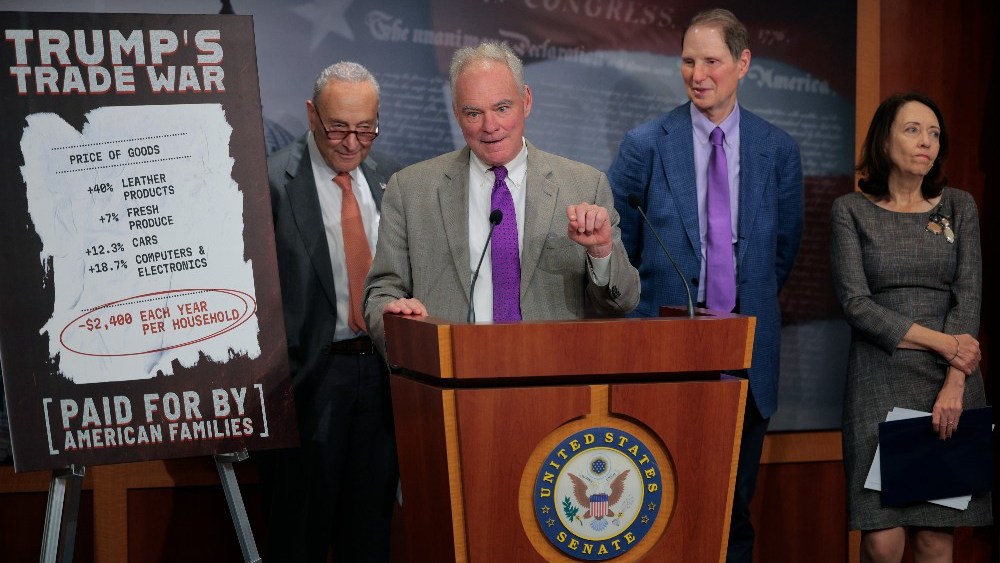
The Senate has voted to halt President Donald Trump’s steep tariffs on Brazil, with some members of the GOP breaking with the administration to terminate the 50 percent duties.
Senators voted 52-48 against the tariffs, which Trump imposed using the International Emergency Economic Powers Act (IEEPA).
Republican Senators including Thom Tillis (N.C.), Susan Collins (Maine), Lisa Murkowski (Alaska), Mitch McConnell (Ky.) and Rand Paul (Ky.), who co-sponsored the measure alongside Ranking Member of the Senate Foreign Relations Committee Tim Kaine (D-Va.), joined Democrats in opposing the tariffs.
You May Also Like
Related Articles
Sens. Kaine, Jeanne Shaheen (D-N.H.), Senate Minority Leader Chuck Schumer (D-N.Y.) and Ron Wyden (D-Ore.) announced their intention to take on the tariffs in July, claiming that they represent an act of retaliation by Trump against Brazil’s prosecution of its former president, Jair Bolsonaro, for attempting to orchestrate a coup after losing his seat in the country’s most recent election. This week at the ASEAN Summit, Bolsonaro successor President Luiz Inácio Lula da Silva met with Trump to explain the seriousness of the plot, which he said included a threat on his life, according to Reuters.
Trump’s tariff policy is causing material harms to Americans, the lawmakers argued, as the U.S. imports over $40 billion in goods like coffee, agricultural products, oils, metals and machinery. Bilateral trade between the two countries is responsible for 130,000 American jobs.
Trump’s reasoning for imposing the tariffs is not linked to a trade imbalance, as he’s claimed with so many U.S. trade partners, including those across Asia and Europe. The U.S. exported $49.7 billion to Brazil in 2024, while Brazilian imports into the U.S. amounted to $42.3 billion — a surplus of $7.4 billion for the U.S.
“Are we just going to allow the trade power which is handed to Congress, or the war power which is handed to Congress, or the appropriations power which is handed to Congress, or the nominations advice and consent power which is handed to the Senate — are we just going to allow those powers to be taken over by this president or any president?” Kaine said to reporters on Tuesday.
“Emergencies are like war, famine, tornadoes,” Paul, the most outspoken anti-tariff senator in the GOP, added. “Not liking someone’s tariffs is not an emergency. It’s an abuse of the emergency power and it’s Congress abdicating their traditional role in taxes.”
Even with bipartisan support in the Senate, the resolution, which aims to overturn the so-called national emergency that the president claimed in introducing the tariffs, is unlikely to make it past the Republican-controlled House of Representatives, which has fervently headed off any challenges to the duties.
“I’m grateful that my Senate colleagues voted to pass our bipartisan legislation to undo Trump’s tariffs on billions of dollars’ worth of goods from Brazil,” Kaine said following the vote. “Today’s vote sends an important message to the Trump administration that the American people are not interested in starting unnecessary trade wars that will raise the cost of everyday goods like coffee and weaken our economy.” He urged the House of Representatives to take up the bill.
Though viewed as a largely symbolic vote given its low chance of passage, the resolution’s bipartisan support belies a growing and broadening dissatisfaction with the administration’s trade regime. The five GOP senators who voted against the tariffs bucked a warning from Vice President JD Vance, who stopped by a Republican Senate luncheon on Tuesday to tell them that doing so would be a “big mistake.”
Now, one week ahead of a landmark Supreme Court hearing that could lead to Trump’s IEEPA tariffs being altogether dismantled, a bipartisan collective of Senate lawmakers is preparing to force another vote — this time, taking on the tariffs imposed on Canada.
Sens. Kaine, Paul, Amy Klobuchar (D-Minn.), Mark Warner (D-Va.) and Schumer announced that the Senate will vote Wednesday evening to unwind Trump’s IEEPA duties on America’s neighbor to the north. The legislation already passed the Senate in April with a 51-48 vote, but was not taken up by the House. Now, the legislation requires a simple majority of votes in the Senate in order to pass.
Tensions with Canada have ratcheted up over the past week, with an anti-tariff ad featuring the voice of President Ronald Reagan infuriating Trump enough to impose additional 10 percent duties on the country’s U.S.-bound exports, bringing Canada’s duty burden to 35 percent.
While his policies are under siege at home, the president is continuing his Asia sojourn, which will culminate in a highly anticipated meeting with Chinese President Xi Jinping on Thursday. On Wednesday, he landed in South Korea and met with trade officials, revealing that a deal with the country is “pretty much finalized.”
After meeting with South Korean President Lee Jae Myung on the sidelines of the APEC Summit — the final stop on the five-day trip — Trump said the two “came to a conclusion on a lot of very different items.”
President Lee’s chief of staff, Kim Yong-beom, announced that the U.S. had agreed to lower tariffs on South Korean goods from 25 percent to 15 percent. He said that the two sides had agreed that the U.S. would, in turn, receive investments from South Korea of up to $20 billion annually, with another $150 billion set aside for investment in its U.S-based shipbuilding operations.
A White House fact sheet posted by the president on Truth Social elucidated some of the specific investments the South Korean government had agreed to, but did not speak to or confirm the new tariff terms.