WASHINGTON — What would be the impact of a Trump trade war?
Fashion and retail executives are on edge over the stream of threats from President Trump about slapping tariffs on imports from Mexico and China and the renegotiation of free-trade deals. Many see a doomsday scenario of the New York fashion industry being almost wiped out and numerous retailers going bankrupt.
That is tempered in part by apparel and textile companies that see an opportunity for the Made in America revival of the last few years to gain further momentum.
Whatever the result, major companies are taking no chances and are beginning to speak out against some of Trump’s and the new Republican-controlled Congress’ policies.
Related Articles
On Wednesday, a group of more than 120 fashion firms and retailers — including LVMH Moët Hennessy Louis Vuitton, Gap Inc., Nike Inc., Macy’s Inc., Target Corp, Wal-Mart Stores Inc., Levi Strauss & Co., Neiman Marcus Group and Hudson’s Bay Co. — launched a coalition to fight Congressional efforts to implement a “border adjustment tax“ that could lead to higher retail prices and a new economic burden on consumers.
You May Also Like
The fashion industry has significant exposure to U.S. trade policy, having imported $105.3 billion in apparel and textiles in the year ended Nov. 30.
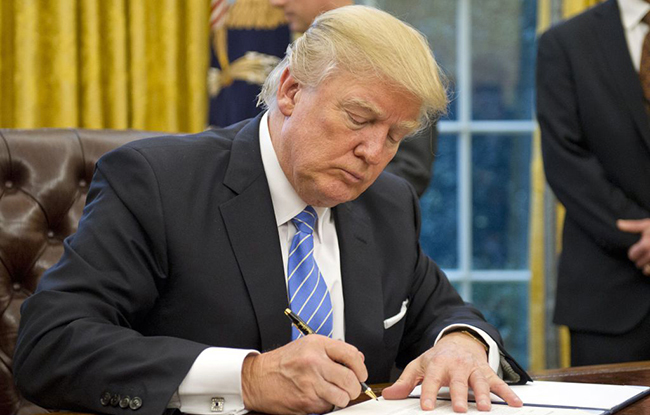
The border tax idea is just one proposal in the new Washington that is creating angst in the industry. President Trump created a dust-up with Mexico — and a potential crisis for companies — last week after he signed an executive order to begin construction on a massive wall along the U.S.-Mexican border and his aides floated the concept of a 20 percent tariff on Mexican imports to pay for the wall. He has also vowed to renegotiate the North American Free Trade agreement between the U.S., Mexico and Canada. The Mexican government said Wednesday that it expects to begin formal talks on renegotiating the pact in May.

“We in America don’t legislate by tweet, we don’t tax by tweet and we don’t tariff by tweet,” said Rick Helfenbein, president and chief executive officer of the American Apparel & Footwear Association.
Those actions, coupled with earlier threats by Trump to impose a 45 percent tariff on imports from China, could put U.S. exports in the direct line of fire.
Rick Helfenbein, president and chief executive officer of the American Apparel & Footwear Association, said, “We in America don’t legislate by tweet, we don’t tax by tweet and we don’t tariff by tweet,” referring to Trump’s penchant for using Twitter to relay his proposals and actions.
Helfenbein said he and AAFA’s executive vice president, Stephen Lamar, have been getting three or four inquires a day since Trump took office from ceo’s expressing concerns over trade policy.
He said a 20 percent tariff on Mexican imports “is a tax on us, not a tax on them.”
“Can you imaging doing a six-month-ago flashback and say, ‘Who’s going to pay for the wall’ and everyone saying ‘Us.’ What we’re missing here is a clear strategy,” he added.
The AAFA is “extremely pro USA” and represents government contractors, he said, noting that while much of the industry infrastructure and foundation has eroded during the import era, it’s not to say “we’re not capable of manufacturing, especially on the textile side.”
“But you can’t turn back the clock so quickly,” Helfenbein added. “Everybody is excited about trying to do more here and creating innovation centers and things that will all help maintain business in America. We still have a textile and yarn business, but the garment assembly business is mostly out of the country, although still in the Western Hemisphere.”
Lamar noted that incoming Commerce Secretary Wilbur Ross was actively involved in negotiations for the Central American Free Trade Agreement when he was chairman of International Textile Group.
“The industry views the Western Hemisphere as one entity,” Lamar said. “Companies look at the constellation of suppliers and markets and they address them using CAFTA and NAFTA, and Columbia and Peru agreement, and opportunities for improving and developing business in the hemisphere that support U.S. jobs in the textile industry and overall supply chain.”
The new coalition fighting the Congressional border tax proposal painted the impact of such a tax in stark terms.
Dubbed “Americans for Affordable Products,” the coalition said it plans to run a national campaign to engage consumers and educate lawmakers about a tax policy that they charge will “result in higher costs for their customers on everyday items including food, gas and clothing [and] is the wrong approach.”
Other retailers and brands signing on to the coalition and effort include Abercrombie & Fitch Co., Kohl’s Corp., Bealls, Chico’s FAS Inc., Clarks, Dillard’s, HSNi, QVC, Ross Stores, Sears Holding Co. and The Bon Ton Stores Inc.
The BAT tax contained in the House Republican tax blueprint proposal released last year would essentially tax the value of imports but not the value of exports.
Companies that currently import products can deduct the cost of the product, including materials and labor costs, when determining income taxes, according to industry officials.
However, under the House GOP proposal, companies would not be allowed to deduct any of those costs on imported products. U.S. companies, on the other hand, would be able to continue to deduct the cost of their products if made here and would only be taxed on the profit.
“Whether it’s the automobile you drive, the gasoline you use, the groceries you put on the table, or the shoes and the clothes you put on your feet and back, the prices of all of those things will get driven up by the Border Adjustment Tax,” said Matthew Shay, president and ceo of the National Retail Federation. “Consumers ultimately are the losers from any effort to tax imports because the economy in the United States is driven by consumers. There are plenty of taxes already on hard-working Americans and the retailers that serve them, and higher prices just add to that burden.”
The NRF estimates that if such a tax were implemented in legislation, the BAT would cost families as much as $1,700.
“We support creating a less complicated, more straightforward and equitable tax code, and will work with both the administration and Congress to achieve that goal, but the Border Adjustment Tax is not the answer. Some may consider this a better way forward, but it is definitely not the best way,” Shay said, pointing to the GOP’s plan titled “A Better Way.” “American consumers oppose a policy that exempts exports from being taxed while taxing imports because of the real-life impact it will have on their everyday lives and household budgets.”
Sandy Kennedy, president of the Retail Industry Leaders Association, said: “The retail industry pays among the highest effective tax rates of all industries. We, therefore, enthusiastically support reforming the current tax code and welcome the fact that both the President and Congress do so as well. However, the Border Adjustment Tax is harmful, untested and would put American retail jobs at risk and force consumers to pay as much as 20 percent more for family essentials.
“We are committed to working with Congress to ensure they understand the impact of this proposal, and to pursue tax reform that reduces rates and benefits American consumers,” Kennedy added.
With controversy swirling around the BAT, some lawmakers are beginning to raise questions about the House proposal.
Senate Finance Committee chairman Orrin Hatch (R., Utah), in a speech at the U.S. Chamber of Commerce Wednesday, noted that a “handful” of senators have “serious reservations” about it and the Senate will take its own approach on tax reform legislation.
“First, who will ultimately bear the tax? To what extent will it be borne by consumers, workers, shareholders and foreigners?” Hatch asked. “Second, is border adjustability consistent with our international trade obligations? Finally, since border adjustability would likely be a significant shift in business tax policy, would adjustments need to be made to ensure we’re not unduly increasing the tax burden on specific industries?”
There is uncertainty in particular over whether Trump’s proposed 20 percent tariff on Mexican imports is a borrowed concept from the House Republican tax plan for a BAT or is something entirely different.
“If a border adjustability tax [in the House proposal] goes into effect it would be on all imports and not target one country, but the import taxes that Trump, as a presidential candidate on the campaign trail, talked about, such as raising duties on China and raising duties on Mexico, are types of policies that could force companies to look at how to shift production,” said Julia Hughes, president at the U.S. Fashion Industry Association.
“There is no question that many of these proposals could be very disruptive to sourcing,” Hughes said. “For sourcing executives, it is pretty hard to construct your alternative strategy until you know what it is you are dealing with.”
Hughes said Trump’s executive action banning immigrants from seven Muslim nations, which was issued quickly and has caused a global uproar, is a “chilling” development, particularly if that is how he approaches trade.
“You can’t make decisions overnight. You can’t change where your production is overnight,” she said. “At least when you are talking about action through Congress we know that takes some time. There will be a process, input and discussion versus an action taking effect immediately.”
Retailers are also voicing concern to their lobbying trade groups.
Hun Quach, vice president for international trade at RILA, which counts retail giant Wal-Mart among its members, said, “A 20 percent tariff or any increase in tariffs would be quite a detriment to our global supply chains, regardless of which country it is, whether it is Mexico or China that retailers are dependent upon.”
A RILA spokesman said retailers would be faced with a “nightmare scenario” if high tariffs were imposed on imports because it would force many to “take a hard” look at whether they pass the costs on to consumers in the form of higher prices.
“We haven’t faced a situation like this where we have seen increased tariffs to that extent,” Quach said. “We have had retaliatory measures taken against U.S. exporters in the past.…It would be quite disruptive and would certainly impact future sourcing trends.”
Jay Schottenstein, executive chairman and ceo of American Eagle Outfitters, stressed that border taxes would be devastating to manufacturers, retailers and consumers, and that Americans have to lobby and protest to resist their implementation.
“When the topic first came up six months ago, no one took it very seriously,” Schottenstein said. “Retailers, manufacturers and consumers have to know about it. Border taxes are a very serious thing. They will drive retailers down and cause tremendous unemployment. If we put in a border tax, every other country will put in a border tax and that will kill our exports.”
He believes it will devastate the retail industry.
“I think half of the retailers in the country will go out of business,” though that wouldn’t be the case with AEO, he said. “It will be devastating to the American people.”
Higher prices will impact all sorts of categories, he said, adding, “Wine will double or triple in price. Apparel will go up substantially. Cheap apparel will no longer be cheap. Lower margin guys are going to get hit the worst.”
Others agree. One industry figure, who requested anonymity, said Trump’s trade policies could devastate the U.S. fashion and retail industries, especially in New York. “A trade war will wipe out the New York fashion industry,” the executive said, adding that, “We don’t make things here any longer, so where are we to source what we need if we can’t make things in China? It will be devastating to the industry.”
On NAFTA, if a worst-case scenario of a total repeal were to take place, Quach said it would be “devastating for retailers.”
“We have supply chains that have been in place for almost over two decades now,” Quach said. “We are quite dependent upon the flow of materials as well as the final product crossing our borders.”
NAFTA has been an important trade deal for the U.S. fashion industry, which has developed a strong Western Hemisphere supply chain that is important for apparel brands and retailers making clothes in Mexico and Canada, as well as a key export market for U.S. textile producers.
Mexico is the fifth-largest apparel and textile supplier to the U.S. based on volume, which hit 2.25 billion square meter equivalents for the year to date through November, according to U.S. data. Imports of apparel and textiles to the U.S. from Mexico were $4.4 billion for the year ending Nov. 30.
In addition, Mexico is the number-one market for U.S. textile and apparel exports, totaling $5.96 billion for the year ending Nov. 30, while Canada is the second-largest market for U.S. textile and apparel exports, which totaled $5.15 billion, according to government data. Textile exports account for the bulk of the combined total of $11.1 billion in exports to Mexico and Canada.
Trump and his aides have argued that the $58 billion trade deficit the U.S. has with Mexico is unfair to American companies that lost jobs because of NAFTA and needs to be reduced.
Augustine Tantillo, president and ceo of the National Council of Textile Organizations, who is optimistic about the emphasis the Trump administration is putting on Made in America and U.S. manufacturing, expressed concern, however, about any move to impose a tariff on Mexican imports.
“In our sector, we would say that could be very disruptive,” Tantillo said. “Mexico is now our largest export market and under a production chain where they take our fiber, yarn and fabric and then assemble it into finished product that oftentimes comes back here for final consumption.
“We would think that while penalty tariffs might be a good idea for certain players in the international trade arena [he later pointed to China], but Mexico would not be a good candidate for that because of the integrated nature our industry at this time,” Tantillo said.
While NCTO would oppose a tariff on Mexican imports, the same does not hold true for imports from China, which is the largest apparel and textile supplier to the U.S.
“The U.S. government has every right to begin questioning whether or not there needs to be some recalibration with countries who subsidize their currencies, subsidize their production, use unethical production techniques, either in the stealing of intellectual property or the employment of underage workers and the violation of reasonable environmental standards and still want free access to the U.S. market,” Tantillo said.
David Sasso, vice president of sales at Buhler Quality Yarns in Jefferson, Ga., said domestic spinners and mills like his have a chance to use their fast-turn capabilities to their advantage.
“These new trade policies will boost U.S. manufacturing to a certain point,” Sasso said. “The more volatile the market becomes, the value of U.S. manufacturing rises. But you can’t get speed without commitment. We have to create a close-knit supply chain.”
Bayard Winthrop, ceo of American Giant, said he doesn’t agree with all of Trump’s policies, such as imposing stiff tariffs on imports, but he is encouraged that there is a focus on domestic manufacturing and that Commerce Secretary-designate Ross has an industry background and understanding as the former chairman of ITG, which owned Cone Denim and Burlington Worldwide. ITG was sold to Platinum Equity this fall.
American Giant owns and has exclusive contractor relationships with manufacturing facilities in North Carolina and Texas that have been modernized with new equipment and a switch from batch to modular manufacturing and are operating at full capacity.
“It’s no longer a question for us of whether to stay with a Made in America strategy,” he said. “If anything, it’s more viable than ever.”
But Trump’s trade agenda, which is coming into sharper focus, has two former trade officials — one under a Democratic president and the other under a Republican — highly concerned about the seemingly protectionist posturing and inward looking administration.
“Import tariffs would have a tremendously negative impact on apparel importers,” said David Spooner, a partner at Barnes & Thornburg and a former chief textile and apparel negotiator at the U.S. Trade Representative’s Office under President George W. Bush. “Any tariff increase, particularly a large tariff increase, would put jobs at risk at brands and retailers.”
A 20 percent tariff on Mexican imports would “potentially devastate Western Hemisphere production,” Spooner said. “I don’t know why it would be in the U.S.’s interest, by that I mean both economic and security interest, to single out a regional supplier on our southern border. It would not only hurt U.S. brands and retailers, but also cause job loss and dislocation and a poor relationship with our Southern neighbor.”
Spooner said a high percentage of the apparel that is made in Mexico and shipped to the U.S. for consumption contains U.S.-made yarns and fabrics.
“A retaliation against Mexico would damage those U.S. companies that supply inputs for Mexican products and would ultimately benefit countries like China that don’t purchase the same amount of U.S. inputs as Mexico does,” Spooner said. “I’m not quite sure why [Trump] would adopt a trade policy that would help China and hurt Mexico.”
Mickey Kantor, USTR under President Clinton, said, “Mexico is our [third]-largest trading partner and since about 40 percent of all goods that come from Mexico to the United States [contain inputs] made in the U.S., it would have a major effect on our economy.”
Kantor, who helped bring negotiations on NAFTA to a close in 1993, said he agrees the trade deal should be modernized. He pointed to provisions such as investor state relations, intellectual property and data transfers as areas that could be updated, as well as enforcement procedures that could be strengthened. But he said Mexico and Canada needed to be treated as equals and criticized Trump’s approach.
“I am just stunned by the lack of thought by the Trump administration…in trying to work this through,” Kantor added. “They could get a lot of what they want, or presumably what they want, if they approach it in a way that frankly is respectful of both Mexico and Canada.”