
Shoppers continue to spend money at a healthy pace, despite the uncertainties caused by the pandemic.
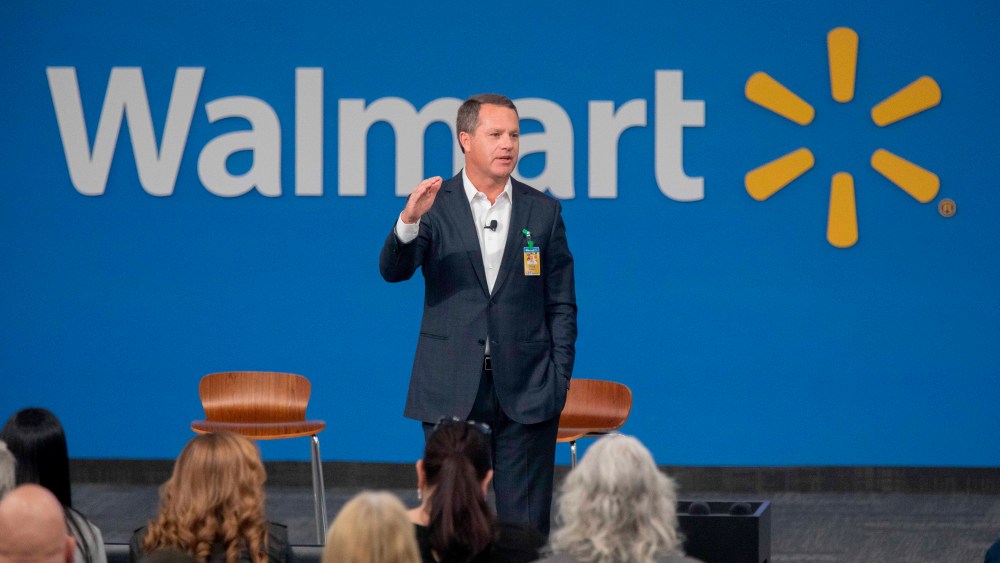
“The consumer is doing pretty good and they’re spending money and we don’t see an abrupt stop to that,” Doug McMillon, president and chief executive officer of Walmart Inc., said during Goldman Sachs’ 28th annual Global Retailing Conference. “You’ve got a continuum, of course, of income levels and wealth levels in the U.S. and there are going to be a lot of people with plenty of spending capacity. For customers at the lower end of that scale, wage rates are going up. So as we look ahead to next year and in the U.S. in particular, and to some extent other markets, I think that’s one of the things, in addition to some of the things that are happening with various forms of government assistance, that will cause us to have a consumer [who] is strong for some time.”
Related Articles
McMillon added that consumers, after more than a year of lockdowns and forced quarantine, will be eager to celebrate the upcoming holidays among friends, with all the trimmings.
You May Also Like
But while consumer sentiment may be on the rise, the CEO did acknowledge other issues throughout the industry during Thursday’s virtual chat, such as supply chain pressures and capacity restrictions amid the pandemic.
“It’s really tight for our associates working in our back rooms to be able to stage all of these [pick up and delivery] orders as the pandemic hit,” McMillon said. “We need more capacity through our supply chain. We need it for what’s flowing into stores and the roles that stores will play in delivering for customers and for pick up. We also need more capacity for e-commerce for first-party and third-party businesses. Our marketplace business is growing. If we could change anything about that right now, we’d have a lot more fulfillment capacity for our marketplace sellers.”
Meanwhile, supply chain issues continue to plague the entire retail space and McMillon said Walmart has fared no better, with container shortages, lack of labor and higher prices throughout the system.
“So there are a lot of things to overcome and it requires creativity and flexibility,” the seasoned retail executive said, adding that changing sources at various points along the supply chain is the number-one way to mitigate pressures.
“It’s helpful to have a lot of merchants with a lot of experience,” he said. “They’ve been able to overcome things when supplier A has an issue they can move to supplier B, C, D, E, F to try and compensate in some way. I do think scale can help and relationships can help [alleviate some issues], but creativity, it shouldn’t be underestimated. We’ve had some supplier relationships where they’ve reduced the number of skus they’re making to focus lines on fewer items. That’s been helpful. We’ve been more flexible on packaging. There’s just a lot of need to be in the moment and to manage a fluid situation and not get stuck in your ways, or have certain requirements, if that means you’re not going to have the inventory that you need.
“I do think these challenges will be worked through,” McMillon continued. “I do think supply chains move. The supply chain, where it is today, is different than it was in previous generations. I think we’ll see shifts that will continue to occur.”
The CEO added that there are similar issues with Walmart Plus, the big-box retailer’s version of Amazon Prime, or a subscription service that offers enhanced delivery options to Walmart shoppers.
“It’s very topical and it is important for us to have a membership,” McMillon said. “And we wanted to launch it. But we also want to make sure that the net promoter score [or customer experience] is high. And as I mentioned we don’t have all the capacity that we need. So the worst thing we could do is to really aggressively market this and get a bunch of members that are disappointed because they can’t get a slot, or we don’t get the right in-stock levels, or some other problem happens.”
Still, he said there’s plenty of room for the mass-channel retailer, which logged $4.2 billion in consolidated net income in the last three months, to grow, especially in the home, food and apparel categories, both online and in stores.
“I see so much opportunity for us on the e-commerce side to add skus and add brands to improve our execution,” McMillon said. “And while we’ve had tremendous growth in the last couple of years there’s just a lot more upside in front of us in apparel. And then everything I’ve just mentioned is Walmart U.S. We have similar opportunities in markets [internationally].
“What has become apparent in recent years is that when you become a digital company you can start to build businesses on top of other businesses in a way that’s efficient and manageable,” he said. “And so I’m not overly concerned about Walmart becoming too diversified.
“The company is going to constantly invest and you saw us increase our capital investment in February with the investor conference,” McMillon continued. “We’ve got a long-term bias and we’ve got a top-line bias. Those are both deliberate and we’ll manage the short term and when things like supply chain costs go up, or COVID-19 costs happen, or a period of wage inflation occurs, we’ll manage through those things. But all the while, we’ll be investing to improve productivity over time with things like this latest wave of automation that’s going to come in the next few years. So that’s part of the story.”
Shares of Walmart are up approximately 5 percent, year-over-year.