
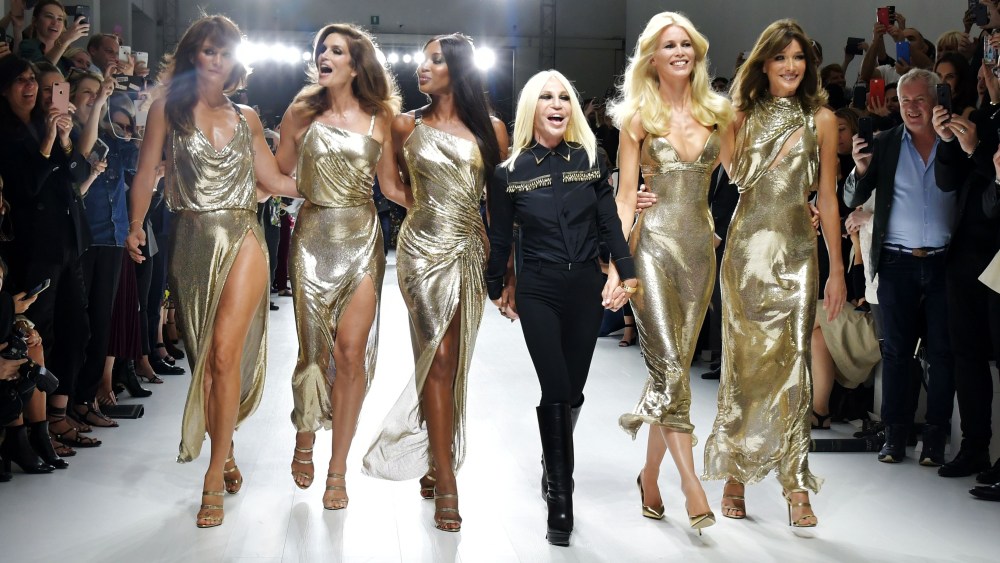
MILAN — It’s a sweet summer for the Versaces. Not only does it come after a 2017 that saw their fashion group return to the black, but it also allowed them to cash in 3.1 million euros of dividends.
As per the balance sheet deposited at the Chamber of Commerce of Givi Holding SpA, which controls the Gianni Versace SpA company, during a board meeting held on April 27 that reported a net profit of 4.5 million euros, siblings Santo and Donatella Versace, president and vice president, respectively, and the latter’s daughter Allegra Versace Beck approved the payment of a dividend of 0.31 euros a share for a total of 3.1 million euros. Santo Versace owns three million shares; his sister has two million shares, and her daughter has five million shares.
Related Articles
The balance sheet revealed that Luxottica founder and chairman Leonardo Del Vecchio is also a member of the board.
You May Also Like
Givi Holding has a 79.80 percent direct stake in Gianni Versace SpA. The latter’s separate balance sheet details the shareholders of the fashion group: Borgo Luxembourg Sarl with a stake of 19.87 percent (it also has one share in Givi Holding with no voting rights); Blackstone GPV Capital Partners VI-D FDI Ltd. with a 0.04 percent stake; Blackstone GPV Tactical Partners N-Ltd. with a 0.03 percent stake; Cordusio Società Fiduciaria per Azioni with a 0.11 percent stake, and own shares (0.14 percent). Gianni Versace SpA inked a deal to sell a minority stake to the New York-based Blackstone Group in February 2014.
In an exclusive WWD interview in June with Jonathan Akeroyd, his first after taking the helm two years ago, the executive revealed several details of the balance sheet, including that the fashion group last year posted net profits of 15 million euros, compared with a loss of 7.4 million euros in 2016, and that sales totaled 686 million euros, in line with the previous year.
As per Versace’s balance sheet, last year’s operating profit climbed 42.8 percent to 5.1 million euros, compared with 3.6 million euros in 2016.
“In 2017, the management goal was to improve the commercial performance of stores, defend the gross margin and rationalize operating costs within the development strategy mapped out in the previous years,” stated the balance sheet. The company operated focusing on sustaining the development and rationalization of the network, working on “market opportunities existing in different geographic areas.”
As reported, Akeroyd has navigated through months of chatter as Riccardo Tisci and later Kim Jones were said to be joining the company, although neither deal in the end materialized. Before his arrival, the company was eyeing an initial public offering, but this is not being considered at the moment. In September, Donatella Versace’s successful spring collection, a tribute to her late brother Gianni, added a spring to her step and opened up the brand to a younger and new customer.
In the first months of 2018, states the balance sheet, the group “continued to improve its organizational asset and its operations to realize its strategy to develop the brand, its business volume and at the same time rationalize and control its costs. Operative flexibility, reactivity and pro-activity as well as careful management have allowed to optimize resources and strategic assets. In 2018, sales are expected to grow with a progressive increase of profitability following actions focused on the industrial, commercial and logistic levels and a rational management of operating costs.”
Last year, while retail sales grew 2.3 percent to 428 million euros, or 4.5 percent at constant exchange, wholesale decreased 3.3 percent to 192.6 million euros (or 2.7 percent at constant exchange), mainly dented by delayed deliveries at the end of the year. The gains at retail were attributed to the “improvement introduced in the product offer of product and the management of the sales network.”
At the end of 2017, the company had 218 stores, compared with 239 at the end of 2016. Last year, the company opened 21 directly operated stores. Thirteen of these were full price (of which only one was for the Versus brand and located in Chongqing IFS in China) and eight were outlets. Ten stores were opened in the Asia-Pacific region, one in Europe, and two in Japan. Of particular relevance were the units opened in London’s Sloane Street, Shanghai Plaza, Chongqing, Zhengzhou and Hangzhou Tower in China. The company also underscored its investments in e-commerce and in its omnichannel. Versace’s online store bowed in China last month. Akeroyd in June said the company is planning the launch of a store concept at the end of this year, designed by the company Curiosity, led by Gwenael Nicolas, and to be rolled out in Bal Harbour, Miami, Munich and China World in Beijing.
In 2017, apparel sales decreased 0.4 percent at retail (totaling 220.7 million euros) and 10.9 percent at wholesale (totaling 112.8 million euros), while accessories grew 3.5 percent at retail (totaling 186 million euros) and 9 percent at wholesale (totaling 67 million euros).
Versace’s home line grew 27.7 percent at retail to 10.8 million euros and 16.7 percent at wholesale to 12.8 million euros.
The company identified accessories as “an opportunity it is pursuing with a precise development strategy based on all the marketing-mix levies (product, price, communication and distribution) and investments in terms of resources, organization and know-how, in the conviction that in the near future, there will be strong positive contributions both in terms of volumes and in profitability.”
By geography, the Asia-Pacific region posted growth of 8.5 percent to 274 million euros. At wholesale, the area represented 30.3 percent of the total, and at retail it grew to account for 49.9 percent of the total.
The Europe, Middle East and Africa area was down 8.4 percent to 273.9 million euros, penalized by both distribution channels.
North America was up 2 percent to 107.2 million euros, compared with 105.1 million euros in 2016. Sales in Japan rose 19.3 percent to 7.4 million euros.
In June, Akeroyd told WWD he planned to grow the European and American markets to the level of success the brand has achieved in Asia.
In 2017, employees totaled 2,464, a decrease of 68 individuals compared with the previous year, or 2.7 percent, in line “with the rationalization of the operating processes” defined by the company.
Investments totaled 28.6 million euros, compared with 48.3 million euros in 2016, channeled mainly in the store network.