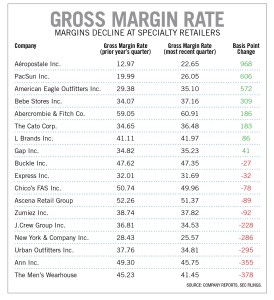
From a profitability perspective, specialty apparel retailers had a challenging fourth quarter, and it looks like things might not improve anytime soon.
In a perfect storm of heavy markdown activity, soft sales and the impact of a West Coast ports shutdown, an analysis by WWD of the gross margin rates of specialty retailers showed steep declines in the profit measure.
Of the 18 companies tracked, 10 suffered deep erosion in gross margins while eight posted gains. Of the decliners, six of the 10 companies posted changes of more than 200 basis points. Of the gainers, four reported gains greater than 300 basis points. Analysts and investors can tolerate swings in gross margin rates that are 100 basis points either up or down. Changes greater than that are cause for scrutiny.
Related Articles
The extreme declines and gains of the retailers analyzed in this report also reflect the nature of being a specialty retailer. This is a channel that is more sensitive to macroeconomic factors and other market changes as compared with larger department store and mass retailers who are often better at weathering market changes.
You May Also Like
Aéropostale Inc., Pacific Sunwear of California Inc. and Bebe Stores Inc. posted the greatest gains in gross margin rates as they controlled markdowns in a tough retail environment. Even on an adjusted basis — not including certain impairment charges — Aéropostale delivered a steep increase in the gross margin rate, said Dana Telsey, chief executive officer of Telsey Advisory Group, in a research note on the retailer. “The better-than-expected performance came as a result of improved markdowns and increased sales of full-price merchandise during the quarter,” Telsey noted. “Performance was driven by 810 [basis points] of improvement in merchandise margin and 70 [basis points] of lower depreciation, partially offset by 160 [basis points] of occupancy cost deleverage.”
The gross margin is the simplest of financial measures and the most telling in regard to the strength of a business. It is the difference between total sales (or revenues) and — for a retailer — the cost of goods sold (and other related costs). The gross margin ratio is used to gauge where gross margins are trending as well as for comparative purposes. In this report, WWD looked at the gross margin rate for the most recent quarter and ranked the retailers by changes in basis points.
Gary H. Schoenfeld, president and ceo of Pacific Sunwear of California, said in the company’s quarterly report that the retailer was able to deliver strong gross margins despite a “highly promotional environment for our industry.” The retailer posted a 600-plus basis point gain in gross margins year over year for the quarter. Schoenfeld said the company is fixated on financial goals that include maintaining robust gross margins “through elevated merchandising and inventory productivity; and incrementally leveraging expenses.”
It’s not going to be easy, though.
Analysts expect the impact of the West Coast ports shutdown to disrupt business for the next few months. Analysts are expecting an additional 50 to 100 basis-point impact on margins due to the disruptions, which is on top of any markdown or inventory issues affecting gross margins.
New York & Company Inc. certainly felt the sting of these disruptions in the fourth quarter. The retailer’s gross margin rate fell more than 280 basis points. Management of the company said in its most recent quarterly report that the decline “reflected increased promotional activity and freight costs.”
The port disruption was especially hard on smaller specialty retailers that don’t have the same cost leveraging power as bigger companies. Margins are already tight in this retail channel, so when costs rise these retailers are pinched hard.
Looking forward, there are headwinds. Consumers — especially in the teen segment — are fast to switch loyalties from one retail brand to another, while overall consumer expenditures are trending flat. The Bureau of Labor Statistics noted recently that apparel spending remains soft. Lower fuel prices and improved weather conditions might offset sales and get people into stores. Then it’s up to the retailer to get them to buy — hopefully at fuller price points.