
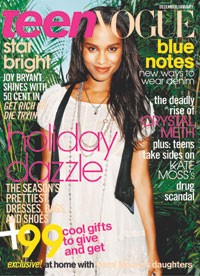
NEW YORK — A lot has changed for teen magazines in the past decade.
The category’s traditional number-two and number-three players, YM and Teen, have ceased to exist, and a slew of new titles, such as Teen People, Cosmogirl and Ellegirl, has succeeded them. One constant, however, has been Seventeen’s place at the top of the advertising rankings. Ever since the Magazine Publishers of America began keeping track of pages in 1967, Seventeen has finished every year with more ad pages than any of its competitors.
This year, that streak ends. According to Gina Sanders, Teen Vogue’s vice president and publisher, the two-year-old title (or four years old, if you count its test issues in 2001 and 2002) will close out 2005 with 999.21 pages. That’s a 28 percent increase from last year. It’s also 25.43 pages more in 2005 than Seventeen, which published more issues (12 regular issues and a prom special) than Teen Vogue (10 issues).
A Seventeen spokeswoman said, “Seventeen runs its business with the focus on revenue over paging — always. Based on current projections, we’re thrilled to be the revenue leader in the teen category for the 61st year in a row.”
However, having successfully navigated the pitfalls of a launch, Sanders feels the Vogue spin-off has earned bragging rights.
“Teen Vogue created a new model for the teen category — upscale, aspirational editorial,” she said. “The readers came, and the advertisers responded.”
Tom Jarrold, vice president of marketing and creative for Armani Exchange, said, “Teen Vogue uniquely offers a fashion forward editorial tone, a teen point of view, and a sizeable readership. No one magazine combined these three attributes before.”
Indeed, many of the brands that advertise in Teen Vogue, including Burberry, Coach, David Yurman and Neiman Marcus, don’t run in other teen books. Editor in chief Amy Astley chalks that up to environment.
“We’re not about boys or embarrassing moments or sex or relationship issues. We’re really about fashion, style and quality fashion photography,” she said, adding that Herb Ritts shot the first issue’s cover and Bruce Weber recently completed his first Teen Vogue shoot. “It certainly makes for a much more elegant package, which probably speaks to us having different types of advertisers who wouldn’t have looked at teen books before.”
Related Articles
You May Also Like
But critics of Teen Vogue say part of what makes the magazine so attractive to advertisers — its depiction of an upscale teen lifestyle, full of expensive clothes and designer accessories and largely free of everything else — can make it somewhat off-putting to a wide swath of actual teenagers. They note that, with average single-copy sales of 223,054 in the first half of this year, Teen Vogue was fourth on the newsstand, behind Cosmogirl, Teen People and Seventeen. In fact, that newsstand average was down 7 percent from the previous year. Teen Vogue’s 169 percent increase in total circulation, to more than 1.5 million, was due mainly to parent Condé Nast Publications’ purchase of YM’s subscriber file following that magazine’s shutdown last year. (WWD, like Teen Vogue, is owned by Condé Nast Publications.)
Sanders countered that Teen Vogue’s newsstand average is up 9 percent in the second half of 2005, and that came despite an increase in cover price, to $2.50 from $1.99. “My view on this is we are settling in,” she said. Moreover, she adds, just as sex- and relationship-heavy women’s magazines such as Cosmopolitan and Glamour vastly outsell Vogue and Elle on the newsstand, it’s to be expected that Seventeen and its ilk would beat Teen Vogue there.
Astley, for her part, while insisting there is plenty of Gap and American Eagle to be found in the pages of Teen Vogue, said her readers are not intimidated by the sight of products whose price tags might give even their parents pause. “We’re leaders in fashion, and our readers expect that of us,” she said. “We get letters all the time saying, ‘Thank you for not dumbing down the fashion. We don’t need to see only cheap stuff just because we’re teenagers.'”