
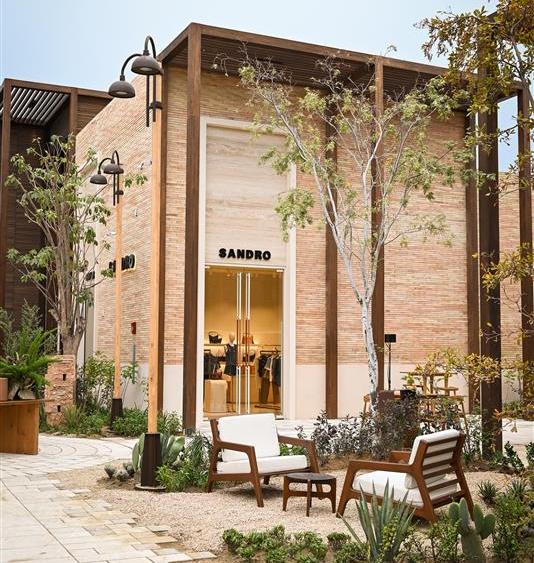
PARIS — French contemporary conglomerate SMCP posted weaker fourth-quarter sales as its exit from BHV, following the department store’s deal with Shein, weighed on performance in its home country.
The group’s sales dipped 1.2 percent at constant currency to 322 million euros after shuttering 26 points of sale across its brands — Sandro, Maje, Claudie Pierlot and Fursac — in all department stores owned by BHV parent company Société des Grands Magasins across the country in the three months to Dec. 31.
Related Articles
“It was a partner with whom we had recurring unpaid invoices for several months,” SMCP chief executive officer Isabelle Guichot said in a call with journalists. “And clearly, there were strategic differences regarding the approach and the type of customers those stores wanted to attract.”
You May Also Like
SMCP’s stable of brands were among the high-profile fashion and beauty companies to exit partnerships with SGM after Chinese ultra-fast-fashion giant Shein opened its first physical store worldwide within BHV Marais.
Sales in France were down 8.7 percent to 107.3 million euros, with a similar percentage drop in the Asia-Pacific region to 46.1 million euros in the fourth quarter.
Guichot added that SMCP is re-evaluating its network to “tactically redeploy” in the cities where it closed doors last year.
“We are actively evaluating solutions,” she said. “These could be physical solutions, temporary solutions, or digital solutions. We’re studying all options. Of course, we continue to serve these cities via digital channels.”
Europe outside of France was a brighter spot, with sales up 6.9 percent to 116.2 million euros. The company sees expansion in the Balkans and Eastern Europe as key growth markets.
The Americas were a mixed bag in the fourth quarter. Sales in the region were up 8.7 percent on an organic basis to 52.3 million euros, but were down 1.2 percent on a reported basis due to currency fluctuations.
Broken down by brand, sales at SMCP’s flagship brand Sandro were down 1.1 percent at constant currency to 161.1 million euros in the fourth quarter, while its sister brand Maje rang up sales of 124.9 million euros for an uptick of 1.6 percent at constant currency rates.
Sales for Claudie Pierlot and Fursac are not broken down separately, but combined, the two brands saw sales drop a steep 9.9 percent at constant currency to 35.9 million euros in the fourth quarter.
Following the departure of Fursac creative director Gauthier Borsarello in mid-December, the company does not have plans to replace him and will stick to a studio system for the struggling men’s label, said Guichot.
“Our brands today work without necessarily highlighting a single person as head of the studio. The work is more collaborative, done with creative teams within the brands. We’re not aiming to replicate exactly the role Gauthier had,” she said. “For now, the studio is focused on the collections, so we’re not thinking about immediately renaming someone.”
Looking at the full year, the picture brightened as SMCP honed its full-price strategy and concentrated on improving brand perception. The group returned to profitability in the fiscal year, posting a net income of 17 million euros compared with a 24 million euro loss in 2024, while adjusted EBIT jumped 80 percent to 95 million euros, reflecting strong margin gains and nearly double the prior year’s free cash flow.
Revenue for the year reached 1.22 billion euros, up 1.7 percent on an organic basis, driven by solid performance in Europe outside of France and the Americas.
In the Americas, sales for the full year were up 10.1 percent on an organic basis to 192.6 million euros.
Like‑for‑like sales increased in both the U.S. and Canada, as it adjusted its store network with the closure of Hudson’s Bay department stores and its opening within Holt Renfrew. SMCP’s strict full‑price strategy resulted in a two‑point reduction in the average discount rate, the company said, as it works to improve brand desirability.
While it closed some doors in Mexico, it expanded into two new markets in South America: Argentina and Chile.
Guichot highlighted the strategic reshaping of SMCP’s global footprint, including 32 net store closures and selective expansion via partners in 10 new markets across South America, the Balkans, Eastern Europe and India. “This approach improves the quality of our footprint while preserving profitability,” she said.
In China, SMCP has stabilized its network at around 135 stores following the closure of 65 outlets from a peak of 200, focusing on client loyalty, targeted marketing and brand elevation. The group’s partnerships remain a growth lever, with new openings planned in India, South America and the Middle East, and continued expansion in existing markets.
Looking ahead, SMCP aims to lift its adjusted EBIT margin to around 10 percent in the second half of 2026 and generate 50 million euros in free cash flow, excluding potential costs linked to a minority share sale.
“The group delivered resilient sales growth in 2025, supported by a strong dynamic in EMEA and America. In a challenging environment marked by political uncertainty, retail like-for-like growth and wholesale partners substantially contributed to performance, offsetting the impact of our network optimization plan and foreign exchange headwinds,” said Guichot.
“Our action plan is delivering as expected, with a strong improvement of profitability, bringing us back to positive net income. We have also maintained strict financial discipline, resulting in record cash generation and continued deleveraging. Building on these results and in a challenging market environment, we reiterate our 2026 guidance for EBIT margin improvement and solid free cash-flow generation.”