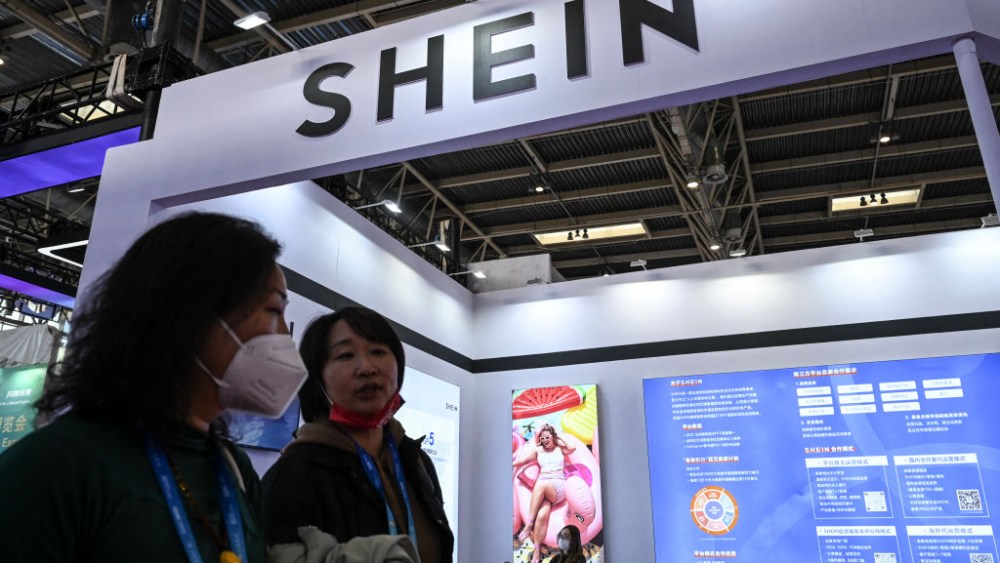
PARIS — Chinese fast‑fashion platform Shein has officially launched its Xcelerator program in France, the U.K. and China, with French high-street brand Pimkie among its first partners.
The program is structured as a joint venture, and aims to help both legacy fashion brands and emerging designers scale digitally and expand internationally while maintaining control over their IP.
Pimkie chief executive officer Salih Halassi said the partnership is part of his recovery strategy aimed at returning the brand to profitability by 2026. The company currently generates 150 million euros in annual revenue, with less than 5 percent coming from digital sales. His target is to grow to 300 million euros by 2028, with 100 million euros of that from digital channels, primarily via the partnership with Shein, although its local French website will remain.
Related Articles
Pimkie was previously owned by the Mulliez family group, which sold the brand to turnaround firm Lee Cooper International in 2023. The company has undergone a significant restructuring since then, including store closures and job cuts.
You May Also Like
The Shein partnership is part of a shift toward reinvigorating its French design and retail base, he said.
“We see this as a significant opportunity to grow our digital business and reach international markets,” said Halassi, citing the U.S., Canada and Brazil as target markets. “We are not scaling back our physical retail network — in fact, we opened 20 new stores this year and plan more in 2026.”
Under the joint venture with Shein, dedicated Pimkie collections will be developed for sale via Shein’s platform. These collections will “exist as a separate fashion universe,” said Shein director of exterior relations Quentin Ruffat. They will be distinct from Pimkie’s in‑store line.
“Our in‑store prices are significantly higher than what we’ll have on Shein’s website for Pimkie products. That’s because of the supply chain costs involved in physical retail, which force us to have higher prices there. There will be two price levels but on two different collections. It’s not the same product sold at two different prices; it’s two distinct products with different prices,” Halassi explained.
The Shein line will not be advertised in Pimkie physical stores, and vice versa, Halassi said. This dual‑channel arrangement reflects Pimkie’s strategy to broaden its product assortment online, with up to 3,000 stock keeping units expected via Shein compared to 500 styles currently in its physical stores.
The partnership is also intended to protect jobs in France, Halassi said, and will create up to 50 new design roles domestically.

European Industry Calls for Tariffs, Taxes and End to Import Rules
European groups responded harshly to the news, with a pre-planned announcement from 22 fashion industry and textile organizations signing at declaration calling on the European Union to move quickly on legislation to curb Shein’s move into the bloc.
The European federations said that ultra-fast-fashion players Shein and Temu already account for 5 percent of sales in Europe, and 20 percent of online sales. The Chinese giants sent 4.5 billion parcels to Europe in 2024.
“The impact is very clear — the direct drop in production and sales in Europe,” said France’s Textiles Industry Union president Olivier Ducatillion, announcing the declaration at the Premiere Vision trade show in Paris. “Every single step of the [industry] has been impacted. There are a lot of companies in France, industrial companies, who are in danger because of this fast fashion….Enough is enough.”
The federations said that the ultra-fast-fashion groups break a number of laws in Europe, including avoiding taxes and cheating on custom duties, as well as violating intellectual property rights.
“The business model they have cannot fit with the vision we have of the environment of our society. What they produce is not used. What they produce goes directly into the trash. It promotes bingeing as a consumption of fashion,” said Pierre-François Le Louët, copresident of the French Union of Fashion & Clothing Industries.
Mario Jorge Machado, president of the European apparel and textile lobbying group Euratex said the Chinese giant’s low-price model is only made possible by flouting EU environmental and tax rules to externalize costs. “Those companies today have a certain advantage — they put the cost on the planet, not cost on product,” he said. It also leaves European brands, which are subject to upcoming eco-fees per garment, stuck with the bill for recycling the imported products.
His organization is lobbying for “a level playing field” for European companies who pay taxes and fees in the bloc.
Ducatillion described the agreement with Pimkie and the promotion of Lhomme as a smokescreen to make the company appear supportive of the textiles and fashion industry, while simultaneously cannibalizing it.
While Pimkie framed the joint venture as a supporting their business recovery after shuttering stores in 2023 citing a precipitous fall in foot traffic, Shein has overall harmed high street brands, he asserted on stage. Other brands that are in a bind will soon join out of “desperation,” the panelists predicted.
Ducatillon and Le Louët both cited the U.S. tariffs and the elimination of the de minimis rule in the U.S as sparking a new crisis — with packages imported to Europe up 28 percent since implementation as Chinese firms turn their focus to alternative markets — as well as an example of what regulations could do.
They called for a tax on small parcels to finance customs controls, of about 20 to 25 euros, as well as an abolition of the exemption for small parcels under 150 euros — similar to removing the de minimis rule in the U.S.
However the panel was pessimistic about the time frame for change, considering the EU’s bureaucratic structure. The bloc’s parliament is not set to move on these rules until 2028, which could push implementation as far as 2035. “By that time we’ll all be dead,” Ducatillon said.
Euratex said it will work aggressively to press the issue with European lawmakers, and the groups said that member states are prepared to move individually to set laws in their own countries, similar to one that has already been passed in France.
Such a move, while necessary, would create a regulatory headache for any brands doing business in Europe.
Shein Cites U.K.’s Missguided as Success Story
Shein said the Xcelerator program differs from its broader marketplace operations in that participants receive support across production, logistics, merchandising and global distribution, alongside data insights and technology infrastructure in a “suite of services” on offer to brands.
The model draws on the pilot program that has been in development since 2023, which saw Shein collaborate with legacy brand Missguided, which generated 230 million euros in revenue over two years, Ruffat said.
“It was so successful that we partnered with its founder, Nitin Passi, who created a new group called Sumwon Studios,” Ruffat said. “This partnership merges Sumwon’s creativity and brand-building expertise with Shein’s [direct-to-consumer] services, logistics, on-demand production and global online platform to support rapid growth.”
In total, around 20 brands have participated in Shein Xcelerator pilot stage, generating more than 340 million euros in sales, Ruffat said.
Shein’s Xcelerator will also work with indie designers to help them launch lines. First out of the gate is Mathilde Lhomme, who will launch her brand Overblushhh on Shein before the end of the year.
“This is really a dream come true for any young designer — to launch their own brand with this level of support,” she said.
“With the launch of Shein Xcelerator in France, we are helping to showcase French fashion brands by building bridges between them and the 160 countries where we operate. This initiative illustrates the complementarity between online fashion players like Shein and traditional fashion brands. We are proud that an iconic brand like Pimkie and a talented designer like Mathilde Lhomme are inaugurating this program alongside us,” added Shein executive chair Donald Tang.
While Shein and its competitor Temu face regulatory scrutiny in France and Europe, including the application import duties in an effort to balance the pricing of its mail-order clothing against high-street stores, Ruffat declined to comment on any pending legislation.