
Investors couldn’t shake the Brexit blues Monday, sending shares reeling in both Europe and the U.S. as politicians, economists and analysts puzzled over the ramifications of the British vote to leave the European Union.
The Dow Jones Industrial Average fell over 350 points at one point Monday, but managed to trim those losses to close the day at 17,140, a decline of 260.51 points, or 1.5 percent. The S&P 500 finished the session with a decline of 36 points to close at an even 2,000. The Nasdaq fell by 113 points to 4,594.
The WWD Global Stock Tracker fell 1.3 percent to 105.57.
Among the decliners were PVH Corp., down 9.2 percent to $84.91; Vince Holding Corp., 8.1 percent to $4.88; Sears Holdings Corp., 6.9 percent to $12.56; Kate Spade & Co., 5.8 percent to $18.85; Abercrombie & Fitch Co., 5.5 percent to $16.80; VF Corp., 4.9 percent to $58.29; Tiffany & Co., 4.4 percent to $57.48; Michael Kors Holdings Ltd., 3.1 percent to $46.19; Coach Inc., 2.8 percent to $37.41; and Macy’s Inc., 1.2 percent to $31.71.
Related Articles
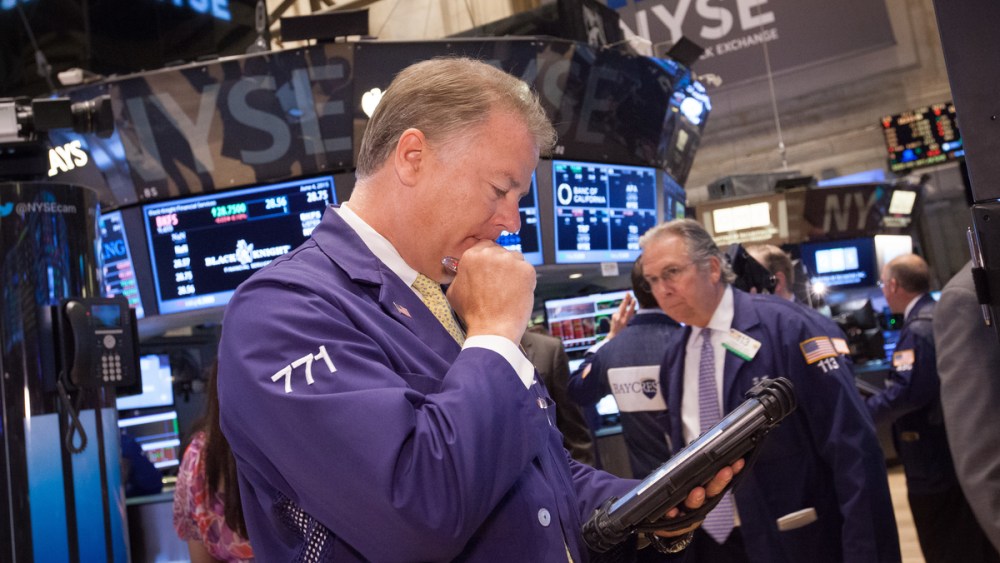
Typically tougher-than-nails New York Stock Exchange floor traders expressed worry over the last two days of selling. A nearly 1,000 point drop in such a short span hasn’t been seen since the early days of the financial crisis in 2008.
You May Also Like
“There’s definitely concern,” said Jon Corpina, senior managing partner at Meridian Equity Partners. “I think the past weekend was welcomed and everyone was hoping that with two days off, people would approach this week differently.”
Instead Corpina said no one was willing to take a stand in stocks without a better sense of how the situation in Europe will play out.
The trading day started off with some promise. Asian markets recovered from its Brexit losses from Friday and on Monday, Tokyo’s Nikkei 225 gained 2.4 percent to end at 15,309 while Shanghai’s SSE rose 1.5 percent to finish at 2,896. Chinese investors snapped up shares after China’s central bank slashed the yuan’s reference rate against the dollar.
Europe initially looked like it would shake off some of its losses during its midday trading session, but it wasn’t to be and the major indices fell even further by the end of the day.
The FTSE MIB in Milan, which has so far felt the biggest shock from Britain’s decision to exit the EU, was down 3.9 percent to 15,103.58, followed by the DAX in Frankfurt and the CAC 40 in Paris, 3 percent to 9,268.66 and to 3,984.72 respectively. The FTSE 100 in London was down 2.6 percent to 5,982.20.
The dollar index moved up about 3 percent since Thursday, while the British pound has fallen 30 percent versus the dollar, indicating traders are looking to the U.S. as a safe haven given the complexity of the situation.
“I suspect that with the British pound down to a 30-year low, investors understand that it should help British exports,” said David Nelson, chief investment strategist at Belpointe Asset Management. “It’s in everyone’s best interest for trade to go on. Treaties will be renegotiated under Article 50, which probably comes into play in October when Prime Minister Cameron steps down.”
British Prime Minister David Cameron spoke to Parliament to try to stabilize the turmoil in the U.K. and the rest of the world. Cameron said the vote to leave would stand, but that the official declaration under Article 50 would be put off until a new prime minister takes over.
German Chancellor Angela Merkel said she was not prepared to hold informal talks with Britain before it formally triggers its exit process from the European Union. “There cannot be any informal negotiations until we get that message from the U.K.,” said Merkel.
British retail and luxury stocks took a hammering, watching their mid-morning losses widen into double-digit percentages. Among the worst hit were SuperGroup, parent of Superdry, which was down 20 percent to 11.84 pounds, or $15.66; Primark-parent Associated British Foods, 15.3 percent to 23.50 pounds, or $31.09; Italia Independent Group, 16.6 percent to 9 euros, or $9.92; Marks & Spencer Group, 12.6 percent to 2.85 pounds, or $3.77; and Ted Baker, 18.3 percent to 21.24 pounds, or $28.10.
Many British brands that source and manufacture in Asia will take a further hit in the coming months due to the weaker pound and ongoing fears that Britain will fail to negotiate favorable trade agreements with the EU and other countries.
In the U.S., analysts are still gauging just which brands will be hit the hardest and which ones will skirt around the chaos.
Cowen & Company’s analyst Oliver Chen said beauty and wellness trends would remain resilient in this period of uncertainty, benefiting companies such as Ulta Salon Cosmetics & Fragrance Inc. and Lululemon Athletica Inc. “We also prefer the middle- and lower-end consumer, benefiting Ross Stores Inc. and TJX Cos. and have greater anxiety on the higher end, meaning Restoration Hardware Holdings Inc. and Tiffany & Co.” He also said companies with prior exposure to currency and tourism issues, such as Macy’s Inc. and Tiffany’s, could continue to experience those problems.
RBC Capital Markets’ Brian Tunick also said the stronger dollar would continue to pose a problem for firms that depend on tourists and those with outlet mall exposure. He also mentioned Tiffany’s and Macy’s as companies that are sensitive to the tourist headwinds and Coach Inc. and Michael Kors Holding Ltd. as having outlet mall exposure.
Gold, however, is shining. The precious metal jumped from roughly $1,250 on Thursday to $1,350 on Friday and has risen over 8 percent in the past 30 days. “It could easily go to $1,400 an ounce by the end of the year,” said David Williams, director at Strategic Gold Corporation. He expects that markets will be unsettled until after the U.S. election.
“It’s the old flight to safety,” Williams said, adding that he wouldn’t be surprised to see gold go to a whopping $3,000 an ounce.
“It may take some time for the shock to fully work through the economic, financial and political systems in the U.K. and Europe,” said Jeffrey Kleintop, chief investment strategist at Charles Schwab & Co. “With no visible catalyst to halt the slide, the decline in global stocks may continue as the risk of a recession increases.” He said that short-term-focused traders should expect further stock market declines over the next three to six months, similar to past market shocks.
As Bette Davis said in “All About Eve,” “Fasten your seat belts; it’s going to be a bumpy night.”