LONDON – After years of false starts, the momentum is gathering pace at Burberry, where retail sales are growing once again after two years of decline.
In the second quarter, like-for-like retail sales grew 2 percent, outstripping analysts’ expectations of flat year-on-year performance. It was also an improvement on the first quarter, when retail sales were down 1 percent.
In the first half, like-for-like retail sales were flat at 854 million pounds. But it was still a win for Burberry, which had reported a 20 percent decline in the corresponding period last year.
You May Also Like
Related Articles
Revenue in the first six months was down 5 percent at reported rates, and 3 percent at constant exchange, to 1.03 billion pounds, broadly in line with analysts’ estimates.
Burberry’s sales declines have been narrowing steadily under chief executive officer Joshua Schulman, and the progress boosted the share price following the results’ release on Thursday. Shares were up more than 4 percent to 13.06 pounds at 9 a.m. GMT, but settled down during the day, closing up 0.5 percent at 12.60 pounds.

Analysts were cautiously optimistic about Burberry’s prospects, but it’s clear they want more evidence of a turnaround before they unleash full-throated praise.
Deutsche Bank said Burberry “appears to be executing on its operational and strategic plan and the first-half results are an important stepping stone on this journey. We need to see a further acceleration in the second half, against tougher comparatives, for investors to gain more confidence.”
Luca Solca, luxury analyst at Bernstein, wrote that “Burberry is slowly but surely moving in the right direction, and sequentially improving performance in both the USA and China should add to investor confidence.”
Given the swing to growth, the mood was buoyant at Burberry and the brand is cautiously optimistic about the second half.
During an analyst meeting at the brand’s Horseferry House headquarters, where the entire team is under one roof for the first time in years, chief financial officer Kate Ferry said that the third quarter “started well,” trends are “in line” with the second quarter, and Burberry is anticipating further incremental growth in the second half.
She and Schulman stressed that the company is still in the early stages of its turnaround, adding that the focus is to build on the progress so far and deliver continued margin improvement “with a focus on simplification, productivity and cash flow.”
Same-store sales growth in the second quarter came from all directions.
The EMEIA region, which covers Europe, the Middle East, India and Africa, was up 1 percent in the half, while the Americas rose 3 percent in the first six months. Greater China improved, with sales shrinking 1 percent in the half, although in the second quarter the region returned to growth, with sales up 3 percent.
Schulman said Burberry’s long-standing Chinese customers are returning and the brand is also attracting Gen Zers. Both sets of customers are responding to the company’s authentic message, classic products and DNA, he added.
“In the past, we may have thought that the key to unlock growth in this younger customer base was to chase industry trends, but this younger Gen Z customer is leaning into the most authentic parts of our timeless, British luxury brand expression, and that gives us confidence for the future,” he said.
Asia-Pacific revenues fell 2 percent in the first half, but also moved out of negative growth territory with a flat performance in the second quarter. Although Japan fell 5 percent in the first half, it returned to growth in the second quarter, with sales up 2 percent.
Growth also came from a few unexpected quarters. Schulman said the new Cavalier riding boot, which comes in a variety of heel heights, was a breakout success in the half.
“We took a big bet with those. They cost 1,500 pounds and there is not a lot of branding. But we learned that Burberry can establish authority in new categories, and we should be the destination for a pair of beautiful English riding boots,” he said.
He believes that the more Burberry leans into its checked past, its love of color, British style and wit, the more it will appeal to customers.
Outerwear outperformed in all regions for the first half and in the second quarter, while soft products, such as knitwear, grew in the double-digits during both periods.
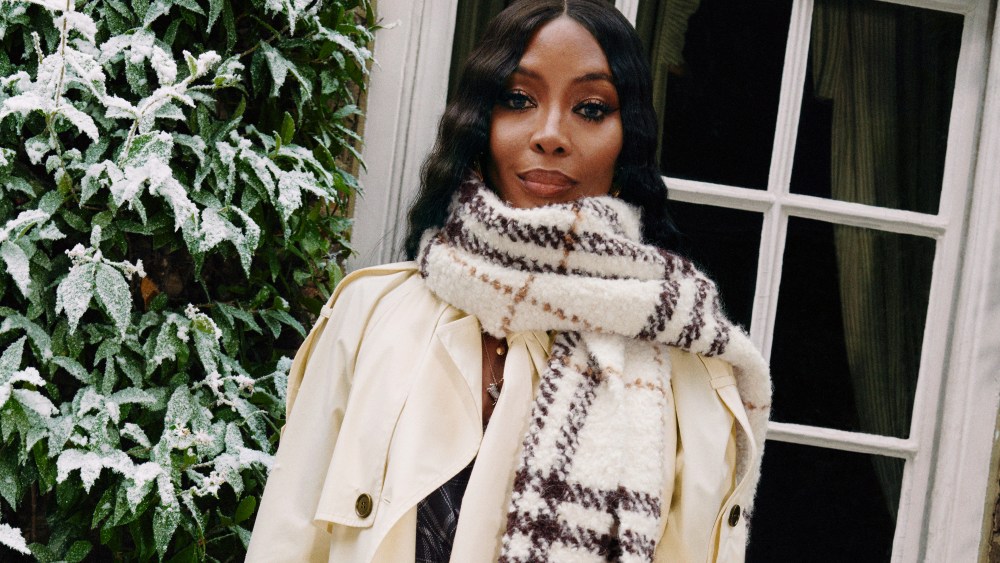
Schulman said Burberry is rolling out its scarf bars further at stores worldwide, offering a broader array of scarves and capes as well as more personalization services. It has also been creating outerwear spinoffs, such as quilted jackets and cropped trenches. There’s even a trench-inspired midi-skirt called the Brenda.
The design and merchandise teams are also working more closely, with chief creative officer Daniel Lee translating statement runway looks for the shop floor.
Examples include the printed burgundy trench with big swishy fringe that Naomi Campbell wore in the fall 2025 runway show. It inspired a lineup of mini and maxi trenches (minus the fringe) but with similar swagger.
For spring 2026, a brown leather car coat with Swinging ’60s appeal has been transformed into a lightweight style in gabardine, and a longer trench with a leather belt and epaulettes. Lee has also been translating big-ticket, private orders to the shop floor, making them accessible to a wider variety of customers.
The strategies have been working. Womenswear sales grew 2 percent at constant exchange rates in the first six months.
Burberry is also thinking laterally, and has begun working with a lighter, tropical gabardine, “allowing the trench to be worn globally all year round,” said Schulman.
The ideas are coming thick and fast, and Schulman believes it’s because everyone is now working together at Horseferry House, he said.
“Most of the work happens right here, in this building,” said Schulman from his sunny corner office with a view over the Thames.
“It’s been great this year because we’ve been able to consolidate — from three different buildings to one — and the team is finally all together. The building is fully renovated in a way that really fosters collaboration and creativity. And that’s really in the spirit of what we’re trying to do,” he added.
Burberry has also restored its fashion showroom at Horseferry House, which means the global retail teams can shop the collections in London, rather than having to travel to the brand’s Paris showroom.
With all the positive signals from the second quarter in particular, Schulman said he’s far more bullish on Burberry than he was 12 months ago. He said the decision to stay true to the brand’s “unique DNA” rather than chase trends or copy-paste competitors’ strategies had been a sound one.
He said there are many “proof points” in the strategy right now, which makes him think “the brand can be bigger than I imagined. We are just getting started.”
The balance sheet is also looking brighter, with losses narrowing, and the promise of profits emerging.
In the six months, adjusted operating profit amounted to 19 million pounds compared with a loss of 41 million pounds in the corresponding period last year.
Burberry reported an operating loss of 18 million pounds, compared with a loss of 53 million pounds in the previous year. The company said the loss in the first six months was due to a restructuring charge of 37 million pounds.
The company also narrowed its pre-tax losses to 48 million pounds from 80 million pounds in the corresponding period last year.