Like other man-made cellulosic fibers (MMCF), lyocell is a plant-based fiber made from wood pulp. However, its production process is friendlier to the environment as its manufacturing process uses non-toxic solvents. Along with its eco-friendly credentials, lyocell’s fiber properties give fabrics the comfort of cotton, the strength of polyester, the breathability of viscose and the drape of fibers like silk, all contributing to high-quality, comfortable textiles.
MMCF manufacturer Sateri has been building up its lyocell capabilities as part of its sustainability vision, investing in the “new-generation” fiber. “Lyocell has strong green properties,” said Sherry Li, marketing head for Sateri Lyocell. “Its production process does not contain harsh chemicals, which is more in line with the trend of green development. Lyocell is more environmentally friendly than cotton and has better performance. It has wide application potential for the future, as it can be a good alternative to cotton applications such as denim, garments and home textiles, helping to upgrade products’ quality and hand feel.”
Related Articles

Instead of chemicals, lyocell production relies on physical reactions to dissolve wood pulp. Fibers are made in a closed-loop system, and 99.7 percent of the organic solvent used can be recovered and recycled. Further reducing the fibers’ footprint, Sateri uses biomass to power its lyocell production in its production site in Rizhao, Shandong province. A life cycle analysis (LCA) was evaluated for the fiber produced from the Rizhao site, and Sateri’s standard lyocell offers a 68 percent reduction in carbon emissions compared to conventional lyocell, while a zero-carbon version of the fiber, branded All for Zero, shrinks its emissions to zero by carbon reduction through energy efficiency optimization and carbon offsets.
Sateri is the first lyocell producer in China to receive Oeko-Tex® STeP certification, which scores companies on areas such as environmental and chemical management, social responsibility, quality management as well as health and safety. Sateri obtained a Level 3 score across all parameters, which represents “exemplary implementation of best practices.” Together with Oeko-Tex® Standard 100 certification, Sateri’s lyocell carries Oeko-Tex’s Made in Green label, which indicates social and environmental responsibility, product safety and traceability.
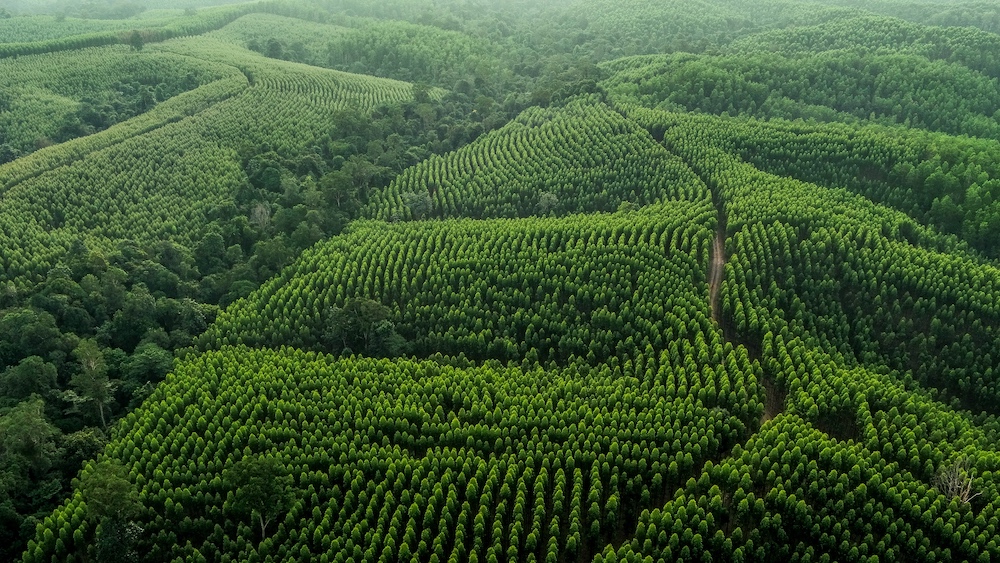
“Lyocell is a key component of Sateri’s sustainable development agenda,” said Li. “It is sourced from sustainably managed plantations, and its unique pulp-making technology and eco-friendly closed-loop production process effectively reduces environmental impact.”
The company’s lyocell is also certified by TUV Austria to biodegrade in seawater, soil, freshwater and compost within 28 days. “At the end of its life cycle, lyocell fulfills the circular concept of ‘originating from nature, returning to nature,’” said Li.
Sateri began producing lyocell at its Rizhao facility in China’s Shandong Province in 2020, with an annual production capacity of 25,000 tons of fiber. This was quickly followed by another two
mills in Liyang and Nantong cities, Jiangsu Province, which collectively produce 210,000 tons per year. The group plans to grow its annual lyocell capacity up to 500,000 tons by 2025.
Sateri’s venture into lyocell is part of its Vision 2030 commitments, which include net-zero emissions by 2050, closed-loop production and circularity. “Sateri is committed to becoming a ‘net-positive’ MMCF producer,” said WenBin Huang, senior sustainability manager at Sateri. “We have released our Sustainability Policy with a firm pledge to focus on responsible raw material procurement, excellent production, innovation and circularity, carbon neutrality and employee and community development.”
Utilizing lyocell
Although lyocell is also a regenerated cellulose fiber just like viscose, it has different properties from the latter. While viscose’s looser polymer structure makes it softer, lyocell’s tighter structure creates glossier, silkier fabrics.
Lyocell is a strong blending partner. Combining it with cotton offers cost savings, since currently, lyocell prices are trending lower than cotton. Additionally, blending cotton and lyocell is virtually identical to spinning cotton alone, eliminating machine downtime. Other processing savings come from lyocell’s reduced combing, low fiber loss during knitting and lower dye agent usage.
Sateri has developed a proprietary green process for cross-linking, which prevents fibers from splitting when abraded, expanding lyocell’s potential applications. The manufacturer has also introduced variations of lyocell in a longer staple fiber length and finer denier—or weight—to further widen its potential uses.
To encourage the industry to accelerate the uptake of more eco-friendly fibers such as lyocell, Sateri provides technical, communications and marketing service support to all tiers of the supply chain, including providing supply chain transparency and traceability through the use of hangtags.
“In the coming years, we expect lyocell adoption to rise for a number of reasons, including its ease of use and affordability,” said Li. “At Sateri, we are growing our capacity to meet this future demand.”
Click here to learn more about Sateri lyocell.