Vacheron Constantin, a Swiss High watchmaking Maison with a long history, has an amazing bond with Chinese culture. From its tentative exploration of the Chinese market in the mid-19th century to a full-scale watchmaking extravaganza in the early 21st century that fully integrated Chinese culture, from the brilliant interpretation of the 12-year cycle of the Legend of Chinese Zodiac to the cultural tribute of the “Seawater Cliff” applied on the watch dials, infinite reveries and ingenuity have emerged from the interaction between the Maison and Chinese culture.
Related Articles

In 2024, the Watches and Wonders exhibition returned to Shanghai. WWD, through an in-depth conversation with Christian Selmoni, the style and heritage director at Vacheron Constantin, explored how the Maison paints a new canvas within the confines of high-end watchmaking when Chinese history and culture shine upon it.
In early August, an exhibition titled “Seawater Cliff in the Journey of Time” was inaugurated at the Pudu Temple at the foot of the Imperial City in Beijing. In this historic complex, which once served as the residence of the Duke of Rui, Dorgon, Vacheron Constantin demonstrated its profound achievement in the fields of culture and art for one more time. Inspired by the “Seawater Cliff”, a motif highly esteemed in the courts of the Ming and Qing dynasties, Vacheron Constantin skillfully interwove the profound Chinese cultural heritage with Swiss exquisite watchmaking craftsmanship, presenting a journey through time that spans across eras and merges the essence of the East and West.
At the end of the month, Vacheron Constantin once again presented a series of new creations at the “Watches and Wonders” Shanghai Haute Horlogerie exhibition. The most eye-catching is the new Métiers d’Art series, The Legend of the Chinese Zodiac, Year of the Snake. The mutual inspiration of Swiss Haute Horlogerie and Chinese culture is what makes the Maison’s timelessness and popularity in China so remarkable in this era of rapid development.
Seeking Ties: the Wonderful Bonding Uniting Chinese Culture and Swiss Haute Horlogerie
In the 18th century, the Swiss watchmaking industry was far from the world-renowned status it enjoys today, being merely a plaything for Western European royals and nobility. Gradually, watchmakers began to sell their products to Russia, Turkey, the Middle East and eventually sailed as far as Japan and China. These exotic “imported goods” were immediately favored by the royals, leading to the establishment of two specialized workshops in Suzhou and Guangzhou to develop China’s own watchmaking, marking the first encounter between Chinese traditional culture and Swiss high-end watchmaking.
Since its founding in 1755, Vacheron Constantin has been deeply rooted in the field of art and culture and committed to expanding the creative space of watchmaking art. By the mid-19th century, the Maison had formed an indissoluble bond with China. From 1845 onwards, the Maison began to explore new horizons in Asia, particularly in China. Vacheron Constantin played a key role in establishing the jewelry watch among the high dignitaries of the Court, for whom it produced so-called Chinese watches, richly decorated with engravings or enamels and often sold in pairs. These watches were also remarkably water-resistant, an undeniable advantage given the damp climate of the Middle Kingdom.
Since then, the Maison has continued to nurture its historic presence in China through numerous partnerships and by creating watches influenced by Asian and particularly Chinese culture that are highly prized by watch connoisseurs and collectors.
This openness to the world, coupled with an insatiable cultural curiosity, is demonstrated by Vacheron Constantin’s latest masterly demonstration of its artistic crafts. Chinese traditional culture, with its vibrant diversity and unique charm drawn from a wide range of influences, has become an inexhaustible source of creative inspiration for the Maison.
“Tribute to Traditional Culture: The Seawater Cliff in the Journey of Time” is a special exhibition at Beijing’s Pudu Temple. Curated by Mr. Song Haiyang, a former associate research librarian at the Palace Museum in Beijing, the exhibition is a collaboration with Swiss watchmaker Vacheron Constantin. It showcases the ingenious connections between Chinese cultural heritage and Swiss watchmaking craftsmanship.
The artifacts, steeped in history, meticulously represent the “Seawater Cliff,” a traditional decorative motif, from its initial mountain and water patterns to its symbolism of everlasting national fortune and prosperity, and at the same time, bear witness to the continuity of the glorious Chinese civilization.
At the same time, the outstanding series presented at this exhibition, including the Villes Lumières from the Métiers d’Art series, the Legend of Chinese Zodiac, and the Florilège featuring the Chinese crane orchid, showcase the Maison’s artistic heritage in watchmaking and its unique ties with the profound Chinese culture through the tiny watch dial.
“We have a great affection for all civilizations, arts, and crafts, which is the true essence of the Métiers d’Art series. About three and a half years ago, we began considering the creation of a series inspired by the ‘Seawater Clif,’ as we were extremely impressed by the dragon robes and imperial court. For us, it was almost impossible to present the dragon robe on a wristwatch with the existing materials and technology. We know that symbolic meaning is very important in Chinese culture; it’s not just about the patterns but also the colors and the artistic form of expression. To solve these challenges, we turned to Mr. Song, a former associate research librarian at the Palace Museum for help, who generously participated in this project and guided our team throughout the design process, allowing us to reproduce the ‘Seawater Cliff’ from the dragon robe on the wristwatch and pay tribute to the ancient Chinese traditional culture and symbolic art accurately. From my personal perspective, this is probably the most interesting set of pieces in the Métiers d’Art series, where we can use our Swiss traditional crafts, such as gold carving and enamel painting, to present the original meaning of ancient Chinese culture.” In the interview, Selmoni shared the story behind this piece.
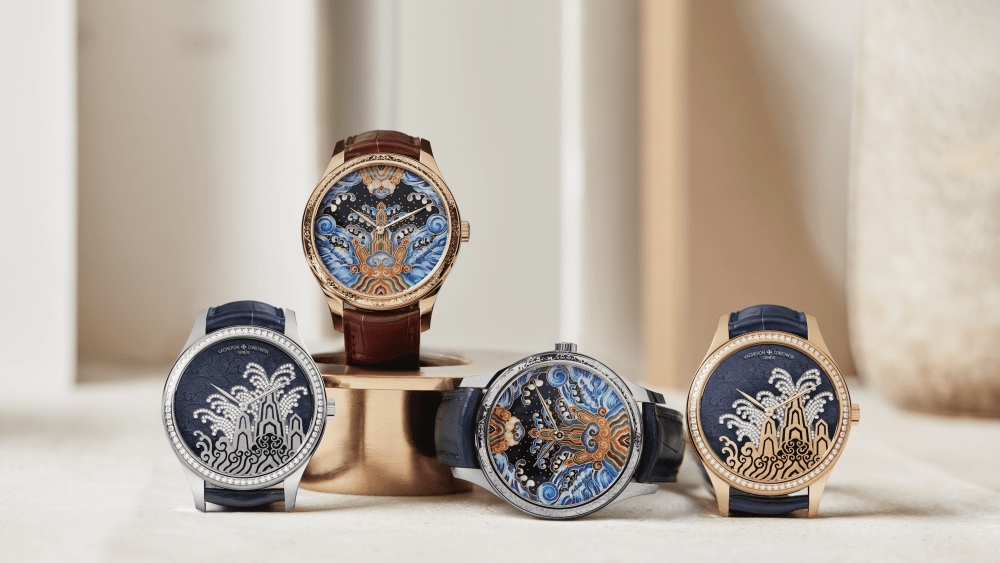
To immerse itself in the distinctive decor from the 14th to the early 20th centuries, the Maison focused particularly on the decorative arts and notably in the “Seawater Cliff” motif omnipresent on courtly architectural elements, but also on furniture and porcelain, as well as on imperial clothing and particularly the ‘dragon’ robes. During the Ming and Qing dynasties, embroidered on the lower hem and cuffs of the robe, this ornamentation was regarded as auspicious for those who wore it. Vacheron Constantin vividly depicts the surging waves and towering mountains of this pattern in four of their new watches.
Drawn inspiration from Chinese culture has become a common practice over the past decade or so for Swiss watchmakers, with countless brands making interesting attempts. If we broaden our horizons back to the decorative art style of the Art Deco era that started a century ago, many watch and jewelry brands have also incorporated memorable designs from Egyptian, Persian, or Chinese cultures. Zooming out further, in the Rococo Art beloved by the French royal family, porcelain from the East was also an essential decoration in the palace that could never be left out. Oriental culture and Western art, though different in origin, have never been separate entities. As time progresses, the two will inevitably meet at the top joyfully.
Traditional Symbols: In-depth Interpretation of Watch Craftsmanship
Talking about the inspiration for this watch, Christian Selmoni noted, “actually, our initial idea was to present a piece that looks like a dragon robe on a watch, but in Chinese culture, every pattern has a different meaning. Faced with so many choices, we needed an expert who was well-versed in Chinese culture to help us make the selection. So, we are truly grateful for all the efforts Mr. Song has put into this piece behind the scenes. It’s not only because he introduced us to the profound symbolic meaning behind the ‘Seawater Clif,’ but also because the features that fit, the choice of colors, and so on, have all been imbued with his efforts.”
Who could have imagined that one day, the “Seawater Cliff” symbolizing eternal national peace and longevity, which adorns the dragon robes and the python robes, would appear on an imported Western “wondrous” wristwatch that was born hundreds of years later? This time, the Métiers d’Art – “Tribute to traditional symbols” feature two completely different dial designs, each paying tribute to this centuries-old motif in a different manner.
The dial of Eternal Flow pays tribute to tradition with its gorgeous colors and saturated imagery: against a star-studded night sky, the mountain peaks, bordered by vegetation in the shape of ginger buds, are caressed by tidal waves. With its colorful aesthetic and respect for traditional Chinese ornamentation, this depiction is a masterpiece of cloisonné enameling, which originated in China. The technique is also named Jingtai Blue, which pays tribute to its heyday, which was in the era of Emperor Jingtai during the Ming Dynasty. The latter technique was a natural choice because of the flexibility it offers in terms of both the choice of colors and the graphic design of the intricate shapes.
To highlight this enameling work, the bezel of the model is entirely hand-engraved with a bat motif. In Chinese, the word bat and happiness have similar pronunciations, which goes some way in explaining the status of this animal as a harbinger of good fortune. In Chinese decoration, five bats are often seen together, traditionally expressing the Five Good Fortunes: longevity, wealth, stability, virtue and happiness. On this watch, the engraver has depicted the bat in the form of a frieze composed of successive volutes representing the animal’s characteristic silhouette.
“This clever design shall also be attributed to Mr. Song, who suggested that we engrave some bat motifs on the watch. In our Western culture, bats do not have good connotations, but he told us that they symbolize good fortune in Chinese culture, and that’s how the bezel came to have these Chinese bat motifs engraved on it now,” said Selmoni.
For this second “Seawater Cliff” motif, the aim was to achieve a depth effect on a monochrome base. The all-in-one-piece dial features hollowed waves, blue enameled parts and raised diamond-set sections for the mountain area. The gold dial is divided into three parts. The first, which delineates the sea, is made of deep-blue Grand Feu enamel applied in successive kiln-fired layers. This is followed by patient engraving. The technique used for the depiction of waves is engraving on enamel to create volutes. These are then accentuated by the master artisan, who fills in the furrows with white enamel that is then also fired. This extremely thin layer creates a subtle shadow on a delicately textured background, giving the impression of a sea in motion. The second part, devoted to the sea tides running along the mountain range, is reserved for the setting. Each sea tide is delicately hand-set with brilliant-cut diamonds, evoking the moon slivers that inspired the name of this piece. Meanwhile, the third part of the dial serves to add relief, with a mountain range lashed by foaming waves. Meticulously engraved with tone-on-tone champlevé enamel inlays to accentuate the depth of the landscape, this portrayal of the mountains is also worked in dry point to accentuate the perspective effect.
This group of creations can be considered masterpieces of Vacheron Constantin from the perspective of an expert in traditional Chinese culture. The Eternal Flow wristwatch visualizes various elements and motifs from traditional Chinese culture, closely resembling the richly colored aesthetic of the Qianlong period, while the Moonlight Silvers wristwatch, in terms of dial design, is a better resemblance of the artistic conception of traditional Chinese landscape painting, expressing a profound understanding of Chinese culture with its generous white space and the implication that the moon is visible without being seen. Both have their unique wonders, and it is hard to imagine that this wonderful collection of wristwatches comes from a Swiss watchmaking Maison. Vacheron Constantin’s profound understanding of foreign cultures is evidently shown.
Heritage and Innovation: Carry on the Connection with Chinese Culture through the Legend of the Chinese Zodiac
In fact, the cultural alignment extends far beyond these two watches. The Chinese Zodiac animals hold very significant heritage connotations in Chinese culture, and wherever there are Chinese people, there will be the tradition of zodiac culture, which also opens a unique window for the world to understand China. As the status of the Chinese market in the watch industry rises, the Chinese zodiac has also become a main battleground for high-end watch brands. According to incomplete statistics, at the beginning of this year, about 20 Swiss watch brands launched the Zodiac Dragon watches, which is a surprisingly large number. As one of the first watch brands to create zodiac watches commemorating the Chinese Zodiac, Vacheron Constantin dedicated two limited series to each sign of the Chinese zodiac for the past 12 years.
The Legend of Chinese Zodiac started in 2012. In terms of design, we drew on traditional Chinese paper-cutting art for the dial background. I think the biggest challenge at the time was how to make the animal images in the Western concept meet Eastern expectations. After all, the image of some animals in our minds is different from that in the East. In this collection of watches, our designers worked together with the Chinese team to ensure that the images of the twelve zodiac animals could fit in the traditional Chinese culture.”
The original design of the Métiers d’Art-Legend of the Chinese Zodiac is a dedicated homage to the Chinese calendar tradition. Over the past twelve years, this series has been a creative interpretation of the complete 12-year cycle, showcasing the collision and integration of different cultural traditions within the small surface of the watch dial. The traditional Chinese paper cutting art, which has been listed by the United Nations as an intangible cultural heritage, and the Scherenschnitt popular in the Pays d’Enhaut region of Switzerland, are integrated on the dial, presenting the twelve zodiac animals with their distinctive and lifelike colors.
Regarding the continuation of this zodiac series, Selmoni said, “as the Maison concluded the last 12-year cycle at 2023 Watches and Wonders (Shanghai) Haute Horlogerie Show, we wanted to carry on this interesting collection but with a different artistic approach. After much deliberation, we decided to continue with the previous movement and functional design, with an imaginative dial without hands. We also continued to use the selected craftsmanship but with a radical change in the design. For the new Year of the Snake watches in the Métiers d’Art series, we have changed the color of the enameled background from transparent to a miniature painting process. A more three-dimensional image of the animal was placed in the center of the dial in a more powerful posture, which I think is closer to the Western expression.”
On the dial of the new Snake watch, a cobra unfurls its sinuous body atop a rock. This artistic masterpiece showcases the masterly craftsmanship of Vacheron Constantin: first, the master engraver expertly carved the precious metal in pink or white gold to create its final texture, using a skillful blend of force and gentleness. The enamel painters then enhance texture and relief with the application of miniature paint and patina. On the pink gold version, the cobra and the rock are ochre-colored, while the platinum version is anthracite grey. From a design perspective, the new creations continue the visual style of the previous round of twelve zodiac designs while at the same time giving the zodiac watches a more vivid and youthful aesthetic expression in terms of color and craftsmanship, from which Vacheron Constantin’s emphasis on the young consumer group is also evident.
Vacheron Constantin has made a marvelous transition from the previous Snake watch, which was infinitely oriental twelve years ago, to the new Snake watch, which is an expression of Western intentions today. Whereas the Maison had certain insight into Chinese culture twelve years ago, watches of this year embody the true integration and mutual learning of the Chinese and Western cultures, demonstrating the approach to heritage and innovation of this renowned watchmaker.
When the Chinese Culture Meets the Western Culture: A Harmonious Fusion
On a small island in the lake of the old city of Geneva, Switzerland, stands the ancient clock tower Tour de l’Île, which has been solidly erected to this day and dates back to the 13th century. In 1843, Vacheron Constantin moved its headquarters here, and almost at the same time, it began the exploration and strategic layout of the Asian market. According to watchmaking historian Alfred Chapuis, author of the book “la Montre Chinoise” published in 1919, the Manufacture “established the jewelry watch on the Chinese market” with models often sold in pairs, designed to withstand humidity and adorned with magnificent engraved, enameled and gem set decorations. In 1846, Vacheron Constantin sent 33 pairs of watches to Canton in order to assess business opportunities in China. Our archives contain sketches of Chinese watches and clock dials from this period, an era that marked the beginning of a long history that would later include orders from Chinese dignitaries and even from the Emperor himself.
Over the generations, we have consistently created watches influenced by Chinese culture. Among our most recent creations is a Traditional Tourbillon watch depicting the phoenix and the dragon, a tribute to Chinese mythology. Other examples of our interest in Chinese culture include the Les Cabinotiers Memorable Places series, which notably features a dial depicting the ancient Summer Palace in Beijing or the gateway to the Temple of Confucius and the Imperial College. Not forgetting the Métiers d’Art The Legend of the Chinese Zodiac series we began 12 years ago. The Patrimony Traditionnelle Laque de Chine watches, the Florilège-Chinese Crane Orchid watch, and the Fabuleux Ornements – Chinese Embroidery watch also showcases the blooming of Chinese craftsmanship and culture in every aspect.
For nearly a century, Maison has been deeply committed to the Chinese market through its diversified marketing activities, which has promoted the recognition and understanding of the Maison by more Chinese consumers. In the post-pandemic era, these activities have become increasingly colorful and diverse.
The Seawater Cliff in the Journey of Time Exhibition mentioned earlier focuses more on the presentation of traditional Chinese culture. Cultural objects loaned by collectors showcase the application of the traditional “Seawater Cliff” on a wide range of utensils and objects. In fact, Vacheron Constantin is also presenting another exciting exhibition in Shanghai this year, the Heritage Masterpieces on the theme of “From Geometry to Artistry,” a retrospective of the Maison’s legendary history. All the watches in this exhibition have been selected by the Vacheron Constantin Heritage Department, which is home to more than 1,600 timepieces dating from the 18th century to the present day, as well as tools and items of furniture. This collection is complemented by an impressive archive of the Maison’s activities over the years and centuries. Through these exhibitions, Chinese consumers will be able to experience more directly how Vacheron Constantin, a watchmaking brand with nearly 270 years of history has continued to develop its own vitality and identity and how it continues to produce timepieces with bountiful cultural heritage.
“In recent years, each of our watch launches has been centered on a theme that allows us to present the art of watchmaking from different perspectives,” said Selmoni. “For this year’s theme, ‘From Geometry to Artistry,’ we decided to extend from geometry to art, showcasing the challenges of geometric shape transformations in watchmaking through the design of the case and bracelet, for example. Of course, the most interesting aspect of this annual theme is that it gives us the opportunity to present our historical product collections, which include more than 1,600 different models from the mid-18th century to the present day, so when we launch a theme each year, we carefully select some historical models that fit the theme. Through these exhibitions, we allow more friends to see at a glance what design philosophy we are conveying this year.”
Through a series of exhibitions, the Maison continues to strengthen its connection with the Chinese market, allowing more consumers to appreciate the intricacy of mechanical gear meshing, the splendor of craftsmanship on enamel and gold carvings, the vastness of Chinese culture that spans ancient and modern times, and the timelessness encapsulated within the watches.
Established 269 years ago, Vacheron Constantin has, for several centuries, connected Switzerland with the rest of the world through its watches, from Europe to America and then to the Middle East and the Far East. As early as the mid-19th century, Vacheron Constantin had already made its presence known on Chinese soil.
While engaging with other civilizations, the Maison has also been influenced by the cultures and craftsmanship of these countries. The profound Chinese culture and the admirable Eastern crafts are all nourishment for the creation of its watches, especially in series like the Métiers d’Art.
As a result, countless classic watches by Vacheron Constantin have been created in different eras, some of which are preserved in our memory, and others, like these new watches, come to life before our eyes. As said by the famous poem, “When Autumn’s Golden wind embraces Dew of Jades, All the love scenes on earth, however many, fade”, the encounter between Eastern culture and Western watchmaking technology is truly an exhilarating cause for joyful celebration.