
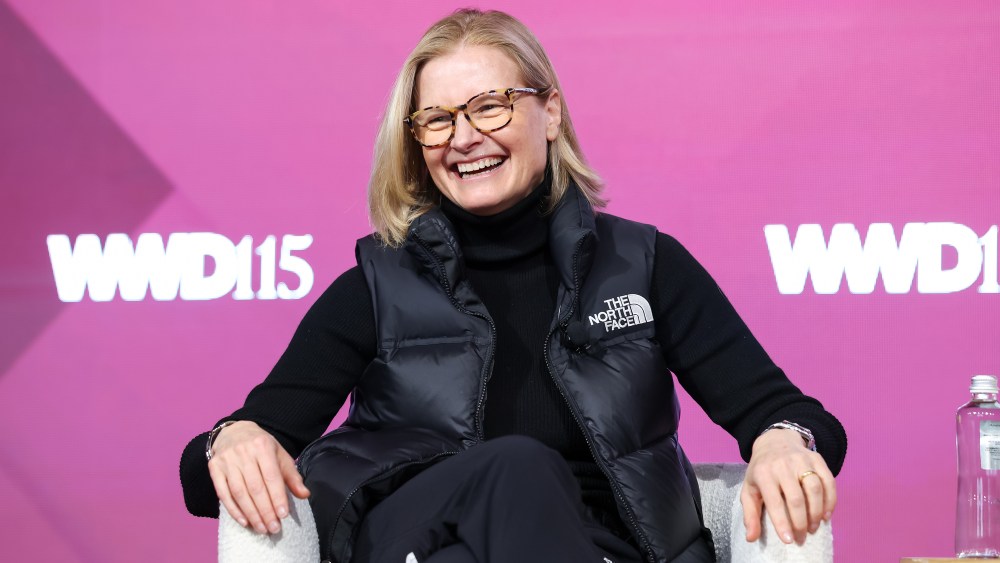
When Caroline Brown goes for a walk, she doesn’t count her steps. Instead, the global brand president of The North Face sees how many times she can spy her company’s logo on the people she passes.
“I do it in every subway car I go in, and every time I walk down the street,” she told James Fallon, WWD’s chief content officer, during a conversation at the WWD Apparel and Retail CEO Summit. “And if I don’t see any, I get a little bit panicked.”
But there’s no reason to panic these days. The North Face remains one of the crown jewels of its parent company, VF Corp., with sales in the recently released second quarter rising 6 percent to $1.16 billion. In 2024, the brand had sales of more than $3.5 billion.
Related Articles
Brown took on the top post at the brand in June 2024 after spending more than three decades in the high-end fashion business in roles that included chief executive officer of Donna Karan International and DKNY, president of Carolina Herrera and U.S. CEO of Akris. She started her career at Giorgio Armani where she spent more than 10 years in various leadership roles.
You May Also Like
While the companies are markedly different, Brown said there is a lot of overlap between fashion and outdoor brands. “The outdoor industry is definitely a beast of its own, but there are actually quite a lot of similarities between The North Face and some of those businesses,” she said.
She said one similarity is that all of these companies employ great teams with “a ton of brand passion. We know what Armani means, we know what Donna Karan means, we know what Carolina means — and The North Face is the same. We’re very rooted in the center of performance and we bring that passion, both internally and externally.”
And at the end of the day, the skill set needed to run these businesses is the same. “No matter what company you’re at, we’re in the business of creating desirability,” Brown said. “So [that means] building great brands, building great teams that can drive those brands, and understanding your market position and where you need to be.”
While The North Face is undeniably linked to the outdoors, the brand has also branched out into the more mainstream arena, a market segment Brown embraces. “It’s a critically important part of our business and something that we are very proud of is,” she said. “We reach two extreme edges of consumers, and there is a very large commercial middle, where we do the core of our business.”
She said that seeing someone in a performance jacket in the middle of Manhattan doesn’t mean the brand is selling out. “We don’t believe that’s true,” she said. “We’re very proud of these edges.”
She said The North Face still provides product for “the obsessive explorer,” otherwise known as the true adventurers who climb the highest mountains and are “looking for pure performance.” But on the other side of the spectrum is the “expressive explorer,” she said. “This is the fashion person. This is someone who loves our collabs, who’s influenced by the spirit of outdoor, but loves the more directional pieces of the brand.”
And it’s by providing product to address both extremes that The North Face has become the world’s largest outdoor brand, she said.
And interestingly, there’s no resentment between the obsessive and the expressive explorers, Brown said. “I think they play really well together. We sometimes anticipate the calls we’re going to get from some of our extreme athletes when we put out something very fashion. But we put out a very directional fashion collab about a year ago, and I checked in with the head of athletes, and I said, ‘Have you heard from any of the athletes?’ And they said, ‘Yeah, they’re really mad they can’t get it sent to them today.’”
Among the most popular items with both the performance and the fashion shopper are the collaborations The North Face creates. Brown said that when deciding on a partner, the collaboration team searches for synergies and companies “that bring something that we cannot bring to the table, and vice versa, so that it’s a complementary relationship.”
But fashion or performance, all of the collabs have to have a deep appreciation for the outdoors at its core, Brown stressed. “We really try to look for a healthy marriage — that’s a win on both sides.”
Sustainability is also key to The North Face. “It’s very important in the outdoor world, because without nature, we don’t exist,” she said. “So we do everything we can. We use all recycled cottons. We have a very robust ‘renewed’ business where we take product back, we refresh and we resell. We have a large amount of our product that is part of a circularity program, particularly our cottons. And you actually see it on the label because the consumer does care.”
Sustainable solutions are not always available to a company as large as The North Face, especially when it comes to high-tech materials and details, but the brand and its parent are working hard behind the scenes to find alternatives going forward, she said.
The North Face’s performance messaging is popular outside the U.S. as well, Brown said. “We actually have substantive businesses on all three continents where we operate today,” she said, which includes Europe and Asia as well as North America. Among the most popular items are the newly launched Red Box vintage-inspired capsule, as well as its footwear category, the latter of which posted double-digit growth in the second quarter. Transitional outerwear was also a strong seller in the period, she said.
The popularity of these categories shows the evolution of The North Face since its founding in 1966 as a mountain equipment company, she said. “We grew over time to be very associated with cold weather, really because of the success of the jackets. And the jackets are pervasive even today.”
But over the years, the company has become a four-season brand by offering more spring and summer merchandise. Brown said that because the company operates a fleet of its own stores, “it’s very hard to have a retail business that you can’t service 365 days a year.”
In addition, the company is also working on strengthening its women’s business since it has historically been more focused on menswear.
All told, The North Face has around 1,700 stores globally — some 1,000 of which are in China — but the company is “doubling down on American retail right now,” Brown said. She said that in its stores — which will include a new unit slated to open on Fifth Avenue and 43rd Street later this month — “we want to bring nature to a city environment.”
The design of the New York store will mimic being above or below the tree line with its color palette and it will feature immersive videos that will allow shoppers to feel like they’re ice climbing or doing other extreme athletic events. “That store will be the biggest store in the world when it opens,” she said. “And we’re looking at some similar-size stores in Shanghai right now. We also have a significant flagship in London on Regent Street, which is also a very dynamic store.”
Although most of the people who will visit these stores won’t be climbing Mount Everest, The North Face sponsors more than 200 athletes from around the world that participate in everything from skiing and snowboarding to trail running, mountain climbing and other sports.
In addition to supporting their athletic feats, The North Face also asks its athletes to test product in “some of the harshest environments on the planet and come back and give us feedback.”
This type of testing led to the creation of the Advanced Mountain Kit, a layering system that allows explorers to venture into the roughest terrain and remain protected and warm, Brown said.
In addition to creating performance product, The North Face also supports a lot of environmental causes.
“This is such an important decision for any brand — making sure that whatever platform you create, it’s in line with the authenticity of the brand, the values of the company,” she said. “And it’s hard. When you have a big company, there are a lot of opinions about what you should be doing.”
The North Face has several philanthropic initiatives including one that launched at the end of September called the Power of Nature. The goal is to encourage young people to get off their phones and computers and spend time outdoors.
“In America today, the average kid is spending about seven minutes outside during the day,” she said.
To change that, the company is investing $1 million, in partnership with the VF Foundation, in the National Park Foundation to help youth explore national parks and partake in outdoor educational experiences. Brown said the goal is to reach 300,000 youth this year in the U.S. and roll out the initiative to Europe and Asia.
“We spent over a year looking at ideas, and this is true to the core authenticity of where we started as a brand. It’s not a marketing intiative. We really think we can affect the lives of a lot of kids,” Brown said.