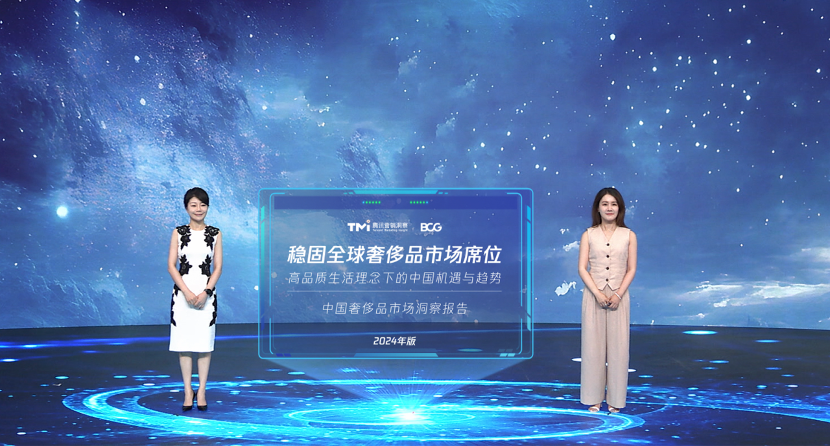
Despite the global macro economy’s negative trend, high-end fashion consumption remains active, with the Chinese market leading the way in retail and cultural influence. The rise of online digital experiences has made omnichannel marketing essential for luxury brands to tap into the valuable and diversified Chinese consumer market.
Focusing on the trend foresight of the luxury market, Tencent Marketing Insights (TMI) and Boston Consulting Group (BCG) have once again teamed up to launch the “China Secures its Place at the Global Luxury Table – 2024 China Luxury Market Insights Report”, which explores how luxury brands can continue to stimulate their vitality and achieve growth through the cycle of the new consumption cycle.
Related Articles
Brand communication in the fashion industry has taken a daring plunge into uncharted territory.
With the maturing market, consumers worldwide now prioritize high-quality living and a diverse range of values, resulting in a shift in demand from products to services and cultural experiences. In the realm of marketing, the focus has shifted from brand volume to striving for compelling connotations.
As a result, the fashion industry has shifted its primary goal to engage with culture, environment, and people in the new normal. Luxury brands now rely on three main strategies for achieving new qualitative growth: maximizing exposure, securing prestigious endorsements and delivering top-notch operations.
On September 5th, Tencent Marketing Insights (TMI) joined forces with Boston Consulting Group (BCG) to release the “China Secures its Place at the Global Luxury Table – 2024 China Luxury Market Insights Report” (referred to as “the report” hereafter). Over the past five years, careful observation of the market has revealed that the consumption of luxury goods in mainland China is projected to reach $80.3 billion in 2024, showing a yearly growth rate of 4 percent.
The Chinese market has consistently accounted for 20 percent to 25 percent of the global luxury goods market in the last five years. This not only confirms the significant role of the Chinese market in the global luxury industry but also highlights how China empowers brands as a crucial consumer market and a hub of brand culture by ensuring their style aligns with the evolving trends. The Chinese market was tapped into to unleash the maximum efficiency of the traffic pool through a unique dialogue encompassing social media effects, commercial consumer recognition, business dynamics and cultural potential.

High-Value Exposure: Creating “Wow” Moments
For major event communication for luxury brands, localization market strategies are key to establishing an emotional resonance with the target market. Brand growth can be greatly boosted during market downturns through the production of precise content and active cultural interaction.
As the customer base evolves, luxury brands are actively engaging in innovative methods to stay in touch. Kiki Fan, general manager of Tencent Marketing Solution commented, “As a very important base for future high-spending customers, medium-spending customers are the major driving force for the future sales growth of every luxury brand. At the same time, we are seeing an increasing emphasis on the identification with the brand spirit and the association with personal emotions in them. Building brand vitality and deepening brand connections with them has become a goal that deserves the emphasis of the fashion industry.”
Nevertheless, the advent of the digital age has not only challenged luxury brands to maintain their high-quality standards but has also raised the bar for them to effectively engage their target audiences and forge meaningful connections with the new generation of consumers.
In the field of cultural marketing, particularly in the realm of fashion luxury brands, the focus is on utilizing the Chinese market as a means to reach a wide audience and promote the brand’s essence and product vitality. This, in turn, has a positive impact on retaining the brand’s customer base.
Luxury brands like Cartier, Loewe and Louis Vuitton have demonstrated a shift in their marketing approach this year. Instead of solely focusing on consumer functionality, they are now placing a strong emphasis on storytelling, brand recognition and event-oriented features. These cases, including the Cartier exhibition, the Loewe exhibition and the Louis Vuitton bookstore, highlight the brands’ efforts to engage everyone and create immersive experiences that leave a lasting impression. These initiatives aim to create “wow” moments for consumers.
Integrating digital marketing with offline activities represents a comprehensive transformation of traditional marketing approaches. It transforms the brand’s role from simply selling a single product to curating a complete lifestyle. Moreover, it shifts people’s attention away from the limited availability of physical goods to the distinctiveness of personalized experience and cultural identity.
According to the report, Chinese consumers are becoming more worried about the vitality and connotation of luxury brands. Consumers prioritize brand vitality based on three essential factors: leading aesthetics and quality of life, staying relevant to the current trend and fostering a deep connection with local culture.
The Tencent ecosystem, with access to a billion-strong luxury consumer base (R0), offers luxury brands more than just broad, precise exposure to anchor their core high- and mid-value customers. It creates a conducive environment for personalized engagement between brands and their target audience.
By leveraging key marketing touchpoints such as “fashion shows + exhibitions,” Tencent empowers brands with enhanced product design iterations, robust data insights and advanced marketing science tools. This ecosystem delivers solutions that are “highly targeted,” “strategically optimized,” and “broadly scalable,” positioning luxury brands for sustained growth and market leadership.
This year, over a hundred luxury brands’ fashion shows were staged on the Tencent platform. Weixin unveiled its first-ever search section exclusively for Fashion Week during the June event, merging mini-programs, video channels and search features to provide users with a comprehensive viewing experience.
In August, Weixin upgraded its live broadcast promotion solution for major events. For example, Balenciaga successfully integrated with Tencent’s ecosystem during the Balenciaga 2025 Spring collection show in Shanghai. They utilized their Weixin channel and Tencent Fashion App for simultaneous live broadcasts. They also increased user engagement by introducing a new feature called “live broadcast room display in real-time” in Moments. At the same time, they effectively targeted the right audience using R0 audience targeting capability to capture the industry’s potential market.
Moreover, the fashion show not only showcases the brand’s iconic narrative but also reinforces its strong ties with the Chinese market and culture. The Cartier Trinity 100 theme exhibition, centered around a mini-program, perfectly replicates the offline immersive experience online. Cartier has taken the lead in the luxury industry by introducing the Weixin Channels + mini-program dual touchpoint live broadcast strategy, focusing on enhancing the user’s exhibition journey.
This strategy covers the entire process before, during and after the live broadcast stages to optimize the omnichannel experience and significantly improve the offline traffic efficiency of the exhibition. As a result, this led to an impressive performance, as it garnered over 20 million new brand audience assets and maintained an average exposure cost that was 40 percent lower than what is typically seen in the industry.
Additionally, the documentary “Inside the Dream of Dior” is exclusively available for cloud screening on Tencent Video, Omega presents the “Olympic Timing Legend” moments through the Tencent ecosystem and Jaeger-LeCoultre partners with QQ Music to create a new style of splash screen redirects to the single track page, player flip special effects, interpreting the brand’s brilliance of “Reverso- Love Beyond the Surface”. By leveraging Tencent’s vast content resources and diverse touchpoints, the “sense of vibe” of major luxury brand events is brought to the climax.
High-Quality Endorsement: From “Product Offer” to “Brand Offer”
The shelf model is not compatible with luxury brands. Product endorsements may provide short-term solutions for luxury brands, but the real key to long-term success lies in building brand power.
According to Kiki Fan’s observations, the Covid-19 pandemic has led to a rise in online interaction, demand and conversion among Chinese consumers in the past few years. However, if luxury brands persist in relying solely on online purchases for their high-end and costly luxury goods, it becomes easy for them to become more focused on “product offers” that primarily revolve around comparing prices.
This approach would weaken the appeal and personalized services of offline experiences to users, resulting in a decline in average order value, customer loyalty and annual purchase frequency. Hence luxury brands should go beyond online interactions and engage with customers offline to introduce their products, establish connections with customers and deliver enhanced service experiences. This is the crucial marketing role that sets luxury brands apart from one another.
Furthermore, when compared to other consumer product categories, the desire for high-quality content among luxury goods consumers can be described in two ways: it is deep and the ambiance is pure and exquisite. In this realm, Weixin holds great significance.
The report indicates that brand advertising has held the top position as the most effective type of content for attracting buyers among consumers, between 2023 and 2024. In 2024, brand concepts like brand documentaries have gained popularity and are now the second most-watched content by consumers.
For luxury brands, the most important thing is how to find the right balance between endorsement, customer conversion and community culture, as these factors directly impact the credibility of their product endorsement. The unique and valuable features of luxury brands necessitate more detailed content to successfully promote them, enabling consumers to comprehend their culture, heritage, craftsmanship and groundbreaking design.
This fosters a stronger connection between customers and the brand, rather than simply focusing on short-term marketing of new products. In terms of brand endorsement, Tencent aspires to join forces with all content creators and brands for in-depth category endorsement in the future.
According to the report’s data, all channels are increasingly effective in capturing consumers’ attention through endorsements, with online brand marketing being the most prominent in recent years. When it comes to online endorsement for consumers, Weixin Official Accounts play a vital role as the primary touchpoints, making up a significant 80 percent share. Additionally, Weixin Channels presents an untapped market for content and offers brands a video-based language to effectively engage with the younger audience.
Weixin provides a trustworthy social environment where luxury brands can utilize various content distribution channels like Official Accounts, Weixin Channels and live broadcasts to create a seamless closed loop. This loop effectively lowers the barrier for consumer purchases. Akie Feng, director of Luxury Industry at Tencent Marketing Solution, believes that the shape of social media affects the efficiency of brand-to-consumer communication.
Within the Tencent ecosystem, in the rich content fields of graphics, music, games and videos, high-quality content produced by talented individuals can be endorsed in social circles for medium and high-spending customers, superimposed with the influence of celebrities and KOLs on young consumers, which can further help the brand establish their identity, strengthen consumer value alignment and achieve deeper psychological resonance and brand endorsement.
In honor of PIAGET’s 150th anniversary, the brand teamed up with media outlets to introduce an innovative live broadcast model. Accompanied by a panel of professional watch critics from Tencent Video, including Ding Zhixiang, Victoria Zhou, Bai Yingze, Laura Lan and Jenny Jing, the brand showcased its story comprehensively during the watch exhibition.
This campaign garnered more than 75 million exposures across all platforms, with a live broadcast audience volume exceeding 5 million on Tencent Video. Additionally, there were over 2 million live viewers on Tencent Video and a total of over 3 million views on custom content. Furthermore, Tencent Fashion, Jenny Jing and Watch Traveler published immersive brand-focused content on Weixin Channels, thereby enhancing the impact of the major event.
High-Quality Operation: Tencent endorsement brings omnichannel harvests
In 2024, having omnichannel access has become a vital term in the global market.
For luxury brands, the most important asset is their cross-platform omnichannel audience. Leveraging its robust data capabilities, Tencent Marketing Solution has introduced its science marketing system this year. This system encompasses various audience levels, including reach, response, resonance, action and trust, as part of the 5R core audience asset model.
According to Akie Feng, omnichannel operation revolves around two main factors: understanding customer needs and optimizing the conversion funnel.
First, luxury brands need to assess if they can reach their target customers through multiple platforms, considering the rising costs of traffic. They also need to evaluate the frequency of communication and the likelihood of conversion before taking any action. The Tencent science marketing system offers luxury brands a customer asset dashboard, leveraging the large user base of the Tencent ecosystem. This dashboard helps them analyze the transition rates and health status of different customer segments, including lightly interactive, heavily interactive, converted and repurchase segments.
Second, luxury brands can take advantage of Tencent’s omnichannel operations to determine the most suitable locations for their business. With high interconnectivity, Weixin traffic has been opened up to third-party e-commerce platforms, breaking down the barriers to online transactions. Simultaneously, they establish effective connections between online and offline by utilizing touchpoints like WeCom and mini-programs to expand business scenarios.
According to research conducted by Tencent Marketing Solution in collaboration with third-party companies, 80 percent of consumers who were exposed to Tencent’s online traffic were successfully directed to offline trials and transactions, resulting in significant business growth. Put simply, the transaction location is no longer important as Chinese consumers are embracing an omnichannel approach.
Fluctuations and various transformations are widespread occurrences in the contemporary market economy. China’s luxury goods market serves as a model for global ecosystem strategies and encourages brands to confidently pursue opportunities in China and worldwide expansion.
Looking ahead, we can see a thriving and limitless future for China’s luxury market. To progress to the next level, the Tencent ecosystem will support luxury brands in meeting market challenges and achieving qualitative growth through three primary capabilities: high-spending major event exposure, high-standard brand endorsement and high-quality omnichannel operation.