
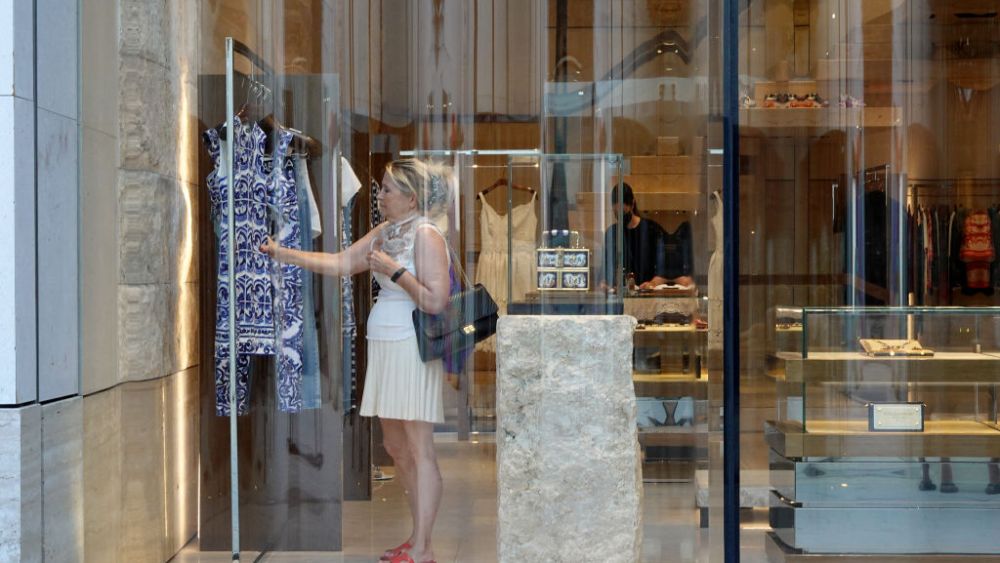
Luxury rediscovered the New World during the pandemic — and it paid off handsomely in 2022.
High-end American consumers fueled luxury’s continuing boom this year, whether by powering through the economic malaise and inflation to spend big at home or taking advantage of the strong dollar on shopping sprees through Europe.
The U.S. has long been a key market for designer brands, but it took on a new, higher profile this year as strict zero-COVID-19 policies put a damper on the Chinese consumers. (Chinese shoppers were only recently able to reemerge from lockdowns and are now being held back anew by a wave of COVID-19 infections.)
Related Articles
European luxury shoppers held on much better than their Chinese counterparts and continued to spend even with war in Ukraine and its economic consequences, but it was Americans — with their American dollars — at the forefront.
You May Also Like
At home, both Saks and Neiman Marcus benefited, in part because high-end shoppers continued to click away.
While overall e-commerce growth waned as the worst of the pandemic eased, Marc Metrick, chief executive officer of Saks, said, “It’s a little bit of a different story for Saks,” which is the e-commerce business for the Saks Fifth Avenue luxury brand.
“We’re still getting the big growth online that we want,” Metrick said. The CEO’s third-quarter letter to vendors said GMV rose 17 percent, on top of a “solid” third quarter last year. The site is trending 115 percent ahead of its pre-pandemic business.
Neiman Marcus Group said it topped $5 billion in gross merchandise value for its fiscal year ended July 31, with comparable sales up 33 percent and adjusted earnings before interest, taxes, depreciation and amortization of $495 million.
“We are really encouraged that we are seeing growth with the luxury customer buying at full price,” said CEO Geoffroy van Raemdonck in October.
Two percent of the company’s customers account for more than 40 percent of its revenues, with the high rollers averaging about $25,000 annually.
The company’s neimanmarcus.com and bergdorfgoodman.com sites logged 300 million visits.
That was enough to get the attention of José Neves, CEO of Farfetch, which made a $200 million investment in Neiman’s and will be “replatforming” NMG’s Bergdorf Goodman and Neiman Marcus websites next year.
“The U.S. is still the largest luxury market in the world,” said Neves, noting that younger shoppers have become a strong component of the “very mature” market in the U.S.
“These new generations are driving a majority of the growth,” he said. “These are generations that grew up hailing an Uber as opposed to hailing a taxi. This is a digital-first customer that is fueling the growth of online.”
Luxury shoppers always hold on better than lower-end consumers if only for the simple fact that they have more discretionary dollars to spend.
Often the luxury crowd is swayed by the stock market as the value of their portfolios change, but that doesn’t seem to have been much a factor this year, even with the crypto meltdown. There have been wild swings on Wall Street with all the hand wringing over inflation and recession, but still the Dow Jones Industrial Average is down just about 10 percent for the year.
Still, the hunt is on for the source of this spending strength.
In a report this month, Morgan Stanley had a novel take, pointing to data that shows nearly half of young adults in the U.S. live with their parents — a historical high not seen since the Great Depression.
Morgan Stanley was looking to tease out just how much of the “very significant growth of luxury in the U.S.” is a function of factors that could prove cyclical or are longer lasting, suggesting a larger addressable market for designer brands.
“Amongst the factors which have contributed to a broadening of the [total addressable market] are the fact that luxury consumers in the West have clearly been getting younger over the past few years (they were already young in China pre-pandemic, with an average age ranging from 25 to 30 years old),” Morgan Stanley said.
“We think the structural change in demographics might have been overlooked,” the research said. “One of the key demographic trends in the U.S. (and the broader Western market) has been the rising number of young adults living with their parents, driven by financial concerns (i.e. rental costs) as well as other sociological factors (e.g. higher penetration of higher education and increasingly delayed age for marriage). We believe that the trend benefits discretionary spending.”
The bank also pointed to social media as a luxury driver in the West.
There has also been a desire to splurge as the worst of the pandemic passed and consumers felt more than ready to be out and about again.
Whatever it was, Americans were out spending.
“In the last year and a half, the propensity to buy in the U.S. was insane,” said BCG managing director Joel Hazan, when the consultancy released research on high-end shopping with France’s Comité Colbert in June. “If you look at consumer prices across all luxury categories, like hospitality, in the U.S. they still are willing to pay a lot.”
The Comité Colbert-BCG report showed that the global luxury market has returned to pre-pandemic levels, and predicted 6 percent growth to $517 billion in 2026.
As is so often the case, it’s been a market where the sector’s leading giants were able to gain more.
“We see no tangible signs of slowing down,” said Jean-Jacques Guiony, chief financial officer of LVMH Moët Hennessy Louis Vuitton, in July.
The U.S. accounted for 27 percent of the luxury leader’s total revenues in the first half, up from 25 percent a year earlier.
“We are not particularly gloomy and pessimistic as to the outlook,” Guiony said. “Obviously we hear what a lot of people are saying about the coming recession. We are planning the business for growth. If things happen to be not as good as we anticipated, we will react and we will cut costs, openings, etc., as we always do. The key of this is to react swiftly.”
LVMH’s momentum in the U.S. went on to slow in the third quarter, but Guiony said it wasn’t a pull back by consumers, but a change in where they were shopping.
“Part of the business shifted away from the U.S. and is now taking place in Europe as American citizens tend to benefit from the strength in the U.S. dollars,” the CFO told analysts. “When we look at the American clusters or the clientele, the business we do with Americans overall, in [the third quarter], we ended up with a very good level of business, which is comparable to what we did in [the first and second quarters]. But the way it spread out in between the domestic market and touristic markets is entirely different.
“So it explains also the strength of the European business, which continues to show very good numbers despite the fact that the comparison basis in Europe is turning more and more complicated as time goes by,” he said.
And that is true across the board as the consumer landscape only gets more complicated going forward — with interest rates rising and recession threatening all over, selling into the Russian market now out of the picture for most major brands and China headed into the next, uneasy, leg of its pandemic journey.
The American consumer — whether living above their parents’ garage or not — powered luxury in 2022.
Next year remains an open question.