With eight college campuses rooted in Providence including the Rhode Island School of Design and Brown University, the city’s arts-friendliness and independent spirit have only grown over time.
With a population of approximately 190,000, Providence is manageable and affordable for creatives and entrepreneurs compared to New York City, Los Angeles and San Francisco. While RISD grads such as fashion designers Robert Geller, and Nicole Miller, artist Shepard Fairey and “The Talking Heads” David Byrne have sprung into wider fame, younger talents are building their businesses in Providence with innovative ideas and nonfabricated community mindedness.
The city’s indie spirit can also be seen in a bevy of vintage clothing stores, including longtime ones like Savers, Nostalgia Providence and The Salvation Army. A Goodwill Outlet store opened last summer and the Bangled Tiger, Old Bag, The Vault, The Nest, The Thrifty Goose, Second Time Around and The Warde-robe. The selection is an indication of Gen Y’s and Gen Z’s interest in buying and donating secondhand clothing. But thrifting’s appeals wider, considering that approximately one-third of the clothing that was purchased in the past year was secondhand, according to CapitalOne Shopping Research.
Related Articles

A few start-ups are using their stores and studios to sell vintage and to help other up-and-coming talents sell their wares. Five years after starting their company Shop Bloom PVD, Savannah Barkley and Heather Wolfenden opened a 1,600-square-foot store at 243 Wickenden Street in August. They offer short-term residencies — typically about three months — to artists, creatives and local business owners to not only give them greater visibility and boost sales, but to provide insights about their respective businesses. “A lot of these folks are really creatives at heart and we want to make sure that they have more business acumen,” Wolfenden said.
As of 2022, arts and culture in Providence was a $207.5 million industry that employed more than 5,100 people. The city is just about at the midway point of its “PVDx2031: A Cultural Plan for Culture Shift,” and public art is a key part of that initiative.
The current assortment includes unisex clothing from a few vintage stores including Island Vintage, which Wolfenden owns that also has a store on Martha’s Vineyard. Shop Bloom PVD also has pre-worn looks from Faded, which does pop-ups in the Boston and Providence area. Shop Bloom PVD is looking into clothing swaps, too. Just as the rotating brands may be testing the waters for stores of their own, Shop Bloom PVD is also using its store to test possible further expansion. Wolfenden said, “Providence is a really special place to grow a business. It feels like the community really rallies behind something new. It’s small enough where you can usually understand what’s going on and you can be really intentional about who you support. We’re really grateful to have so many wonderful people behind us.”
You May Also Like
Another relative newcomer to the retail scene is GreeneStone Studios, which debuted in August at 1160 North Main Street. It houses two businesses: Brendan Greene’s clothing brand Greenewrks and Sawyer Stone’s vintage curation Never Miss Thrift. The childhood friends started their companies as undergraduates at Providence College and Clemson University respectively. Many drop by the 1,800-square-foot space looking for unique $25 T-shirts to add to their collections — whether that be a vintage band one or a screen printed Greenewrks one (which is done on-site.) Shoppers can also make custom requests, Greene said. Outerwear, pants, and other styles are in the mix, too.
Inspired partially by the community vibe that exists in skate culture, GreeneStone Studios offers free pop-ups to small clothing brands, ceramicists, artists or musicians. Greene said, “If anyone thinks they can benefit from presenting their work in our space and they’re a friend of ours, and we think they’re cool, we’re not taking any money,” Greene said. “We really want this to be a space for all of us.”
Hailing Fairey’s early days starting Obey in Providence, Greene said he also liked the fact there is no Obey flagship in the city. GreeneStudios also wants people to hang out. Well aware of how sometimes workers in some New York City streetwear stores size up shoppers as soon as they walk in the door, Greene said, “We’re really here to include people. We want people to come to take their lunch break, to yack with us, eat their sandwich and skateboard out front [where a bench is meant for tricks].”
He added, “This store is everything to me. It’s important that people want to hang out here. It’s really more of a community space than a retail space at the end of the day. Providence is the perfect place for that for so many reasons. There are a lot of hardworking creatives that we have been able to wrap into our universe, which is just really exciting.”
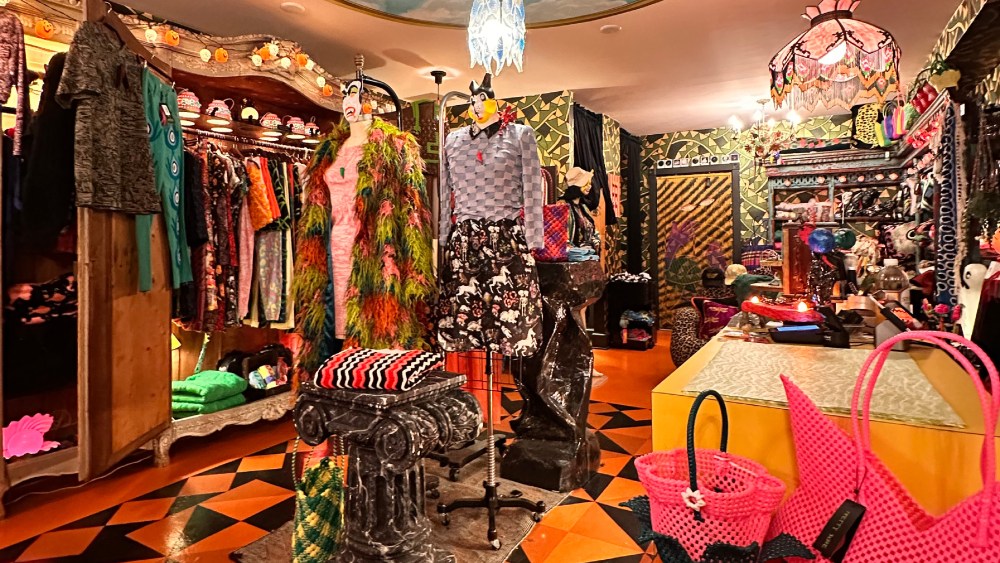
Twelve years after starting Pretty Snake in Providence, Joseph Aaron Segal is still very high on the city. In July 2024, the company unveiled a freestanding 500-square-foot store in the Fox Point neighborhood. Designed to be “an emporium of curiosities,” the outpost offers apparel, home decor items and textiles that Segal designed. He handles the print design, and a small team does the sample making on-site. With retail prices ranging from $50 to upward of $300 for knitwear, Snake Pit’s $26 men’s underwear is the most popular item for guys. The waistband features a snake eating its tail, which is sign of rebirth and growth, according to Segal. For women, $90 slip dresses having been selling well.
Being in the city enables Segal to teach at his alma mater RISD and to build his company gradually. Although sourcing material can be more challenging compared to Manhattan, he said he can still tinker in Providence and enjoy the quality of life offered there. He said, “When families are visiting RISD, Brown and Providence College, they’re looking for something a little different. I’ve taken a risk by making something really unusual. And it’s been successful in drawing people in.”
Having established his business before interest real estate prices started to rise, Segal said artists are starting to be displaced by former New Yorkers and Bostonians. He said that can be a mixed bag. While the newcomers from bigger cities may have bigger spending budgets, “which is great for business,” that’s “also making it harder for the artists to stay. We’re at this turning point where we’re not sure, which way it will go,” he said. “But there are people, who believe in small businesses and support creative enterprises.”
Another RISD alum Nicole Romano, who is from Rhode Island, started her signature jewelry business in Providence 15 years ago. That was due partially to her family’s intergenerational ties to the city’s jewelry industry, which dates back in its most simplistic form to the 1890s. Being able to work elbow-to-elbow with skilled artisans like solders and platers is one of the upsides. She said, “There’s much more history and depth here than a piece of jewelry that gets manufactured anywhere else.”
Noting how initiatives are in place to support young artists and designers – such as the Design Catalyst Program, Romano said, “Providence is such a small and tight-knit community that you can be very resourceful in an easier and quicker way. And you can make things happen for your business, because everyone is so close and supportive in the community. It’s not a vast city – it’s so much easier because of that.”