If it wasn’t for Jockey, men might still be wearing union suits.
It was in 1934 that the company created a brief with a Y-front fly that transformed the underwear industry and gave men an alternative to the full-body suits that were the undergarment of choice at the time. The brief, which the company called the Jockey Y-front, a loose reference to the jock strap, sold out the day it debuted at Marshall Field & Co. in Chicago and has become a staple in the zeitgeist ever since.
Related Articles
While the Jockey brief may have put the company on the map, its origins date back much further — 150 years in fact. It was founded in 1876 by Rev. Samuel T. Cooper and his sons, Willis and Henry, as S.T. Cooper & Sons creating socks for lumberjacks. In 1879, following additional investment from Abel Wells, the business became Cooper, Wells & Co., producing hosiery for men, women and children. In 1900, they started producing underwear and incorporated under the name Cooper Underwear Co. In 1972, it finally adopted the name of its hero product, changing the corporate name to Jockey International.

The Kenosha, Wis.-based business is still private and in the fifth generation of family ownership. The Cooper family continued to own the company until 1971, when Harry Wolf Sr., president at that time, purchased what was then Coopers Inc.
You May Also Like
Wolf’s daughter, Donna Wolf Steigerwaldt, took the helm in 1978 and spearheaded the launch of the women’s collection in the early 1980s. Today, Debra Waller, her daughter, serves as chairman and chief executive officer.
“For 150 years, families have trusted Jockey to deliver comfort and quality they can depend on,” said Waller. “As a family-owned company shaped by generations of leadership — from Rev. Cooper to my grandfather, Harry H. Wolf Sr., and my mother, Donna Wolf Steigerwaldt — we approach this milestone with responsibility. Our focus has always been to deliver comfort and quality, serve families and communities, and design for the next generation.”
Mark Fedyk, president and chief operating officer, said the company is “blessed to have an owner that is involved and supportive, and it keeps us anchored to our values.”
Those values, he said, remain the same as when Rev. Cooper started the business and continue to be the company’s motto: “Satisfying the Human Need for Comfort.”
Over the years, Jockey has amassed more than 1,300 patents and trademarks and highlights include stitching a company name into the waistband of underwear for the first time, merchandising underwear outside of closed drawers at retail, creating the first no-panty line underwear for women, launching the Skimmies slipshort, and creating the first volumetric base-fitting system for bras.
“We’re very much an innovative company,” Fedyk said.
It’s also a global company, with its products being sold in over 120 countries.
It operates 64 stores around the U.S., a mix of full-price and outlets, and also has a strong wholesale presence at retailers such as Target, Kohl’s, Walmart and Macy’s, Fedyk said.
“As a private company, we don’t really share the financials, but I can tell you that we operate in both DTC and wholesale channels. They’re both very important. While wholesale has grown, the direct-to-consumer business has grown quicker,” he said.
About a year ago, the company opened an experiential flagship in Nashville’s popular 12South neighborhood, called Coopers 12South. Fedyk said the assortment is skewed heavily toward Jockey’s outdoor and activewear/loungewear offering, “complemented by underwear.”
Although the company has been expanding its apparel collections in recent years, launching an outdoor line with country music star Luke Bryan for example, Fedyk said the majority of the business continues to be underwear.
And even though it was only introduced in the 1980s, women’s has grown to become a slightly larger percentage of the overall business today.
The company sells to a wide range of customers, but its target is the “family optimist,” he said: a 25-to-45-year-old male or female, middle- to upper-middle income “with a discerning palate for style and quality,” Fedyk said. “We probably wouldn’t appeal to a younger customer involved in fast fashion.”
Fedyk acknowledged that the competition in the underwear space today is broad but he believes Jockey can continue to succeed by sticking with the “principles and values that brought us here. We are relentless innovators and uncompromising when it comes to quality.” That includes always working to improve styles, silhouettes, production methods and fabrics to remain current.
North America remains Jockey’s largest market but internationally, it’s India, South Africa, Australia, New Zealand and the Philippines where the company has the largest reach.
Although he declined to provide specifics, Fedyk said there are still a few global markets that represent “huge opportunity” for Jockey, but he also envisions continued growth in North America. “With what’s happening with online shopping and AI, that could be a real accelerant.”
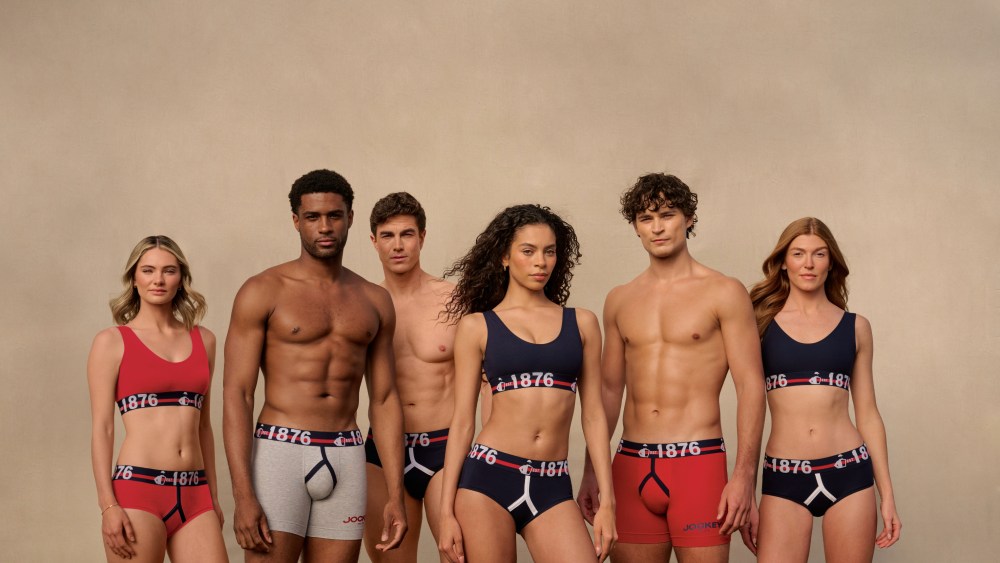
Another accelerant could be the 1876 Collection of limited-edition product that Jockey will be releasing for its 150th anniversary. The line, which will include underwear and other apparel, is an “interpretation” of some of the brand’s greatest hits, reengineered with modern materials, updated fits and contemporary detailing.
The first drop will be in March and will continue throughout the year. There will also be events and partnerships with a variety of organizations including America250, Trackhouse Racing, Folds of Honor and New Zealand Rugby’s All Black.
The collection will be available at Jockey stores and online.
And in May, the company will host a celebration in Milwaukee for employees, partners, ambassadors and international partners that will feature brand installations, storytelling and a live performance.
Looking to the future, Fedyk said Jockey’s next 150 years “will mirror our first. I think we can bring the DNA of this brand — the innovation, the quality, the comfort — to a broader audience.”
The goal is to continue to grow the apparel segment, but not at the expense of the underwear. “The focus is really expanding the reach and customer base of the brand,” he said. “We’re at a time where our society needs brands and institutions they can trust and depend on. And I think when consumers learn about the integrity of the company and our true commitment to responsibility, that’s how we’ll grow.”
He said not many people are aware of Jockey’s philanthropic side. In 2005, the company established the Jockey Being Family Foundation to support foster and adoptive families. It stemmed from the fact that Waller had been adopted. Over the years, the foundation has worked with more than 426,000 families and contributed more than $13 million toward post-adoption support while also providing 118,000 backpacks and resources to adoptive families and children.
Fedyk stressed that, beyond sales and profits, what continues to be of utmost importance to the company is “serving families and serving communities. The message we really want to make sure that people hear is that it’s more about mission than it is about money. It’s more about taking care of people, taking care of communities, taking care of families, whether that’s with our product, our philanthropy or our relationships. If we can get that message out there, it’s going to continue to fuel the growth and the popularity of the brand.”