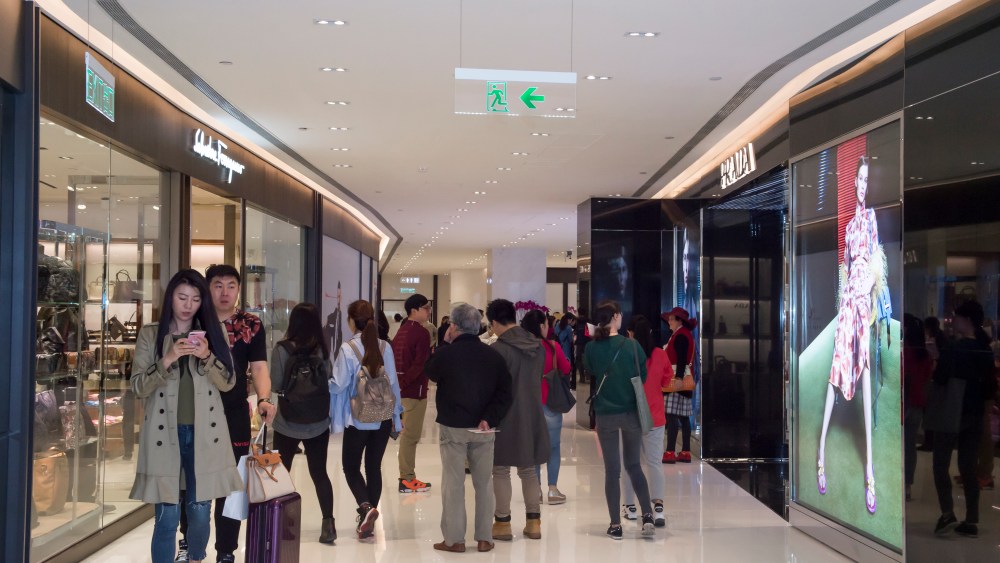
HONG KONG — There is no shortage of luxury fashion stores in Hong Kong but with fewer high-spending Mainland Chinese tourists, it’s now discount outlets that are sprouting up across the city.
This past Saturday, Hong Kong welcomed its first all-luxury outlet shopping complex, Florentia Village. Located in the industrial neighborhood of Kwai Chung and developed by RDM Asia, it soft opened over the weekend with seven tenants including bold-faced names like Prada, Versace, and Kenzo.
“We think it’s the right moment because there’s a downturn in retail. There’s need for retailers to sell some stock,” Maurizio Lupi, RDM Asia managing director, said referring to the 22 consecutive months of shrinking sales. “We think it’s the right investment in the right place.”
Related Articles
The Giorgio Armani Group and Lane Crawford are also set to move in at a later date with more possibly to come — half of the spots in the 60,000-square-foot complex have yet to be leased.
You May Also Like
RELATED STORY: Shenzhen Fashion Scene Emerges From Factory Capital >>
At first, it seems a bit odd that Hong Kong, an international shopping capital, would lack a developed range of outlet retail. But during the years of gangbuster growth, brands were so busy trying to keep up with insatiable Mainland Chinese appetite, there was no need to open them up. Then there was the problem of location. Outlets need to be positioned far away enough from the downtown stores to not cannabalize the full-priced business. In Hong Kong, a densely populated and compact city, that is hard to achieve.
By most measures, Florentia Village is not far from downtown. It’s located 25 minutes from Tsim Sha Tsui’s Canton Road and 35 minutes to the main CBD but Lupi said he wasn’t overly concerned about being too accessible.
“The perception of the distance in Hong Kong is not the same as the States,” he said. “Being in a place that is practically in a storage area, we are in the middle of nowhere for the average Hong Kong[er]. Such important brands are joining us, which means they are not afraid of hurting their image.”
RELATED STORY: Hong Kong Tenants Are Getting Serious Discounts on Rents >>
RDM Asia has experience in its favor although all its projects prior to this have been on the mainland. It has three outlet malls in Tianjin, Shanghai, and Guangzhou, where in aggregate Lupi said they’ve enjoyed 11 percent year-on-year growth in the most recent six-week period. More projects in Wuhan, Chengdu and Chongqing are being developed.

Before Florentia Village’s arrival, Hong Kong bargain shoppers could either go to Citygate Outlets, located in Tung Chung near the city’s airport, or to the smattering of fashion brand outlets in and around Horizon Plaza in Ap Lei Chau. While the southside neighborhood was once relatively remote, a new metro line that opened in December making the area only 15 minutes from the CBD has some in the industry expecting that it will pivot away from the handful of fashion outlets it has–Prada, Lane Crawford, and Diesel–to more fully cater to its furniture and home discount shopping tenants.
RELATED STORY: Hudson’s Bay Co. Believed to Have Chinese Partner in Deal for Macy’s >>
Retail Outlet Management founder Ivano Poma said that as a general rule of thumb, brands keep six full-priced retail stores for every one outlet. Poma was the original brains behind the Kwai Chung outlet complex that would become Florentia Village. He ended up selling the project to RDM, whose Asia business he also used to oversee. Seeing that both Prada and Lane Crawford have taken up space in Florentia Village, it seems unlikely the brands would continue to operate outlet stores in Ap Lei Chau for much longer.
Citygate meanwhile is more of a mixed bag of tenants unlike the true luxury labels found in Florentia Village. It is home to some high end brands such as Dunhill, Brooks Brothers, and Max Mara, but it also has the more mainstream Nike, New Balance, and Levi’s in its mall. Although mass retail is faring better than luxury sectors, it still is bearing the weight of the retail downturn. Operated by Newfoundworld Investment Holdings Limited, a consortium of five local developers, the complex ended 2016 down 8 percent from the year before.
RELATED STORY: Chinese Label Bosideng Shutters London Flagship >>
The group has a second plot of land adjacent to its outlets that it’s reportedly mulling developing into a Citygates Outlets Phase II. A spokesman for Newfoundworld Investment Holdings Limited confirmed the 480,000 square feet of retail space is earmarked to be completed late this year or early 2018, but declined to say whether it would be positioned as full-price retail or discount.
Also sensing an opportunity, start up concepts like On The List, are taking a boutique and digital approach to the outlet business. Founded by Diego Dultzin Lacoste and Delphine Lefay in January of last year, the firm helps brands get rid of excess stock in pop-up sales around the city in lieu of a permanent brick-and-mortar presence.
By keeping each sale to a few days, it limits any potential damage to the brand image, Lacoste said, and the company is conscious of picking elevated spaces as venues. For instance, they hosted a sale for Italian men’s shoe brand Santoni at the city’s revered China Club and for its Leonard Paris sale it went to the Fringe Club, an arts performing venue. At the one-year mark, it had organized 29 events with each event averaging 2,000 attendees over four days. To date, they have upwards of 50,000 members.
The business idea came to the pair because they found that Asia had relatively few channels to get rid of excess stock. Many brands have been shipping it back to the U.S. or Europe or even destroying products, he said.
“Brands were trying to organize staff sales, friends and family sales, but they don’t have the database. If they invite their own customers, it will cannibalize their business,” Lacoste said.
RELATED STORY: Sports Mall to Displace Hong Kong’s Iconic Sneaker Street >>
The company offers the additional benefit of QR tracking. At most traditional sample sales, Lacoste said, staff don’t bother to track who is buying what, as brand managers are often just desperate to get rid of the product. But On The List requires sign-up to be allowed into the sales, and each person’s individualized QR code is scanned at purchase, allowing On The List to track and collect insights about their members’ behavior across all of their events.
“We want to protect the image. We don’t want to have any daigou or gray market parallel people coming and shopping it and then selling it on the internet. There is the control with the QR code,” Lacoste said.