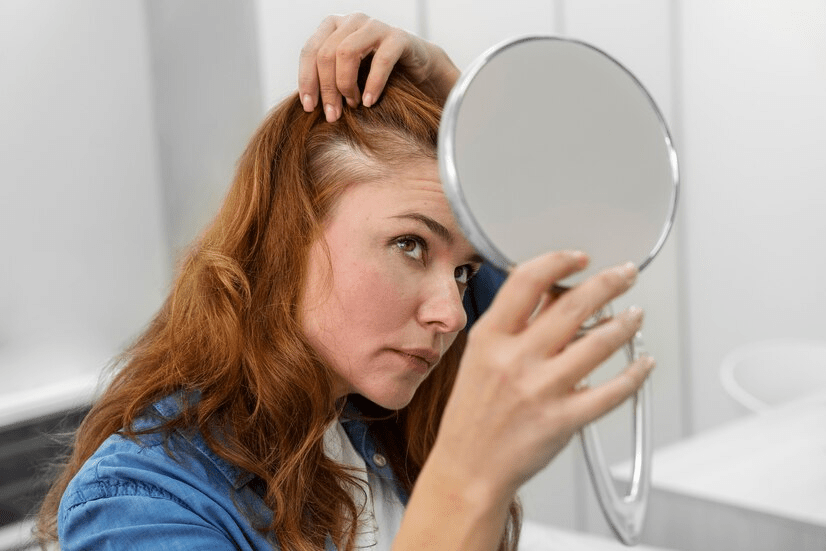
As time passes, women go through a variety of changes in their skin, body and hair. It’s a beautiful and natural process and women’s inherent beauty endures despite these changes. However, embracing the journey of aging doesn’t mean ignoring the potential challenges. Let’s take a close look at a delicate topic: hair loss in women. Understanding the causes, which can range from hormonal shifts, daily hair routines to genetics, empowers women to make informed choices about their hair care.
Follicles on the Radar: Causes of Hair Loss in Women
A woman’s self-assurance often hinges on her hair. Generally, women invest twice as much in their annual hair care routine compared to men, and a whopping 81 percent of women believe that their confidence affects the state of their hair. During your typical daily hair care routine, you probably observe a few hairs on your brush. The bottom line is that we say goodbye to between 50 to 100 hairs every day on average. It’s all just a natural dance of hair falling out and new hairs growing in its place.
Related Articles
What would happen, though, if this delicate balance gets disrupted? How would you feel if your hair fell out faster than it grew in? Well, this is exactly what we call hair loss. And forget the stereotype – hair loss isn’t just a men’s thing. Over 50 percent of women experience noticeable hair loss with female-pattern hair loss (FPHL) taking the spotlight. According to a study, by age 50 about 40 percent of women will have encountered this follicular challenge. It turns out, even our locks come with their own midlife crisis.

Almost every woman will experience some degree of FPHL at some point. While it can kick in post-puberty, it is most commonly noticed around menopause when hair loss tends to intensify. As the candles on the birthday cake increase, so does the risk, particularly for those with a family history of hair loss. It is significantly impacted by genetics. Hair follicles affected by this condition undergo a process called miniaturization. This implies that as time passes, the affected hair follicles shrink, resulting in shorter, finer hair. Certain follicles may eventually cease to produce hair entirely. Women with FPHL typically notice diffuse thinning over the top of the scalp and generally the hairline is kept in place.
The Hidden Impact of Tight Hairstyles on Your Hair
Is it possible that your stylish braid or sleek ponytail is actually harming your hair? Let’s explore the surprising effects of tight hairstyles and reveal the secret story behind your go-to looks. Get ready to reconsider the impact of your everyday hairstyles on your hair’s health!
Tight hairstyles, such as braids, ponytails, and cornrows, can contribute to hair loss in women, a condition known as traction alopecia. This type of hair loss results from the constant pulling force on the hair roots.
Beyond the aesthetic concerns, constant pulling can cause inflammation around the follicles, disrupting their normal function and impeding essential nutrient supply due to reduced blood flow. In severe cases, the tension can even cause scarring, resulting in permanent hair loss in affected areas. While it is most commonly seen in women of African descent with tight spiral black hair, recent research suggests that the primary risk factor for traction alopecia is hair care practices rather than specific hair types.
How can you protect your gorgeous strands while rocking your favorite hairstyle?
Don’t want to say goodbye to your fashion habits while keeping your hair? Fear not. Here are some quick tips for you to keep both your style and your hair intact.
- Loosen your hairstyle, especially around the hairline, if it is pulled back.
- Wear tightly pulled styles, like braids, for no more than two to three months.
- To reduce constant tension, diversify your hairstyles. Allow your hair to recover before switching styles. For example, after wearing cornrows, consider loose braids or embracing your natural hair for a few months.
If you wish to self-assess the potential onset of traction alopecia, keep an eye out for small flesh-colored or white bumps near tightly pulled hair follicles, as well as symmetrical hair loss along the hairline.
Your Action Plan to Tackle with Severe Hair Loss
For women, losing hair is more than just strands falling out; it’s a more challenging journey because, let’s be honest, society can be a little less accepting. A thorough study revealed that for women, hair loss means fewer positive moments, increased social anxiety, a drop in self-esteem, and a decrease in overall satisfaction. It is more than just a physical change; it is a rollercoaster that affects emotions and life quality.
In severe cases of hair loss in women may not be reversible with medications or supplements. But don’t worry ladies – there’s a remedy for every ailment.
Thanks to the latest advancements in hair transplant technology, gaining confidence back and thick hair has become easy. With the highest techniques such as FUE and DHI hair transplant, a precise, natural-looking and safe hair transplant is possible for females. The chief executive officer of MCAN Health, a reputable hair transplant center, states that hair loss caused by menopause, pregnancy, extreme stress, or genetic factors adversely impacts women’s lives. By witnessing the experiences of numerous female patients, they have noted a significant and positive transformation, observing women gain confidence, beauty and a glowing self-perception.
References:
- Aukerman, E. L., & Jafferany, M. (2022). The psychological consequences of Androgenetic Alopecia: A systematic review. Journal of Cosmetic Dermatology, 22(1), 89–95. https://doi.org/10.1111/jocd.14983
- Famenini S, Slaught C, Duan L, Goh C. Demographics of women with female pattern hair loss and the effectiveness of spironolactone therapy. J Am Acad Dermatol. 2015 Oct;73(4):705-6. doi: 10.1016/j.jaad.2015.06.063. PMID: 26369846; PMCID: PMC4573453.
- Hairstyles that pull can lead to hair loss. American Academy of Dermatology. (n.d.). https://www.aad.org/public/diseases/hair-loss/causes/hairstyles
- G. Fabbrocini, M. Cantelli, A. Masarà, M.C. Annunziata, C. Marasca, S. Cacciapuoti, Female pattern hair loss: A clinical, pathophysiologic, and therapeutic review, International Journal of Women’s Dermatology, Volume 4, Issue 4, 2018, Pages 203-211, ISSN 2352-6475
- Knoedler, Leonard & Ruppel, Felix & Kauke-Navarro, Martin & Obed, Doha & Wu, Mengfan & Prantl, Lukas & Broer, Niclas & Panayi, Adriana & Knoedler, Samuel. (2023). Hair Transplantation in the United States: A Population-based Survey of Female and Male Pattern Baldness. Plastic and Reconstructive Surgery – Global Open. 11. e5386. 10.1097/GOX.0000000000005386.
- Pulickal JK, Kaliyadan F. Traction Alopecia. [Updated 2023 Aug 8]. In: StatPearls [Internet]. Treasure Island (FL): StatPearls Publishing; 2024 Jan-. Available from: https://www.ncbi.nlm.nih.gov/books/NBK470434/
- Traction alopecia: Alopecia symptoms and treatment. Skin of Color Society. (2021, April 15). https://skinofcolorsociety.org/patient-dermatology-education/traction-alopecia/
- Unger RH. Female hair restoration. Facial Plast Surg Clin North Am. 2013 Aug;21(3):407-17. doi: 10.1016/j.fsc.2013.05.011. PMID: 24017982.
- van Zuuren EJ, Fedorowicz Z, Schoones J. Interventions for female pattern hair loss. Cochrane Database Syst Rev. 2016 May 26;2016(5):CD007628. doi: 10.1002/14651858.CD007628.pub4. PMID: 27225981; PMCID: PMC6457957.