
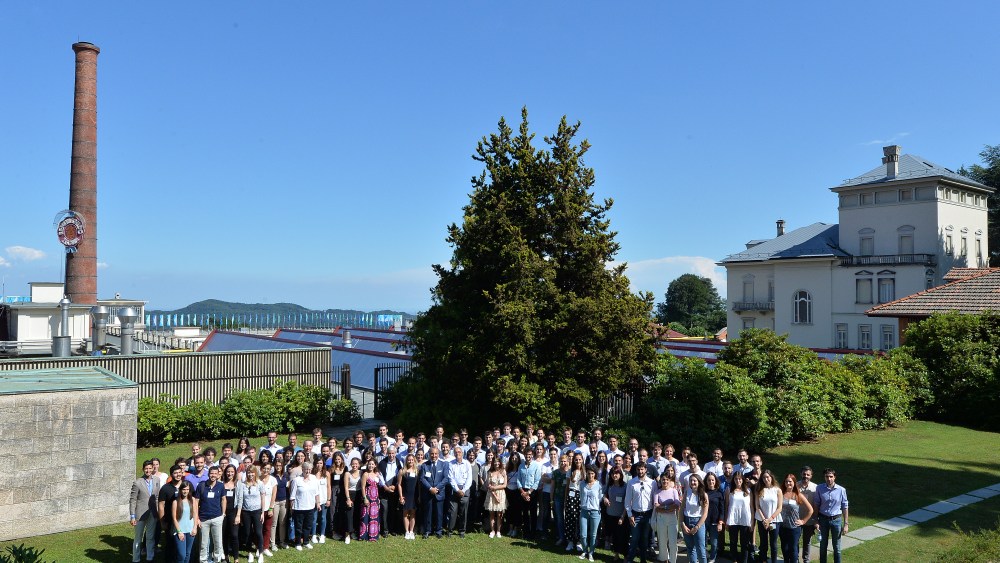
MILAN — Starting in 2014, the Ermenegildo Zegna Group earmarked 25 million euros to stimulate excellence in Italy.
The Ermenegildo Zegna Founder’s Scholarship is a tribute to the namesake founder of the giant men’s wear firm, who died in 1966, known for both his philanthropic activities and his innovative approach to business. Every year, in a 25-year project, the group provides one million euros to enable talented Italian graduates to pursue postgraduate studies or conduct research outside of Italy. The funds are granted on condition that those students return to Italy upon completion of their programs abroad.
“We are taking stock of the situation after five years, and it’s all very positive,” an upbeat Gildo Zegna, chief executive officer of the family-owned group, told WWD. “I have strongly wanted this project and the feedback has been beyond our expectations.”
Related Articles
Earlier this month, to celebrate the fifth anniversary of the scholarship, the group invited the 114 students who participated in past editions of the program as well as the 49 students who are being awarded a scholarship for the 2018-19 academic year, to Trivero, Italy, where the company was founded in 1910 and where it is still based. The scholars toured the Lanificio Ermenegildo Zegna, the Zegna Archives, Casa Zegna, and the natural park Oasi Zegna, a day concluded with a dinner at the family’s charming Bucaneve Hotel, with regional dishes and wines.
You May Also Like
The goal was to share the group’s core values and to highlight some of the tangible results of the founder’s philanthropic vision. The executive emphasized the “excellence, and highest level” of the students and their partners, who were also invited. “There was such positive energy, a shared pride, joy and desire to prove the abilities of the best in Italy around the world. These are Italian talents that will return to the country with a stock of added value that only the confrontation with an international reality can offer.”
Zegna was impressed by the students’ “attention to political, social and economic issues. They value the experience abroad and they hope to improve our country, in both private and public sectors.” To date, 71 awardees have completed their programs abroad, and 20 have already come back to Italy and are employed in “top level” groups, from McKinsey & Co. to Banca d’Italia and Oliver Wyman, to name a few.
For the 2018-19 academic year, 49 scholarships are being awarded to candidates chosen from a list of 64 proposed by 15 Italian universities that are partnering with the Zegna Group on this project, as well as the Fulbright Commission. Most of the new scholars will study abroad for a master’s degree or a Ph.D., while others will attend pre- or post-doctoral research programs of a shorter duration.
Since the launch of the project, 163 scholarships were awarded, of which 73 were bestowed to female students.
The universities include the best in class, ranging from the Milan Politecnico and the Bocconi University to the Scuola Normale Superiore di Pisa to Rome’s La Sapienza. Some of the universities and research centers attended by the awardees include Oxford, Cambridge, Harvard, MIT, Yale, Princeton and Stanford to name a few.
The committee in charge includes Gildo Zegna; Rosario Bifulco, president of medical technology firm Sorin SpA; William B. McGurn of the international law firm Cleary Gottlieb Steen & Hamilton LLP, and Professor Giuseppe Azzone.
The Zegna Group keeps in touch with the scholars while they are abroad and stands ready to offer them advice at the conclusion of their studies, to help facilitate their return to Italy.
The candidates, also selected based on their desire and ability to contribute to Italy, will be able to pursue a master’s degree for a maximum of two years or a doctorate for a maximum of three years, after which they may work abroad for a limited period of time before returning permanently to Italy. Zegna Scholars receive up to 50,000 euros annually in financial assistance. Scholarship recipients who choose to pursue careers outside Italy will be expected to repay the amounts awarded to them, so that they may be used to fund scholarships for future candidates.
Zegna also highlighted the importance of creating a network of alumni that will continue to grow over the years, but he expressed his disappointment that the group’s example has not yet been followed by others with “a similar project with a similar goal. My wish is that this will change through an expanded communication.” In Zegna’s staple understated ways, the company wanted to have specific numbers to discuss. “I now hope word-of-mouth will also contribute to spark similar projects to help curb this unnatural phenomenon of Italian talents leaving the country to seek better opportunities. We need to create a more positive future in the interest of everyone. This is what we as a united family and private company try to do to pay tribute to the founder and his farsighted vision. Like my grandfather, we believe that knowledge, together with personal ethics, form part of the true heritage of our country.”
Zegna said Italy’s educational system is strong, with universities of the highest level. “What is missing is an incentive to help students find a job in line with their expectations, and to give them possibilities.”
In June, on the occasion of the 70th anniversary of the Fulbright program in Italy, the executive received an award from the Fulbright Commission in support of the Ermenegildo Zegna Founder’s Scholarship in the presence of the Italy’s Foreign Minister Enzo Moavero Milanesi, of the American Ambassador to Italy, Lewis Eisenberg, and the Italian Ambassador to Washington, Armando Varricchio. Zegna said Fulbright’s award recognizes the “long-term vision and continuity” of the scholarship.
Founded in 1948 to manage cultural exchanges between Italy and the United States, the Fulbright Commission aims to encourage the exchange of knowledge and activities between the two countries in the field of culture and education through the granting of scholarships toward the pursuit of an academic path in the USA and in Italy.
“The problems are what they are,” said McGurn of Italy’s employment issues, “but we believe this is giving them a leg up on a very rewarding professional life and who knows what the scenario will be in Italy in the long-term, hopefully it will be healthier than today.”
“We live in a globalized world, so it’s logical to spend some time outside Italy,” he said, adding however that the goal is for the students to come back to Italy, so that the selection to this end is quite strict, and that the quality of the candidates “is not surprising” based on the level of the Universities.