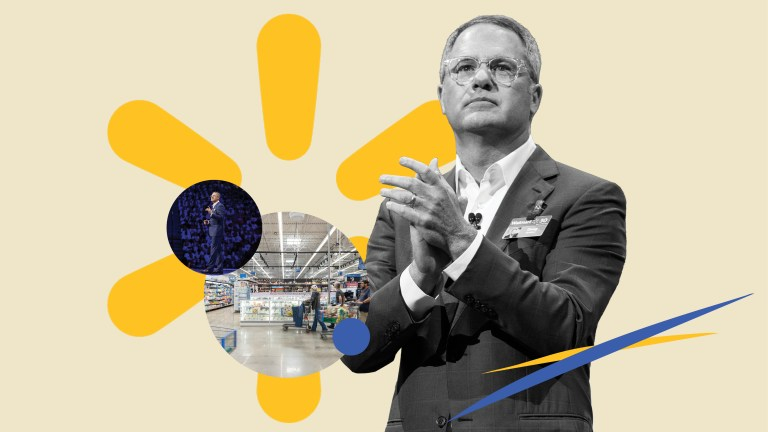
Doug McMillon’s 12 years as chief executive officer of the world’s largest retailer had its share of difficulties.
He took the reins of what was then Wal-Mart Stores Inc. in 2014. The giant supercenter business was slowing. Complaints about low wages and unpredictable schedules for associates were rising. And after more than a decade of ruling the retail universe, Amazon was seen by many as grabbing the consumer throne.
Much more privately, McMillon had to manage all of that while sitting behind the desk of Sam Walton — the big-box retail pioneer who took over the industry from Bentonville, Ark.
Related Articles
“I thought I kind of knew what that would be like because I’d reported to Lee [Scott] and Mike [Duke] and I’d been in Sam Walton’s old office with them for years,” McMillon told WWD last week, referring to the CEOs who preceded him.
You May Also Like
On his first day in the proverbial corner office, McMillon went out with one of the company’s many truck drivers and visited stores, starting a process that would see him jetting around the country, yellow pad in hand, to ask store associates what the company needed to do to reignite growth.
On his second day, the-then 47-year-old McMillon needed to start internalizing the reality that he had become CEO of Walmart.
“My second day I came into what had been Sam Walton’s office and I couldn’t sit behind the desk,” recalled McMillon. “I was intimidated. I was spooked. That’s where all the CEOs were until we moved to this new home office” last year, a campus in Bentonville that rivals the heaquarters of any Silicon Valley tech company.
“I pulled a chair around to the opposite side of the desk where I had more comfort because I’d been on that side of the desk many times and I started working from that side of the desk answering my email and doing other stuff,” said McMillon, his already quiet demeanor quieting even more.
“Mike Duke, my predecessor, came in and walked by and saw me sitting there and started laughing. He said, ‘Listen, I know how that feels, but I’m not doing it anymore. And tomorrow you’re going to sit behind that desk. So today just walk around there a few times and get yourself comfortable. You’re going to do this job.’”
So, on the third day, he sat in Sam Walton’s place and McMillon admitted, “it was very strange to start with.”
But over the course of the interview — one of his last public-facing acts as CEO of Walmart — it became clear both just how much McMillon grew into the job and how much of that humility he retained.
McMillon not only did the job, but proved to be a transformative CEO at a scale where radical transformation is exceedingly rare. And his actions not only reinvented Walmart, but influenced the entire retail sector given the company’s size.
The journey was long.
Under his watch, the company changed its name to Walmart Inc.; bought and eventually shuttered Jet.com; cycled through ownership of Bonobos, Moosejaw and Eloquii; got into the advertising business; exited big divisions in Brazil, Argentina, Japan and the U.K.; set up the new headquarters; navigated the pandemic, and more.
Along the way, Walmart stopped being just the biggest brick-and-mortar retailer in the world and became a legitimate competitor to Amazon — from its growing marketplace of third-party brands online to its ability to deliver online goods to 93 percent of American households with same-day shipping.
How McMillon did it is a case study in how to absorb and embody a company’s values and then use them to steer a new direction. It took a lot of hard work and skill, the ability to make one’s own luck and the support of the Walton family.

Merchant McMillon
While McMillon spent a dozen years at the top, before that he was CEO of the international and Sam’s Club divisions. But for most of his more than 40 years with the company, he was a merchant.
It was the “best part” and “so fun,” he said.
“Being a merchant at Walmart puts you in the center of everything,” McMillon said. “You start with the customer and understanding them and you work all the way through to the suppliers and the supply chain and marketing and operational execution.”
McMillon started with a summer job in Walmart’s warehouse number 2 in Bentonville, where the company’s new headquarters now sits. His dad, a dentist, moved the family there to open a practice and told his son he’d need get a job to pay for college.
“McDonald’s paid $3.35. The Kraft cheese plant didn’t call me back and Walmart paid $6.50 in the warehouses,” he said.
So McMillon took a summer job unloading trailers.
It was an inauspicious start for the future CEO since he rear-ended his boss’ car on the first day.
He didn’t get fired — and Walmart fit well enough that he stuck with it, working later at a store in Tulsa, Okla., as he was in graduate school for business, joining the buyer training program and finally becoming an assistant buyer of fishing tackle at the home office in 1991.
“I moved to ladies’ wear and I was dealing with factories and getting involved in detail like fabric construction and thinking about cut-and-sew costs and granular detail and then moved on to other categories,” he said. “But it was just such a great education in business.
“I was responsible for ladies’ woven tops and related separates back in the earlyish ’90s. I was buying from all kinds of people, Oxford Industries, and I was trying to recruit brands like Tommy Bahama at one point, and I was doing great imports. We would work with designers and we would travel all over the world sourcing all kinds of ladies’ wear.”
McMillon made a lasting impression on Tom Chubb, chairman, CEO and president of Oxford Industries Inc.
While the vendor now has its own branded business, 30 years ago it was all private label, including the Oxford Women’s Wear line sold at Walmart.
“When Doug was involved directly in that business, we were probably doing about $100 million a year with them, which was a big number for us and for them within that relatively narrow category,” Chubb said.
Chubb described McMillon as “one of those guys” who after 30 seconds makes you think he’s “going to do big things.”
“I can’t say that necessarily he would’ve predicted exactly how big, but you could tell that this guy was a special guy,” he said.
And at a special company.
“They’re just such amazing merchants and their logistics capabilities are just unbelievable,” Chubb said. “I never bought into the sleepy old Arkansas business thing, but to see what he’s done during his tenure to truly take them to the next level and the hundreds of billions of dollars of shareholder value that’s been created, I mean, it’s something else.”
During McMillon’s run, Walmart’s share price has shot up 392 percent, easily outpacing the S&P 500’s growth of 298 percent. The company’s stock hit an all-time high of $124.06 on Monday and has a market capitalization of $989 billion. While Amazon has the lead on Wall Street with a market cap over $2.5 trillion, Walmart is far and away the biggest in the brick-and-mortar crowd, easily twice that of even luxury LVMH Moët Hennessy Louis Vuitton, which has a market cap equivalent to about $315 billion.
The retailer’s stock market growth has had two drivers.
One is Walmart’s own expansion — revenues are on track to rise 4.8 percent to 5.1 percent to at least $706 billion this year. That’s a better than 48 percent increase over the past 12 years. The final figures will be released later this month when the company reports fourth-quarter earnings. McMillon spoke to WWD before the quiet period for that report began.
But investors are also seeing a glimmer of where the company is going, with Walmart, Sam’s Club, the marketplace, the nascent advertising business, the international business and more.
Fashion Focus
As high-tech as Walmart has become — its e-commerce business tops $100 billion and its work with artificial intelligence is multiplying rapidly — the company has also found room to improve in fashion, a big business and staple of the retailer that has historically been underloved.
In 2024, McMillon told analysts that the retailer had “punched below our weight on general merchandise, specifically in apparel and home for a really long time, maybe forever.” He attributed the relatively recent progress to in-store remodels, e-commerce and the marketplace.
When asked what changed in the C-suite that ignited the fashion segment at last, McMillon looked to bolster his successor as CEO, who previously led the namesake chain.
“John Furner deserves a lot of credit for this,” he said. “The first thing that changed was that we found the right leader in Denise Incandela and she built a team and she had the right vision for what the fashion categories could mean at Walmart.
“The second thing that changed is we took a longer term view and gave her more time,” he said. “You can’t move our fashion categories in one year. There’s too much work to do. The lead times are too long. You’ve got to be thoughtful about how you bring the customer along. Good, better, best merchandising, for example, has to be well thought out.
“Denise and her team are the primary reason things have gotten better,” he said. “The product’s gotten better, the presentation’s gotten better, our sales have gotten better.”
Good Businesses
While Walmart history is a story of growth piled on top of growth, McMillon was the CEO who started to take risks — buying Jet.com for $3.3 billion in 2016 and control of Indian e-commerce company Flipkart for $16 billion just two years later.
He is the CEO who also learned when to quit.
“One of the things that I experienced and learned through this process, along with the team here, is that being in good businesses really matters,” McMillon said. “The positioning aspects of business really matter. What businesses are you in and what are you not in?
“That played out with us exiting international markets with us closing some stores in different countries around the world, closing some Sam’s Clubs in the United States,” he said. “And when we made an e-commerce acquisition that didn’t work, we dealt with it. We either sold it or we shut it down. That portfolio management aspect of the business is underappreciated.
“If we were still working hard to try and fix Brazil and Argentina, grow in Japan, reposition the U.K., that would all take organizational energy and talent and tech resources,” he said. “And because we learned to say no to some things, we were able to redirect to our bigger opportunities.
“I did not appreciate the significance of that when I started,” he said. “It kind of played out one decision at a time.”
Learning to Engage
McMillon has an almost professorial air that’s articulate, polite and exudes competence — but his skill set was honed by long years of experience.
In the early 2000s, when Scott was CEO and McMillon was a key deputy, Walmart was struggling to bounce back from years of criticism. Walmart had become the poster child of the big bad corporation that underpaid its workers, squeezed its suppliers and tore at the fabric of small-town America.
“We started trying to fight with facts,” McMillon said. “Somebody would accuse us of something like Walmart doesn’t provide health care. And we would say, ‘Oh no, we do. In fact, we cover this number of lives and it’s affordable and here are all the benefits of our health care plan.’ But it missed the news cycle and nobody really cared about the good news. The criticism was much more entertaining. We were losing that kind of reputational battle.”
After a few years, Scott pivoted and said, “Let’s do it differently. Instead of fighting back, let’s just get quiet and listen.”
McMillon said that Walmart, in a way, is like a big start-up, super-focused on its customers and its associates.
“Sam Walton said: If you serve customers well and treat your people well, the rest of it will work out. Don’t worry about what the newspapers are saying, etc. Just focus on those two stakeholders,” he said.
“We started to learn about waste in a different way,” McMillon said. “Renewable energy, our products and the packaging that we were using were scrutinized in a different way. And we learned a lot from the books that we read. I went to a landfill in Atlanta and waded through our plastic private-brand packaging.”
McMillon grew frustrated, wanting to start to make changes, but Scott kept encouraging the company’s leadership to keep learning.
A few weeks after McMillon became CEO of Sam’s Club in August 2005, Hurricane Katrina hit New Orleans hard.
“Lee says to us, ‘New Orleans and southern Mississippi are in trouble. Recovery’s not happening fast enough. And don’t worry about how much it costs. If we miss the quarter, we miss the quarter,’” he said.
“We had a store manager who borrowed her brother’s backhoe and crashed through the front of her store so that people in her community could get into the store and take the supplies they need without paying,” he said. “And she didn’t mention it or get anybody’s permission, she just did.”
Walmart sent supplies, had military helicopters landing in its parking lots — “amazing stuff,” McMillon recalled.
“And the sheriff and other members of the community in New Orleans were then on TV saying, ‘thank God for Walmart,’” he said. “For a few days Walmart was looked at nationally in quite a different way, very, very positive. [Scott] then turned around to us and said, ‘How’d that feel?’ We said, ‘That felt so much better.’ He said, ‘OK, now let’s talk about what it’ll take to be that company every day.’”
While Walmart still has its critics — and always will — the company has become much more practiced at stepping up.
McMillon said that, while the retailer has spoken up on big societal issues on occasion and other times made “a quiet phone” to “use our influence,” the company’s engagement starts with things it’s directly responsible for.
“We have 2.1 million associates. We have approximately 1.6 million in the United States,” McMillon said. “Our job starts with, How are they doing? Do they feel respected? Do they have career opportunities? Do they have the resources that they need, whether it’s wages or it’s the cash bonus or it’s things like supporting the 401k? The last thing we’re trying to do is to be divisive or to create wedges between people. We want to do the opposite.”
Transforming Walmart
When McMillon finally settled into Sam Walton’s old office, there was real work to be done.
For years, McMillon had seen the e-commerce opportunity that Walmart was missing and was itching to go after it. But first he had to get the company’s superstore comparable sales growing again after several down quarters.
“Job One was you got to fix that,” he said. “If you don’t move that number, you don’t have the time and the resources to go and build an e-commerce business.”
McMillon went to the board with a plan straight from the yellow pad he kept with him as he toured the company. It was heavy on paying associates more, giving them predictable schedules and adding back some positions that were eliminated.
McMillon told the board: “Here’s a plan to grow that business. It comes from our associates. I completely believe it will work. The problem is it’s expensive. It’s billions of dollars in investments in our associates and it’s billions of dollars in investments and low prices, and it will take our earnings down, but I think we should do it.”
The board liked the plan, but wanted to supersize it.
“‘We want you to go invest more,’” was the feedback for McMillon. “‘Raise wages more and you’ve got two weeks to figure out what that looks like. We’ll have a call. You tell us what a more aggressive plan would look like.’ That’s where we took our starting wage rate up to $9 an hour and we said in 12 more months, we’ll go to $10.
“It did create the earnings pressure. And we had a tough day in October of 2015 where we lost more than $20 billion in market cap when we quantified for the investment community what the wage increase was going to cost us and told them we couldn’t offset it.”
McMillon has given significant credit for the decision to the Walton family, which continues to own just half of the company’s shares, putting three Waltons ahead of Bill Gates on Forbes’ list of billionaires, ranking as the 11th, 12th and 15th richest families on the planet.
What Does Retail Need More Of?
When asked what retail needs more of, McMillon didn’t pause at all.
“Long-term thinking,” he said.
“The advantage that we have here of having a Walton family still involved is unique. And if you look at what’s happened here, the willingness of that family and our board to take short-term pain to create a stronger business over time enabled all this to happen.
“I look at other retailers, they don’t all have that opportunity,” he said. “They’re under too much short-term pressure and they may know what to do, but they don’t have the freedom to do it because somewhere is going to hold them accountable in a way that’s going to create a bad outcome either for them individually or for the company.
“There are a bunch of smart people working in retail and a lot of them have things they want to do, but sometimes the incentive structures don’t enable them to take a long-term view,” he said.
The Future
Despite that long-term thinking at work, the now 59-year-old McMillon has given little thought as to what comes next for him.
“I don’t know,” he said. “The truth is that I’ve been so focused on this and this work and this transition that I really don’t know exactly what I’m going to do.
“I’ve been working since I was a teenager and having a few months where I don’t have a completely packed calendar is very appealing and my wife and I are going to figure it out, but it may take months for me to sort that out.”
He’ll remain on the board until June and stay on as an adviser to Furner for a year.
McMillon, who has two grown children, described that consigliere role as being a Walmart “associate.”
And that’s fitting. At the interview, he wore his name tag, which simply says Doug, just like any Walmart greeter.
He’s not ready to let it go.
“Twelve months from now I’ll take off,” McMillon said of the nametag.
The Next Generation
As McMillon steps away, another company veteran is stepping up.
Furner, who officially took over as Walmart president and CEO on Sunday, worked with McMillon for over 20 years — and now faces the big chair himself.
But now it’s McMillon who can help him settle in.
Furner said: “The biggest thing [McMillon’s] taught me is how to connect purpose to performance: keep values constant, and be willing to change everything else as customers change. Across our style categories, that means staying curious and humble, taking smart risks, and raising the bar on style and quality while delivering the value customers trust and expanding our assortment with more brands they want to buy.”
Staying “curious and humble” while also “taking smart risks” is a page right out of McMillon’s playbook.