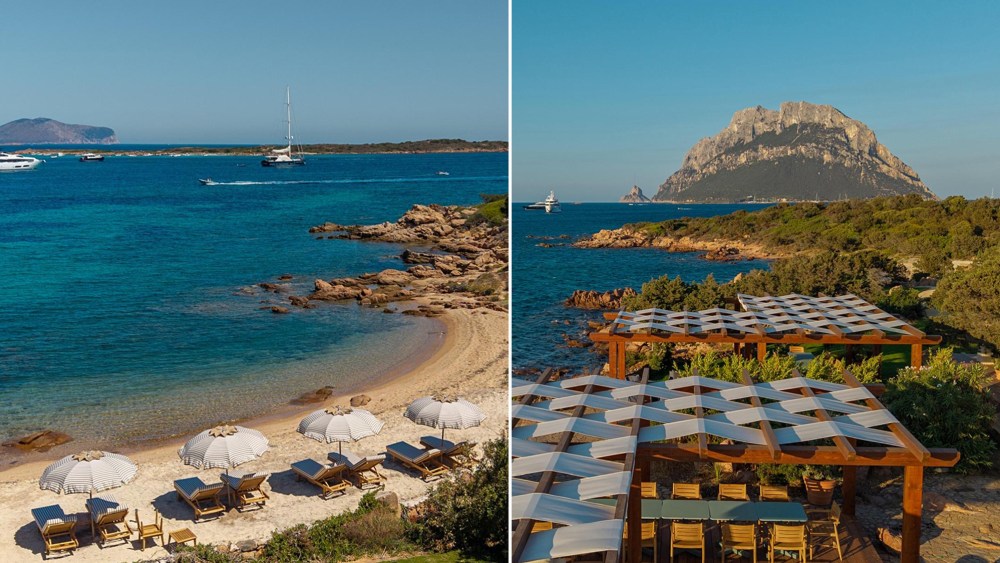
Brazil’s JHSF conglomerate is bringing its luxury “ecosystem” to Europe for the first time.
On the island of Sardinia, Italy, along the Mediterranean coastline, JHSF Fasano Sardegna project is under development. The masterplan encompasses more than a million square meters and calls for six private beaches, a marina, a village with local and international brands and restaurants, villas, bungalows, tennis courts, paddle courts, a gym, a wellness center, an 18-hole golf course designed by legendary golf pro Jack Nicklaus, a heliport, a private club and two hotels.
Related Articles
Phase one of the development, the Fasano Al Mare Beach Club, had a “soft” opening during the summer for invited guests. The rest of the project is expected to be completed in 2028. It’s being designed by Isay Weinfeld, who has worked with JHSF on past projects and is among Brazil’s most accomplished contemporary architects, known for incorporating nature into his designs.
You May Also Like
For José Auriemo Neto, the chairman of the São Paulo-based JHSF, the Sardinia development is a “milestone” in his company’s international expansion. Not only does JHSF Fasano Sardegna mark his company’s first foray into Europe, it occupies “a truly unique and irreplicable setting within Europe,” he told WWD. “Located in a protected natural area, it offers crystal-clear waters, and a privileged view of Tavolara Island,” which is known for its steep cliffs and scuba diving and is just a five- to 10-minute boat ride away and in clear sight. “This project reflects our vision of creating timeless destinations where nature, architecture and lifestyle coexist.”
JHSF is also planning Fasano hotels for the Mayfair section of London and in Cascais, Portugal, in Quinta da Marinha. Elsewhere, JHSF is developing Fasano Hotels in South Beach, Miami, and in Punta del Este with a second hotel on La Barra beach in Uruguay.
Three years ago, JHSF opened the Fasano restaurant on Park Avenue and 49th Street in Manhattan, the site of the former Four Seasons restaurant. JHSF bought the Fasano hotel chain 14 years ago, and opened the Fasano Fifth Avenue hotel in New York City four years ago.
“We would like to achieve 20 destinations around the world with Fasano,” said Augusto Martins, the chief executive officer of JHSF, during an interview. “We are looking at new destinations in Europe, the U.S. and the Caribbean so we are working very hard to to announce new destinations, new projects in the next months. We have not closed on the negotiations, but what I can say is, all of these destinations are very special, targeting international high net worth individuals who choose to spend the best days of their lives at one of our destinations.”
Asked if developing in Europe has a different set of challenges from developing in the Western Hemisphere, Martins said: “Of course, Fasano Sardegna is a new project and a new challenge for us, but it’s not completely new, and we have local partners, including some suppliers, to help us develop. They are with us.”

JHSF’s businesses and properties are concentrated in Brazil. Among the company’s holdings is the mammoth Boa Vista Complex, a gated community roughly the size of Manhattan. Located an hour from São Paulo in Porto Feliz, Boa Vista has hundreds of large homes and apartments, lush landscaping, four golf courses, three equestrian centers, a triathlon training center, three polo fields, spas and a wave pool for surfing.
The JHSF portfolio in Brazil also includes:
- The Shopping Cidade Jardim mall in São Paulo.
- The Catarina Fashion Outlet, which is by the São Paulo Catarina International executive airport and 20 kilometers from the Boa Vista Complex.
- Usina São Paulo, a hub for corporate offices, media firms, entertainment and culture situated by the Pinheiros River and connected to Shopping Cidade Jardim.
- The São Paulo Catarina International Airport for private jets.
In addition, the company operates dozens of designer stores in Brazil for luxury brands such as Celine, Chloé, Isabel Marant, Balmain and Emilio Pucci, while also leasing space to many other high-end names in its centers including Hermès, Louis Vuitton, Dior, Van Cleef & Arpels and Valentino.
The family-run, publicly held JHSF has emerged as largest luxury player in Latin America. The company continues to show sales and profit gains despite the luxury sector’s global softness, according to its executives. JHSF gets it name from the first-name initials of the founders, including Fábio Auriemo.
The Auriemo family currently holds 55.2 percent of the total capital of the company. According to Martins, being diversified helps buttress the company against macro headwinds, and the various business units of JHSF share many of the same customers. Increasingly, JHSF has been concentrating more on recurring revenues, which include rents from residences, airport hanger space and retailers in the malls; club memberships; Fasano hotel fees charged to landlords, and its JHSF Capital unit. These recurring revenues are steady, received regularly, and can be considered a better barometer of a company’s financial performance, and a better basis for planning and forecasting. For all of 2024, recurring revenues rose 21 percent to 1.1 billion reais, or about $200 million, representing 64 percent of the company’s total revenue.
Fasano Sardegna, located 15 miles south from the Olbia Costa Smeralda Airport, will replicate the character of JHSF’s existing developments and unique holistic approach to catering to the affluent lifestyle. “We will have this 100 percent ecosystem developed in Sardinia,” Martins said. He described JHSF’s business approach as being “completely attentive” to the customer, and maintaining a complete awareness of how they live, where they go, and what products and services they want.
Regarding architecture and atmosphere, Martins said Fasano Sardegna will be “very elegant, discrete and sophisticated,” consistent with the company’s other properties. However, in Sardinia, “There will be this strong focus on health and the wellness for our customers,” Martins added.
Part of Fasano Sardegna is contained within a national park. “Of course, we will protect the area and maintain the conservation of the area,” Martins said. “The natural aspects of Fasano Sardegna are its most important characteristic and most important distinction from other places. So our clients will have the opportunity to be very connected with nature and wellness. Sardinia is one of the most important destinations for high net worth individuals.”