
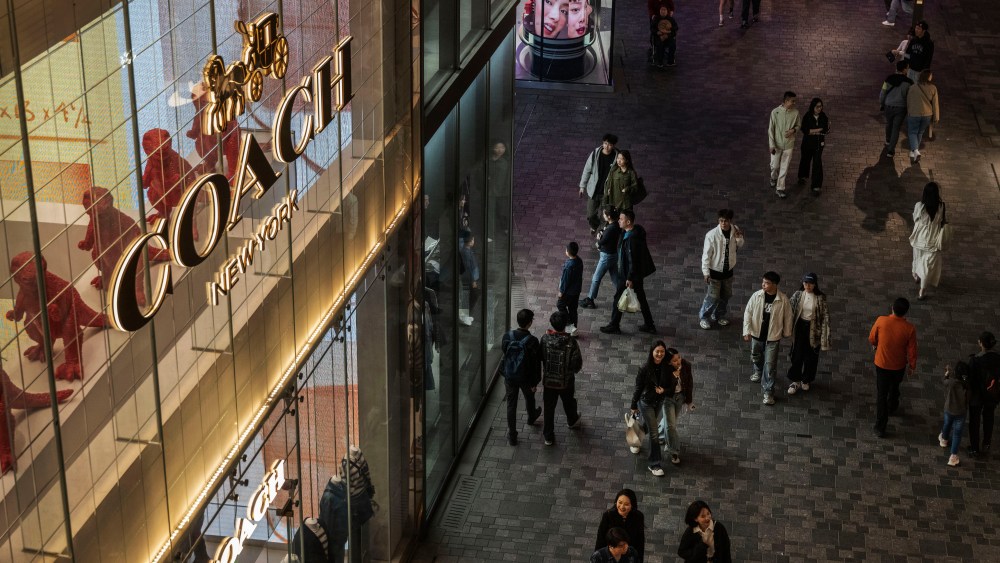
China’s luxury market is entering a new era — shifting from rapid expansion to fierce competition, with brands now vying for market share rather than chasing pure growth — according to a recent Barclays report.
Based on a recent two-week market visit where the investment bank met with around 30 stakeholders, including brands, luxury malls, retailers, investors and sector experts in Hong Kong, Beijing and Shanghai, Barclays pointed to three standout trends as the Chinese luxury consumer continues to mature.
Related Articles
“Amid the macro downturn and the concerns around government crackdowns, showing off your social status through luxury goods has become less necessary; a diminishing marginal utility for repeated consumers who might face a sense of saturation, and a growing interest in other segments such as wellness or experiences,” noted the report, titled “On the Road in China: Early Signs of Big Changes?”
You May Also Like
With negative retail performance throughout the summer, Barclays expects the numbers to improve in the third quarter, albeit still negative at around a 5 percent decline. “Overall, we expect sales of the Chinese cohort to be down around 10 percent in 2025,” Barclays said.
“On the whole, brand performance is still very polarized, with some brands seeing small growth whilst others are still down more than 30 percent,” Barclays added.
While the Chinese cohort trails behind the U.S. in terms of overall market share, a volatile U.S. market means that “maintaining the long-term growth of the sector in the future is therefore not guaranteed,” the report added.
“We maintain our neutral view on the luxury goods sector and note that the ability to maintain historical top-line growth of around 7 percent could be more challenging in the future,” Barclays said in the report.
The rise of local competitors continues to shift perception around what can be defined as a luxury good.
“What also matters is the social value, and right now Labubu is seen as more fulfilling,” read a quote from a local fashion expert included in the report.
“More Chinese consumers believe that the quality of Chinese products has caught up with the West, so the high barrier to entry of European luxury brands may be weaker than the market expects,” the report added. “Close to 80 percent of Laopu Gold consumers are reportedly also consumers of key luxury brands such as Cartier, Hermès or Louis Vuitton.”
“While we do appreciate the competitive threat from domestic Chinese brands like Laopu Gold in the region, we note that the overlap probably concerns the entry price point of the jewelry maisons’ brands,” noted Barclays.
With muted feedback on Hermès, Barclays cautions about “a lack of strong acceleration” and lowered growth forecasts for 2026.
“We turn incrementally more cautious on the name as the brand may not be able to reach double-digit growth in fiscal 2025 considering the ongoing trends in China,” Barclays said.
Louis Vuitton stood out during a quiet marketing period this summer with its larger-than-life “The Louis” retail project and the launch of cosmetics, which could translate into sales momentum for the rest of the year.
“However, feedback on other key [LVMH Moët Hennessy Louis Vuitton] divisions, such as Sephora or wines and spirits, remained muted,” the report said.
At Kering, Gucci remains “very weak” in China and traffic remains “very low in stores,” according to Barclay’s survey on the ground.
“Beyond Gucci, we expect Saint Laurent and other houses to continue to struggle, and absent signs of an upcoming inflection point, we remain comfortably underweight,” Barclays wrote.
Overall feedback for Burberry and Moncler remained positive in China.
“Fashion experts we met on our trip seemed more positive on Burberry’s new collections, and landlords also pointed out that improving trends were helped notably by better merchandising, with a focus on accessories, notably scarves,” wrote Barclays.
“Moncler continues to be a popular brand in China and should remain in positive territory, in our view. The only pushback on this view during our trip resulted from the brand’s perceived lower level of marketing push at the moment,” the report continued.
In the jewelry and watches business, Barclays noted sustained growth momentum at Van Cleef & Arpel first, followed by Cartier, Bulgari and Tiffany & Co.
“Watches remain the weakest segment, in our view, with sales probably still down by a strong double digits,” the report said.